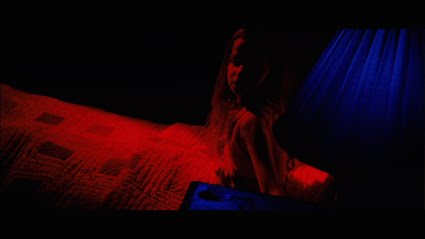
Queen of Blood
Directed by: Chris Alexander
USA, 2014
Horror, 89min
Sequel time… or is it? Chris Alexander dived
head first onto the genre filmmaking scene with his impressive debut feature
Blood for Irina a few years back, and I had the great privilege of checking it
out whilst it still was in post. What I saw blew me away, and being a huge fan
of Herzog, Rollin and Franco, Blood for Irina was a love letter penned with passion
from a guy who certainly knew how to summon up the aura of late seventies Eurohorror.
So when an email dropped into my in box posing
the question, ”Would you be interested in seeing an early cut of Queen of
Blood?” I never hesitated a second. Partially because I truly did enjoy Blood
for Irina, and partially because I wanted to see how Alexander tackled the
tricky second feature curse!
 Vampire queen Irina [Shauna Henry] walks the earth again,
although this time it’s set in a western time period. Irina crawls out of a
dirty riverbed drooling blood and with hunger in her eyes. Moving from place to
place, encountering people along the way. People whose fates she will affect.
The tone and atmosphere is much the same as in Blood For Irina, as in being
gentle, meditative and cautious. But at the same time, momentary rushes of
death and destruction are in place. Irina lashes out in her hallucinatory like
state, turning the dreamlike shimmer into a dark nightmare. Remember that
Herzog film where everyone was supposedly hypnotized before they shot the
movie… Well, this captures the feeling of Heart of Glass, [1979] but with a
Vampires and bloodshed!
Vampire queen Irina [Shauna Henry] walks the earth again,
although this time it’s set in a western time period. Irina crawls out of a
dirty riverbed drooling blood and with hunger in her eyes. Moving from place to
place, encountering people along the way. People whose fates she will affect.
The tone and atmosphere is much the same as in Blood For Irina, as in being
gentle, meditative and cautious. But at the same time, momentary rushes of
death and destruction are in place. Irina lashes out in her hallucinatory like
state, turning the dreamlike shimmer into a dark nightmare. Remember that
Herzog film where everyone was supposedly hypnotized before they shot the
movie… Well, this captures the feeling of Heart of Glass, [1979] but with a
Vampires and bloodshed!
So does he pull it off? Has Alexander been stricken
by the curse of second feature failure? Well if you are a recurrent reader, you
know me. I believe in honesty in everything that I do. I only write about movies
I like, movies that affected me, movies that have something unique and movies
that have some thought put into them. Only on a few occasions have I slammed
movies for bad story, missing the bigger picture or not really getting their
message through, even though I stand firmly by the theory that sometimes a
zombie movie is only a zombie movie.
 I do have some small issues with certain
moments in Queen of Blood, but they are the kind of things that really don’t
affect the movie as a whole, they are merely details of taste, and will vary
with each individual viewer. With that said, one of the things that makes
modern society so great is that one can discuss films with the filmmakers in a
few simple punches of keyboard buttons. I’ve had the pleasure of talking about
Queen of Blood with Alexander, and presented the issues to him. I also stand
firmly with the belief that if a filmmaker did something intentionally, then
that’s fine. I can’t, and won’t really interfere with artistic vision, and when
said filmmaker answers with a referent to Franco’s Female Vampire, it kind of made
my point void. Chris Alexander knows exactly why every scene, beat and frame
looks, feels and works the way it does, and that’s something you have to
respect!
I do have some small issues with certain
moments in Queen of Blood, but they are the kind of things that really don’t
affect the movie as a whole, they are merely details of taste, and will vary
with each individual viewer. With that said, one of the things that makes
modern society so great is that one can discuss films with the filmmakers in a
few simple punches of keyboard buttons. I’ve had the pleasure of talking about
Queen of Blood with Alexander, and presented the issues to him. I also stand
firmly with the belief that if a filmmaker did something intentionally, then
that’s fine. I can’t, and won’t really interfere with artistic vision, and when
said filmmaker answers with a referent to Franco’s Female Vampire, it kind of made
my point void. Chris Alexander knows exactly why every scene, beat and frame
looks, feels and works the way it does, and that’s something you have to
respect! The style that Alexander chose for his first
feature, was a meditative, fever dream and also gentle,
despite the topic. That’s all here too, but this time the content is what makes
a difference. You will find multiple characters, multiple story arcs and
multiple scenes of violence. Boundaries are pushed, both within the film and
with the audience; it’s obvious that Alexander isn’t here to make mainstream
mediocrity that we have seen way to much, he’s here to create his own unique
space; a realm where Irina is Queen and a force of nature to be wary of.
The style that Alexander chose for his first
feature, was a meditative, fever dream and also gentle,
despite the topic. That’s all here too, but this time the content is what makes
a difference. You will find multiple characters, multiple story arcs and
multiple scenes of violence. Boundaries are pushed, both within the film and
with the audience; it’s obvious that Alexander isn’t here to make mainstream
mediocrity that we have seen way to much, he’s here to create his own unique
space; a realm where Irina is Queen and a force of nature to be wary of. But let’s talk about characters. In Blood for
Irina we saw a pretty basic small cast. We had good, we had evil, kinda, It’s
not really fair to call Irina evil in the classic antagonist way, she’s a
tormented antagonist that we have an emotional recognition with and we do end
up rooting for her, hence turning her into protagonist. This is basically what
is transferred right over to Queen of Blood. Irina is that same character,
tormented, wounded, vulnerable without being hapless. In some ways, I feel this
to be perhaps more of a prequel than a sequel, as I find that there are keys to
why she’s the suffering persona of Blood for Irina hidden within this film. (Also
a scene where a photograph may unlock a deeper level to Irina’s background) But
this time around, Alexander adds an element to the mix; he brings in characters
that we almost could call red herring characters. Then there’s the highly
intriguing character of The Preacher, portrayed with a broodingly sinister vibe
by Skinny Puppy front man Nivek Ogre. Irina and The Preacher characters work
splendidly, drawing the audience in with their mystical stories, living parallel
lives in the same space, both with drifter-like agendas that we all know will
lead them towards each other.
But let’s talk about characters. In Blood for
Irina we saw a pretty basic small cast. We had good, we had evil, kinda, It’s
not really fair to call Irina evil in the classic antagonist way, she’s a
tormented antagonist that we have an emotional recognition with and we do end
up rooting for her, hence turning her into protagonist. This is basically what
is transferred right over to Queen of Blood. Irina is that same character,
tormented, wounded, vulnerable without being hapless. In some ways, I feel this
to be perhaps more of a prequel than a sequel, as I find that there are keys to
why she’s the suffering persona of Blood for Irina hidden within this film. (Also
a scene where a photograph may unlock a deeper level to Irina’s background) But
this time around, Alexander adds an element to the mix; he brings in characters
that we almost could call red herring characters. Then there’s the highly
intriguing character of The Preacher, portrayed with a broodingly sinister vibe
by Skinny Puppy front man Nivek Ogre. Irina and The Preacher characters work
splendidly, drawing the audience in with their mystical stories, living parallel
lives in the same space, both with drifter-like agendas that we all know will
lead them towards each other.
In this way, expanded, multiple character arcs
make it a more complex piece than Blood for Irina. It takes some time before we
can finally decide where our dedication will be, with Irina, The Preacher or
that third character I will keep secret. I really dig movies that take time to
establish characters and flip the classic archetypes on their ass, moving
protagonist to antagonist and vice versa.
 One of the things that I really loved about
Mike Mignola’s Hellboy when I first discovered that comic, was that the fights
where instant. He didn’t waste time or ink on illustrious battles that
stretched over pages and pages with big spreads of glorious combat. “Red” just
got in there, got slapped by the foe, cursed and then easily hammered the beast
into submission with a single blow from that big ass red hand. Done. All in one
page, or two at tops. There is something of this in Queen of Blood to, Alexander
doesn’t dwell on the attacks or fights. He builds an atmosphere, get's in there and get’s the
job done. I like that, because despite the slow move forth and gentle pacing,
he’s not wasting time he lashes out and sending a blast of violence crashing down and then settling into that gentle pace again. Dynamic to say the least!
One of the things that I really loved about
Mike Mignola’s Hellboy when I first discovered that comic, was that the fights
where instant. He didn’t waste time or ink on illustrious battles that
stretched over pages and pages with big spreads of glorious combat. “Red” just
got in there, got slapped by the foe, cursed and then easily hammered the beast
into submission with a single blow from that big ass red hand. Done. All in one
page, or two at tops. There is something of this in Queen of Blood to, Alexander
doesn’t dwell on the attacks or fights. He builds an atmosphere, get's in there and get’s the
job done. I like that, because despite the slow move forth and gentle pacing,
he’s not wasting time he lashes out and sending a blast of violence crashing down and then settling into that gentle pace again. Dynamic to say the least!
Queen of Blood is a natural progression of the
story presented in Blood for Irina. Alexander takes Queen of Blood and expands
on that universe, has a wider space in which its story takes place, locations are bigger, there are more characters, more depth, we get further
into the head of the mystical Irina. Also Queen of Blood lives up to its title,
as there is more blood and violence this time around, in a provocative way. Alexander
get’s in there and pushes some limits and in many ways opening up new
roads for fever dreams to come. Just wait until you see the re-birth lake of
blood scene, it’s a fantastic moment, and what happens to lead there is shocking indeed.
 Personally I see Queen of Blood as a genesis story, I see
moments here that clarify why Irina reacts as she does in the initial movie,
even though Alexander sees it as a sequel, and another of Irina’s feverish
dreams taking place in that remote hotel room of Blood for Irina. An exciting
detail is that the movie takes place in a timeless universe. What starts off as
a Western setting gradually shifts into a contemporary setting and in its own
way becomes a metaphor for Irina’s timelessness. After all, Irina is eternal!
Personally I see Queen of Blood as a genesis story, I see
moments here that clarify why Irina reacts as she does in the initial movie,
even though Alexander sees it as a sequel, and another of Irina’s feverish
dreams taking place in that remote hotel room of Blood for Irina. An exciting
detail is that the movie takes place in a timeless universe. What starts off as
a Western setting gradually shifts into a contemporary setting and in its own
way becomes a metaphor for Irina’s timelessness. After all, Irina is eternal!
There’s also an interesting and captivating wider
aspect to Queen of Blood; Alexander is building a universe in the same way that
Rollin and Franco built universes around their recurrent characters, themes and
stories. These universes are key to Alexander’s movies, and without them you
may just find yourself lost in Irina’s world. It’s the recognition and the familiarity of how
those films work that is echoed through Alexander’s Irina movies. Sometimes a
perfectly composed shot will tell you more than a line of dialogue; sometimes metaphors
will work better than explanatory a poor exposition; sometimes less is more
giving the audience an opportunity to become one with the piece instead. It will alienate some viewers, and will undoubtedly polarize the genre fans, but with that said, Queen of Blood isn't a movie for each and every genre fan either. It's a required taste, and as far as I'm concerned, I'd rather go with original over generic any day. Queen of Blood isn't for everyone, and everyone will not be for Queen of Blood.
 Queen of Blood is a worthy sequel, or prequel
if you take my path of interpretation. Alexander has done well within his own universe. He takes us on
a completely different path this time, but sticks to the themes and tone that
he introduced in Blood for Irina. At times it doesn’t quiet manage to hold the
same magic aura that Blood for Irina had, but it’s definitely bigger, bolder
and more ambitious creating a captivating tone and universe. Irina is a great
character, and the fact that Alexander doesn’t present a transparent backstory
and a traditional explanation to her character works in advantage of the piece.
She keeps her mysticism and that means it doesn’t collide with the fact that
Irina, as she is in both movies, is basically emotionless. Irina shows no
angst, no remorse, she’s just cold-blooded killer… or is she? The only thing
that haunts her is her eternal damnation to walk this earth and that “loss”, "search" and "longing",
the same ever-important Jean Rollin themes.
I have a theory on that, but will leave it to a later time as you still
have to see the movie and how it unfolds before we discuss that without spoiling. Queen of Blood also opens up doors
into a universe that Alexander knows like the back of his hand, and he doesn’t
hold back on tipping his hat, even though he’s claiming his own turf in those familiar
spaces. I have a feeling that in a decade or two someone will have the great delight
of digging into the universe of Irina and Chris Alexander as many of us have dug
into the worlds, themes and symbolism of Jean Rollin and Jess Franco, because
Irina is eternal, and she is the Queen of Blood.
Queen of Blood is a worthy sequel, or prequel
if you take my path of interpretation. Alexander has done well within his own universe. He takes us on
a completely different path this time, but sticks to the themes and tone that
he introduced in Blood for Irina. At times it doesn’t quiet manage to hold the
same magic aura that Blood for Irina had, but it’s definitely bigger, bolder
and more ambitious creating a captivating tone and universe. Irina is a great
character, and the fact that Alexander doesn’t present a transparent backstory
and a traditional explanation to her character works in advantage of the piece.
She keeps her mysticism and that means it doesn’t collide with the fact that
Irina, as she is in both movies, is basically emotionless. Irina shows no
angst, no remorse, she’s just cold-blooded killer… or is she? The only thing
that haunts her is her eternal damnation to walk this earth and that “loss”, "search" and "longing",
the same ever-important Jean Rollin themes.
I have a theory on that, but will leave it to a later time as you still
have to see the movie and how it unfolds before we discuss that without spoiling. Queen of Blood also opens up doors
into a universe that Alexander knows like the back of his hand, and he doesn’t
hold back on tipping his hat, even though he’s claiming his own turf in those familiar
spaces. I have a feeling that in a decade or two someone will have the great delight
of digging into the universe of Irina and Chris Alexander as many of us have dug
into the worlds, themes and symbolism of Jean Rollin and Jess Franco, because
Irina is eternal, and she is the Queen of Blood.


 Amer
Amer