Showing posts with label Coming of Age. Show all posts

Saturday, November 17, 2012

Excision


Excision
Directed by: Richard Bates Jr.
USA, 2012
Drama/Horror/Dark Comedy, 81 min.


Growing up is Hell… we’ve all been there, adolescence, raging hormones, alone against the world, struggling to be a part of the bigger picture, whilst nobody understands a single word we are talking about…

The American nuclear family was shattered decades ago. Kids want to live their own lives and don’t want to follow guidelines given by parents, teachers, councilors etc. We all know this, and it’s through our emotional recognition with the characters we see on TV and film that we with ease can identify with the youth in despair we see in what best can be called coming of age movie, a genre that basically relies on the basic plot of transforming an innocent youngster into a budding adult. Sometimes as quirky comedies, other times hard as fuck dramas, but I love it best when this genre is meshed with horror themes, as they sometimes really hit it out of the park. Stand By Me, Lost Boys, Jack and Diane, Let the Right One In, and Carrie are just a couple of examples of where it all clicks and makes for a brilliant little gem.
Pauline – played to perfection by AnnaLynne McCord - is a teenage girl, best described as alienated, a loner, a late developer, sexually confused and immensely frustrated. Struggling her way through school, dreaming of a career as a surgeon, trying to keep her head above water is a constant struggle, not made any easier when constantly overshadowed by her younger, more developed, more mature younger sister Grace. You know the type, and you have seen it in every single coming of age flick, every high school film, every youth oriented movie you ever watched, and Pauline fits the archetype to the dot. Although the off kilter erotic and gory amateur surgeon wet dreams which Pauline wakes climaxing from each night are a completely new and unique addition to the teenage angst story.
Time is spent setting up the family structure; a classic shattered one, with a fixed façade so that nobody will ever know of the turmoil on the inside. Pauline is the natural outsider, where strictly religious mother Phyllis [Tracy Lords] is the dominate parent, appalled by her husband Bob [Roger Bart] and deeply concerned about the Grace [Ariel Winter] who suffers from Cystic fibrosis… see, no place for troubled Pauline, hence her being sent to counseling with family priest William [John Waters]. The family shares some absurd dark secrets that intertwine life and disease, which also generates some of the violent frustration and repressed hate with in the constellation.
The way that Bates brings his characters together in sensitivity and strenuous    moments of affection only to flip the scene on its ass when their fixed roles break through is like poking a dirty finger in the open sore that family life can be, and it is heartbreaking. As the formula goes, all underdogs have their moment, and we all know that they find that one challenge that makes them rise to the occasion. Excision has this too, and Pauline finds her quest, the one that will elevate her to legendary status, set everything right and make her the center of attention… the only distraction being that this is coming of age blended with horror and there’s no climax in horror without violent death. Something that makes Excision raise its self above the completion and scream – Look at me you bastards, I made you laugh, but now I’ll tear your hearts out!
All of Pauline’s torment and antagonism builds our empathy for her. She is the obvious point of identification, despite all her disillusions and freaky behavior. Hey come on, who doesn’t love an eccentric weirdo? But what makes her such an interesting character is not the fact that she’s an outsider kid that we can relate to, but the complexity of her character. Because despite being alienated and isolated from peers and family, Pauline is very proactive in her actions. She has an agenda and she sticks to it. She wants to lose her virginity and she makes it happen, again in great originality and in such a way that you can’t possibly not feel for, and with, Pauline. She turns the tables on her tormentors, and gets even in the most awesomely sinister way. She strikes out when she’s cornered. She’s a pretty active character. These are all important actions before the movie grinds into its climax, one that generates a lot of tension. I’m not going to talk about the climax of this film, as it would be idiotic to spoil that experience, and it is an important part of the movie’s realism. No matter what you think when you get there, it’s a true and honest ending. One that I totally respect Bates for sticking to.
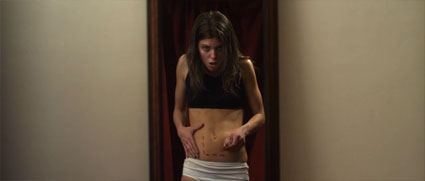
There’s’ a great use of guilt in Excision. Catholic guilt, the mother of all guilt! On a few occasions, Bates cuts to intimate moments of Pauline praying. Begging forgiveness for her sins, desperately asking for a sign, a sign that she’s accepted… It shows that she knows her actions and thoughts are wrong, but at the same time coming to the subconscious insight that there is no God.
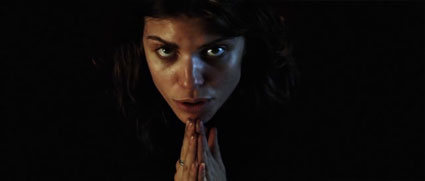
Metaphorically the prayers also represent how Pauline is taking distance from the world she has grown up in. Challenging God, she takes departure from the catholic upbringing her mother has raised her in. At the same time, Bates is playing mind games with us in the scenes of prayer… Pauline looks as beautiful as she does in her own erotic fantasies. Perfect complexion, beautifully lit, almost angelic, perhaps whilst questioning faith, Bates may be commenting that there is a God who accepts Pauline just as she is… or that there is no God, and that the perfection strived after in prayer, is the same as in Pauline’s dreams.
Excision stays very true to it’s own universe, and delivers no supernatural fix at the end of the line. We are taken along on Pauline’s journey and we stick with her. We empathize strongly with Pauline and really want the best for her. We want that magic moment that this hybrid genre traditionally brings, the destruction of all foes, the telekinetic vengeance, a supernatural fix or the rush of insight, as characters become adults. Instead Bates makes it his own realm in a harrowing way. It’s a brave way to go when Bates easily could have stepped down a completely different path in the last act. But he doesn’t and he keeps realism and painful reveal packed into one disturbing final tweak that sticks haunting insight in the mind of his audience. Growing up is Hell.
The supporting cast is great, bit parts by Ray Wise, Malcolm McDowell, John Waters and Marlee Matlin are nice additions to the fantastic job Arial Winter and Roger Bart do as the family. Although extra credit has to be given to Tracy Lords as Phyllis, the complex mother, struggling through her life with a husband she’s grown to resent, a daughter with a deadly condition and Pauline the weird hormonal rage machine.
Excision is a powerful and beautiful movie, not only story wise, but visually it looks fantastic, as reality and dream crash in contrasting styles and tone. The film is filled with emotional recognition; personal torment and a disturbing climax that totally crashed the buzz the movie set me up for. It’s like riding a rollercoaster without a clue of where it goes, and not knowing if there are enough rails to get you safely home.
Deliriously disturbing, and magically captivating, I love Excision as it takes convention and makes it real. I live for movies like this, movies that dig into familiar genres and niches, only to crush prediction and deliver an impactful movie unlike the others. If you where to see one coming of age horror hybrid this year, then this it the one to see.
 

Thursday, March 29, 2012

Alyce

Alyce
Directed by: Jay Lee
Horror/Thriller 93 min
USA, 2011

If you had told me beforehand that this was made by the same guy that wrote/directed Zombie Strippers 2008, I’d probably never have slipped the disc into my machine. Zombie Strippers is a movie that I still haven’t seen, and never really been interested in, although find myself curious as of now. Because I would never have thought that the same person who made a spoofy zombie flick could have made a genuinely disturbing and haunting flick as Alyce.

Following a party where a common sleazy trait is exposed by boyfriend Vince [James Duval], Alyce [Jade Dornfeld] and her best friend Carroll [Tamara Feldman] take to partying on their own, so that Carroll can tend to her disappointment. But the girls’ night of bonding and confessions comes to a harrowing end when Alyce accidentally knocks Carroll of a rooftop. The accident becomes a catalyst for the deterioration of Alyce, as she becomes snared in a downward spiral taking her through a maze of drugs, sex and violence finally landing her in a deep dark place.
Alice’s Adventures in Wonderland [1865, Charles Lutwige Dodgson, aka Lewis Carroll] may just be one of the most important works ever written. Despite being within the fantasy realm, it’s a story that strongly influences the horror genre, and perhaps it’s something of an underestimated gem if you look at it through the horror goggles. As a child that animated Disney flick used to freak me out, and to some extent still does. So one can easily see how it metaphorically can be applied to movies on the genre scene. But this isn’t something new; as early as 1903, when cinema was in it’s infancy, Cecil Hepworth and Percy Stow directed a ten minute short version, and with its stop motion animation and in camera effects, it’s certainly breathes an eerie sensation. Jaromil Jires loosely based his Valerie a týden divu (Valerie and her Week of Wonders), 1970 on Carroll’s novel, Czech stop motion wizard Jan Svankmajer made a bizarre version in 1980, and it comes as no surprise that the subject matter appealed to GothBoy Tim Burton either. Therefor one would think that it would be easy to get lost in Wonderland, stuck in convention and repetition after being such a heavily sourced material, but instead Jay Lee’s Alyce reveals itself to be an intriguing dark gem of modern genre cinema.
The reason Alice in Wonderland appeals to these days, and probably all those genre directors too, is that within that great source material lies a coming of age tale which gives the opportunity to deconstruct the main character, take them from innocence and propel them to adulthood. Alice goes from naïve little girl to powerful woman, hence the adult version directed by Bud Townsend in 1976, and the obvious attraction the original text has on genre directors.
Referents to Alice in Wonderland are riddled throughout the movie, from audio cues – A cover of Jefferson Airplane's White Rabbit is heard early on. Lines of dialogue, such as the bartender holding up shots in front of Alyce as he in a childish voice says “Drink me, Drink me”, and Alyce at one point says “off with his head”, as anyone familiar with the original text will know to be a frequent line uttered by the Queen of Hearts. Images, set design and scenery refer to the book - several times Alyce is seen with a white rabbit in the foreground of the composition, as she takes different drugs to achieve different “outer body” experiences, metaphorically changing her persona. Names especially reflect the source material; Alyce is the obvious referent, but even her friend Carroll Lewis, which is an obvious one.

But even the villains, the druggies, these characters are obviously reflections of characters in the books. Rex [Eddie Rouse] the drug dealer wears hats, much like The Hatter. He’s the supplier, just like in the books, where he’s the supplier of tea, and just like his metaphorical namesake he’s in trouble with the law. There’s also traits of the Caterpillar found in Rex, as he is the one person who whilst smoking, questions Alyce and her identity crisis… oh, by the way Rex is Latin for King, and in this inversion world, Queen is King. Rex is in other words a composite of several key characters in the books. By his side he has his cohorts, March [Brian McGuire] - a nod to the March Hare and the character is just like his book counterpart, something of an oddball, prankster and when push comes to shove, he’s the sidekick from hell! Finally there’s Mouse [Catero Colbert] – like the mouse that swims in Alice’s tears in the book, Mouse shares the numbing effects of the drugs with Alyce, and spends most of his scenes sleeping. Referents and metaphors like this are found all over the place in Alyce, but I’ll leave some of them for you to discover by yourself.
I’m convinced that this movie would never have had been anything as charismatic and powerful as it is without the outstanding performance given by Jade Dornfeld! She completely mesmerizes me, she has me falling head over heels in love with her, and her transformation from the fragile, delicate character we are first introduced to, to the raw, psychotic death machine in the last scene is truly one of the most spellbinding transformations I’ve seen in ages. And I’ll tell you why it works right now! When we’re first introduced to Alyce, she’s obviously playing second fiddle to Tamara Feldman’s Carroll. Gently we learn more and more about Alyce, and it’s apparent that she’s previously had issues with her own identity. This is hinted at in scene between the two women after the subplot concerning Carroll and Vince is instigated. Scorned, frustrated, angered and seeking ways to scorn Vince, Carroll brings important backstory into the piece. At one point in time, Alyce mimicked Carroll. In such a way that Carroll refers to it as the “Single White Female” incident. This backstory and the restrained reactions Alyce gives when Carroll tries to seduce Alyce, along with the initial distance Alyce keeps between her and drug dealer Rex, all help the audience to empathise with Alyce. Empathy needed before she starts her decent.
We want to help her, we want to comfort her, and we want her to come through the ordeal. This makes us empathise with her. When the envelope is pushed to far, starting with the fucking for drugs, the degradation at the funeral, the obnoxious visit from Vince, the physical and mental taunting, the nightmarish condition, we have an emotional recognition with Alyce. The most of us have done things we regret, been blamed for something outside of our control, treated wrongly, and we have all felt that strong urge to lash out and settle the score. This is exactly what happens in Alyce, and this is why we cheer Alyce on as she goes off that deep dark end… that violent and bloody rampage in the last act.
Seeking the core of Alyce was a fantastic journey. If you are a regular reader, then you know that I have a few corner stones that I rely upon when yapping on about what makes a great genre movie… and the crown jewel of all these traits is GUILT! Alyce is all about guilt. From the inciting incident on the rooftop, Alyce’s guilt drives her deeper and deeper into the abyss, or rather further down the rabbit hole towards her own transformation. Guilt is a magnificent tool, and in Alyce it’s like clockwork, at first it forces her to retrace her steps… i.e. to the club, to relive the moment in a desperate attempt to change reality, which takes her to her to doing more drugs, which in it’s own turn leads to her degrading herself to gain even more drugs (at mid point, the point of no return), which leads to the nightmarish world of abusive sex, necrophilia, violence and death. The fact that the film at times looks and feels like a mix of Dario Argento’s Suspira 1977, Roman Polanski’s Repulsion 1965 and David Lynch’s Lost Highway 1997, with effects in the vain of key splatter films of the eighties – courtesy of Patrick Magee and Josh Russell - makes me bond with the movie even more!
Beautiful death, accompanied by the atmospheric industrial rumblings of Billy White Acre’s sublime soundtrack. The final reel of Alyce is a symphony of destruction leaving no holds barred. From frail delicate and reclusive girl to fucking machine of mayhem, Alyce tears a hole in your soul large enough for your next-door neighbour to peek through, and I loved every warped minute of it!

A somewhat "Spoilerish Trailer..."

Saturday, September 24, 2011

Attack the Block

Attack the Block
Directed by: Joe Cornish
England/France, 2011
Horror/ Sci-Fi/Drama, 88min


A bunch of young kids… bully’s, thugs, roughians. You know them, you have seen them, and to some extent you may even fear them. But these are merely movie characters, although you judge them from first sight. You recognize them from movies like James Watkin’s Eden Lake 2008, Daniel Barber’s Harry Brown 2009 and Johannes Roberts F 2010 – those movies where the nasty little bastards hide their faces behind their hoodies as the toss insults at people and pose a threat to mankind. You know they are trouble, and a sudden knife in the back wouldn’t surprise you.

At the same time these kids we see on screen in Attack the Block are our version of Goonies, our Eliot trying to protect his extra terrestrial friend or even the kids from Super8. But this isn’t a Hollywood action adventure, this is British horror drama Attack the Block and the kids are merely doing what they do everyday, looking out for their mates and protecting their block.

A young woman, Sam [Jodie Whittaker] walks home from work late one night. In a dark backstreet, a band of kids circle her, pull a knife and mug her. Something falls from the sky, smashing through the roof of the car parked on the street. Sam uses the moment to run to safety whilst gang leader Moses [John Boyega] checks out the car to see what loot may be found. Instead of booty, he finds a hairless small being that attacks him, scratching his face in the process. The creature escapes and the gang, Jerome [Leeon Jones], Dennis [Franz Drameh], Biggz [Simon Howard] and spunky junky Pest [Alex Esmail] all lead by Moses, chase the creature, forcing it to hide in a playground shack… from which escape is impossible. The band of lads cockily wanders into the shack and beat the naked monkey werewolf alien like creature to death. They take it back to their block of flats, showing it off, and boasting about their feat to friends along the way, with the intention of hiding it in the back of the dope room, belonging to their mate Ron [Nick Frost].

That’s when more things start to fall out of the sky… things determined to reclaim that one of their kind that has fallen victim to the earthlings. Hence starts the battle of the block.

Attack the Block is the English equivalent of J.J. Abram’s Super8 2011, but instead of the stereotypical American cute and innocent adolescents, the UK once again goes for a harsh realism that portrays the kids of today as victims of circumstance. These lads are no innocent little boys, they are rough, tough thugs… or at least that’s what we are supposed to believe in the initial setup and presentation of character.

Because where we are led on to believe that these lads are hardened criminals, they are all fruit of the council blocks. They do what they see, and strive to become what they know. The lads look up to resident gangsta Hi-Hatz [Jumayn Hunter] just like the comic relief found in the shape of Probs [Sammy Williams] and Mayhem [Michael Ajao] look up to the lads in the gang. During the narrative, Moses is made (a dealer for Hi-Hatz) and Probs and Mayhem are made too when they save Biggz. Yet another thing that separates this movie from the nice fuzzy cosy American counterparts is that Cornish dares to let the alien invasion have an effect on the gang of kids… Let’s just say that not all the kids will be going back to mom’s cooking at the end of the flick. Which brings a rather dark tone to the movie despite several comic relief moments. But overall, this is a dark movie.

The child characters are intriguing and filled with dimension, which make them interesting for us as an audience. On the one hand they are threatening thugs, in the next they are really only little kids who on any given moment would stay at home and play video games. This shines though on several occasions, like when Biggz calls his mom, or when Jerome explains that the knife used in the opening mugging merely was to scare her. A token of power over an adult situation. As I mentioned earlier, the kids are the result of the situations they have been forced into. There is a social commentary within the movie no matter how apparent or deliberate it may have been. Rough areas breed rough kids, and as the lads say on several occasions, the fuzz never listen to them, but merely judge them upon sight as crooks. Nothing positive can come out of prejudice.

Obviously Moses is the most intriguing of the characters. Where he has a real hard façade, director, writer Joe Cornish waits until the very last moment to let us in behind that rock-hard brick front. The scene where Sam enters Moses apartment, realizing that he lives alone, and in reality is only a kid forced to become an adult, is tender. Short and brief, but still a tender moment – Moses is merely a kid and we feel for him. It gives an insight into Moses life – keep in mind that his apartment is the only one we don’t tag along into when they all scoot off home to suit up their weapons early on – so he’s the enigma of the piece. It also validates Moses as a character to root for. With the insights that he’s come to and the insight the audience now have into his character, we empathise with him and accept him as the hero of the piece.


Being a lifelong fan of English sci-fi, the referents to great English genre authors really pop off the screen for me, [John] Wyndham Tower, [Alan] Moore Court, [J.G.] Ballard Street are smart – just like the several movie referents to Joe Dante’s Gremlins 1984, Spielberg’s E.T. 1982, Reitman's Ghostbusters 1984, all are dropped as he pop-culture referents they are and not as desperate nods at other stuff. As I mentioned this is the modern English version of something like Donner’s Goonies 1985, and the other mentioned films above, although in England we are all shoved together in suburban housing projects, which gives a perfect setting. This also gives for a great opportunity to call upon all those post-apocalyptc flicks that the filmmakers enjoyed as kids, because the movie does ooze John Carpenter. It almost feels like watching Assault on Precinct 13 1976 mixed with Escape From New York 1982, but with kids in the leading parts instead. With this in mind, Attack the Block is one of those movies which will be equally entertaining upon repeated viewing as you will spot more referents the more times you watch.

All right so the monsters may not be scary – there’s still a few good shocks and jump scares in there though – but they look fucking awesome, totally believable and work terrific in the setting which is presented. Terry Notary’s title of movement choreographer may sound ever so lame, but damn does he bring those creatures to life in the most amazing way.

Finally music. Stephen Price’s original score is terrific but the real delights are the stunning tracks by house music legends Basement Jaxx (Simon Ratcliffe & Felix Buxton) who give the movie the perfect tone. And perhaps I feel this way as the majority of their tracks are like updated John Carpenter soundtracks… remember those two movies I mentioned earlier… well you get the idea of what this soundtrack sounds like then don’t you.

Attack the Block is a brilliant movie. It’s not horror, but it does rely on horror motors to drive it forth. It’s really a classic hero’s journey flick. As Moses goes from an outcast – reflected in the way Sam, a metaphor for society, first reacts to him – to neighbourhood hero – as Sam speaks up for him and the neighbours cheer his name in the final moments of the movie. This one is a keeper mates, and a movie I'm already wanting to watch again.

Monday, February 21, 2011

AMER


Amer
Directed by: Hélène Cattet & Bruno Forzani
France/Belgium, 2009
Drama/Horror/ Arthouse, 87min.
Distributed by: Anchor Bay

Where the yanks pay homage to their gore, slasher and grindhouse history, the Europeans create pastiches of their cultural treasures found amongst the alternative genres… such is the case with Hélène Cattet & Bruno Forzani’s stunning debut feature Amer!

Amer is without a doubt the most minimalist and stylised approaches to the horror genre ever put on screen. But it’s also one of the richest and most detailed movies in the genre. Anyone with the slightest knowledge of European art house, the mystery of the Italian Gialli, the lighting of Mario Bava, the sensuality of Borowczyk, the daring mise en scène of Jean-Luc Goddard, to name a few will undoubtedly fall in love with the many nods, homage’s and direct referents to the many movies that dominate the visual style, narrative and tone of Amer.

Amer tells the tale of a woman, Ana, in three stages of her life, [Casandra Forêt, Charlotte Eugène Guibeaud & Marie Bos] as a child where the death of an elder haunts her and set’s demonic ghosts at play, her adolescences, where budding sexuality torments her as she comes of age and tries to fins her place in her new body, and finally the adult Ana coming to grasps with her memories of childhood and the traumatising experiences that she had.

A fascinating aspect of Amer is the minimalist dialouge. There are no long scenes of dialogue or hefty monologs; instead the restricted discourse pushes forth to suggestive imagery that drives the narrative forth.

Symbolism and metaphors are a huge part of Amer and it’s discourse with the viewer. It’s in the colour schemes, it’s in the imagery, it’s in the unspoken dialogue, it’s in the juxtapositions - it’s everywhere. Where deliberate referents have been created, they in turn spin non-intended into play.

Amer plays like a checklist of your favourite Euro horror titles, especially witin the Gialli sphere. Dario Argento’s Deep Red and Suspria, Sergio Martino’s Torso and All the Colours of the Dark, Lucio Fulci’s New York Ripper and many more, are all movies that flash to mind when watching Amer. Something that obviously pleases an old genre hound like myself.
Then there’s that superb soundtrack - what a soundtrack! A mere six tracks make up the entire soundtrack to Amer - Bruno Nicolai’s La Coda Della Scorpione, Ennio Morricone’s Un Uomob Si è Dimesso, A. Celentano/E. Leoni/P. Vivarelli’s Furore and Stelivio Cipriani’s La Polizia Chiede Aiuto, La Polizia Sta A Guardare and La Polizia Ha Le Mani Legate. Six tracks, six classics, six friggin’ masterpieces that give further dimension to Amer and propel the narrative forth when the music bursts through the speakers. You know the movies and that sets you in a certain mind frame. Obviously these tracks are very determined choices to layer out the movie and indicate to what is happening. Each track holds a key to reading the movie. There’s thought behind placing a track from a movie about childhood traumas and sexually charged crimes alongside the images that enhance the experience. It brings an incredible depth to the movie.

Amer is also quite possibly the most sexually explicit movie that you will ever see without actually seeing anything. Yes, without seeing anything. This is a magnificent aspect of Amer, everything is insinuated, everything is amplified by sound and image, but you never see it. The second and final act all ooze sex. You can almost taste it in the air from the atmosphere this movie creates. Theme wise, Amer is all about life, sex and death, which is exactly how the three acts play out.

The first sees Ana coming face to face with death, hence realising the value of her own life. She struggles against the antagonistic forces of the “ghosts” in an attempt to save her own life. The act comes to a harrowing climax – no pun intended – when she interrupts her parents being intimate, their own way of overcoming death. A moment that scars Ana, haunting her for the rest of her life. I will get back to that in a moment.

The second act is the sex act. Ana has become a young woman. All men she encounters look at her from a voyeuristic standing point. We can easily read their minds; they all want her. This is also enhanced though the choices of imagery. Low camera angles, almost peeking up her skirt, the oral symbolism of “sucking on her hair”, wind blowing through her thighs... If you pay attention you will also notice how her mother [Bianca Maria D’Amato] sees her daughter as a threat. She constantly corrects Ana’s ways and when there’s a man on horizon, she evokes all her female attributes, becoming almost a woman and not a mother anymore – a mother with needs, lusts and desires which may not have been responded to in a long time – we see no father figure and the scene is secondarily about a trip to the hairdresser. In a way it’s the mother’s demonstration of power over the young woman, the young woman who obviously is still a child in her mothers eyes. The entire scene holds a feeling of that classic moment where a parent corrects their child from doing the same things that make up their own traits. Do as I say, not what I do…

The final act is the obvious climax/death act, in more than one way. Remember that the French also call the orgasm “Le petitie mort”. Pretty early on in this sequence Ana falls onto a tree trunk and puts her hand in resin. With the suggestive line of association that has been put forth so far in the movie, this resin is not too far from come, a climax symbolism in it’s own right. There’s the anticipation of coming full circle, we are back in the house where the mystery started, we are expecting the ghosts to come back, but instead we encounter a completely different kind of ghost, the ghost of fornication past. Also there’s the climax to the line of Ana’s story. Where we expect her to fall victim, things take a completely different path. Pay attention to the closing scene, it’s a compact concentrate of the three main themes of the movie Life-Sex-Death and when the final climax is reached colour comes back to the world. The circle starts once again.

Freudian analysts would have a field day with this movie, one example being the cyclic movement that flows throughout the movie and the oral fixation, be it fingers, tongue or straight razor in the mouth of Ana. But getting into a brief psychoanalysis, AMer is once again a testament to the great power of guilt. Once again it rears it’s head and shows just how effective it is. As a child Ana interrupts her parents having sex. Her mother is crying a trait that a child will read as pain or sadness. Therefore Ana can’t be intimate without feeling sadness or pain. Also the frightening ordeal before she disrupts her parents – the blasphemy of stealing from a dead person, the horror of having ones life threatened, and the traumatising interruption – seeing mom crying as father [Jean-Michel Vovk] penetrates her – undoubtedly make it impossible for Ana to be intimate. Instead she get’s her kicks from stalking and claiming her own victims.

Her guilt of the childhood experience, disrespecting the dead, evading death, and interrupting life make her the hot mess she is. The life-sex-death circle is complete. Taking a Lacanic approach to the movie and his theory of “objet petit a” it could be fair to suggest that Ana is metaphorically murdering her father for causing that “pain” her mother experienced in the first act.

Without competition, Amer is one of the most visually stunning movies in a long time, but be aware - this isn’t a movie for a lazy audience, this is a movie that you need to pay attention to whilst watching. It may seem to be random imagery, but observing and taking in what you see will lead you to the conclusion. Much like watching early Giallo movies. You think you know where it’s going but you will never be prepared for the next surprise that comes your way. Not until the final moment will you be able to read the movie and gain the insight you are looking for.

Amer - suggestive, surreal and seductive, a honey-coated mindfuck – it probes deep and thrusts hard. With this movie Hélène Cattet & Bruno Forzani definitely have created a fascinating art-house genre piece that reaches the top of the scale. But the major question is where do they go from here?

Extras:
On the BluRay you can find the four short movies directed by Hélène Cattet & Bruno Forzani. These four short movies obviously play as a breeding ground for the style, and themes that later would become Amer. There's also the theatrical trailer and teaser.

Now tell me that the juxtaposition below was unintentional...


Thursday, November 11, 2010

Susanne


Susanne
Directed by Elsa & Kit Colfach
Sweden 1959
Drama/Coming of Age, 88min
Distributed by KlubbSuper8

Whack! What was that you ask, well that was the impact of the Elsa and Kit Colfach’s only feature length film ever – Susanne. A grim tale of youth gone wild that will move you in more than one way. A shocking piece of social realism that finally gets a deluxe treatment it deserves thanks to the guys at KlubSuper8 – back after a way too long hiatus, and it’s a welcome release, because this is one hell of a special trip.

Susanne [Susanne Ulfsäter] is a young woman who lives with her parents, parents that don’t really give a toss about her and spend more time entertaining guests and complaining about their fair daughter and her appearance. Agitated by her parents hassle and moaning during their chic dinner parties, Susanne takes off to a café where a lad she’s attracted to, Olle [Arnold Stackelberg], is hanging out with his greaser mates. He invites her on a date the following evening during which they make out and drive way to fast – despite Susanne’s objections.

Olle obviously tries to cop a feel, but Susanne rejects him. Instead they booze it up, cops arrive and after a swift chase at high speeds they laugh off the police as they evade them. On her way home from that one night of randy drinks and fast cars Susanne and Olle crash head on into an approaching car giving the Colfach’s an opportunity to gloat in the aftermath of the accident. But the dead bloke hanging out of the windscreen of the other car is only the beginning as this movie is just about to turn nasty on you. The young couple are taken to hospital after a lengthy sequence showing Olle writhing in pain with his moans and groans being the only soundtrack playing, the ambulance personnel pointing out that the other driver would have survived if he only had wore his seatbelt. In hospital their treatment of internal organs is shown in all it’s gory glory - with real O.R. footage, as doctors try their best to patch them both together again.

Susanne has some wonderful trippy, erotic, guilt dreams whilst in a coma, and it isn’t The Wizard of Oz dreams she’s having because when she comes out she’s a changed woman. Instead of the tender, frail teenager, she’s now a hardened girl with a bad mouth and filled with urges she can’t quite control. Stuff you mom and dad, I'm gonna drink, ride and screw! The now promiscuous Susanne takes to taunting her parents, partying with the gang, riding in fast cars again, and taking advantage of all the men she can set her claws into whilst driving Olle up the wall with jealousy.

Realising that she’s preggers she takes drastic means to loose the child, but Olle stops her and makes an honest women out of her in the eyes of God to keep her from having an abortion. But their relationship rapidly deteriorates after the wedding and before you know it, Susanne is in labour after battling some heavy suicidal thoughts. Again Susanne’s mental state is question as she can’t bond with her child or find happiness in her current situation. Olle broken by the way Susanne acts decides that he’s had enough and leaves her. But after fate plays an evil trick on her that almost costs her babies life she comes back to her senses and finally matures into the responsible young mother that is expected of her.

Written, directed and shot and by the married couple Elsa and Kit Colfach, who both obviously held a great passion for movies, Susanne is a superb movie. A long lost, great movie, best described as an odd mix of a genre’s blending a warning to youth, coming of age and exploitation in a magnificent oozing cocktail. Editing duties where given to Carl-Olov Skeppstedt who previously and later edited several of Arne Mattson’s movies (See all swedish cinema ties in with the majestic Mattsson) , Torgny Wickman’s epic Ur Kärlekens Språk (The Language of Love) 1969 and worked with Vilgot Sjöman on his Jag är Nyfiken – En film i blått (I am Curious - Blue) 1968. Needless to say the Colfach's where in good company.

Originally a surgeon, Danish born, but Swedish resident, Kit found that the increasing amount of motorbike related accidents he often ended up patching back together, where of growing concern. Armed with a camera he already owned, he decided to shift the focus from the usual family outings and make a movie that could act as a warning to the youth gone wild. Said and done the shot movie Blindbock was made. A uncompromisingly shocking movie that screened the aftermath of motorbike accidents. And it worked, according to the statistics – yes statistics, Swedes have always been anal for statistics – after the movie went theatrically, there was an increase in motorbike helmet sales.

Anyways Kit and Elsa screened their movie for colleagues at Kit’s resident hospital in Västervik and the ball was in motion. The national traffic safety board picked up the movies and put it up theatrically along with screenings in schools and youth centres. Kit’s light was lit and he followed Blindbock with a couple of documentaries and finally returned to his themes of the raised finger of warning – Susanne. Ulfsäter who never had any theatrical or movie experiene previously was simply the girl next door. True, she was literally the girl who lived next door to the Colfach’s and they couldn’t have made a better choice. So in a sentence you could say that Susanne is a testament to an amateur filmmaker who certainly left his imprint with this small masterpiece and finally has been presented in the best shape it’s ever looked.

If low budget, independent movie making at one time looked as good as this movie does, then I have to say that the simplicity of video has to be cast aside. Go back to celluloid even if it’s simple 8mm (if that even still exists) and learn the trade properly. – nah just kidding, but you really should watch this because if this is what two amateurs could pull off fifty years ago, there’s no reason why the shit that hits the scene today looks as poor as it does, there are tricks to be learned from old movies like this. And I’m still a sucker for grain, and hot, pregnant chicks chain-smoking...

The grain of the 16milimeter and that real footage of operations, the fully graphic childbirth scene (obviously not Ulfsäter, but some other woman’s strained soft lady-parts captured for eternity) along with Susanne telling her own story through voiceover adds to create an almost authentic documentary feeling. Even the amateur actors do a decent job of it, as they bring a fitting naïveté to the piece that suits it well. Technically the movie is somewhat of a small masterpiece. Completely different actors later added all the dialogue and there are very few spots where it shows. Kit was, as said a doctor, which gave him access to the operation theatre and delivery rooms, which is about as speculative as it can get. In the late fifties, real hardcore stuff like that wasn’t something you’d expect in your cinematic entertainment.

But Susanne isn’t all fun-fun-fun with fast cars, boozing, dancing and fucking, but also pretty harsh in the way it presents the heavy shit that can come in it’s wake – as said the main reason for Kit Colfach making the movies - and further more it has a lot of that great Scandinavian melancholy as it shows the way Susanne’s mindset deteriorates. But rest assure as soon as she picks up the baby from the hard tarmac, inches away from the screeching car tires, she breaks the circle and realises that she has the chance to give her child everything that she didn’t get from her parents in those opening scenes. Love, affection and attention, all good stuff that she’ll eventually get back as you reap what you sow here in life.

There’s a lot of American Driving Education scare tactics vibe to the movie, and that’s a conscious move on behalf of the Colfach’s as they wanted the movie to act as a stern warning to the youth of Sweden. Don’t Drink, Don’t Drive and definitely Don’t Fuck. Seems like their mission failed, as the Swedish Sin Boom would erupt just a few years later!

Enclosed on the disc as supplemental material you’ll actually find Blindbock – the forty minute short that was made before Susanne and if possible, Blindbock is even grimmer in it’s uncompromising warning to the dangers of racing motorbikes... and the consequences, portrayed once again through Colfach’s unique operating room footage. We may have a new contender in the epic question of who started the splatter niche here – or even the Mondo; because this is one sick puppy that hit the scene almost a decade before H.G. Lewis made his claim to fame or Jacopetti, Cavara and Prosperi unleashed the horrors of Mondo Cane.

The gimmicks that the yanks – especially the magnificent William Castle - used for exploitation movies – the old “nurses standing by, for patrons who may faint” tricks where a reality for Susanne, there where nurse’s where on standby to reassure patrons that there would be medical attention available if the movie proved to strong for them. During screenings of Blindbock a grand total of 25 people fainted during a screening of the movie in Örebro – a record undoubtedly unchallenged by anything that came after Susanne in any part of the world.

Image:
Fullframe 4:3, colour.

Audio:
Swedish dialogue, with optional English Subtitles. A long desired addition to KlubbSuper8’s releases.

Extras:
This disc is so packed that it's almost a crime. There's a wonderful audio commentary track with the star of the piece, Susanne Ulfsäter and her daughter Lotten Sundgren, a Swedish Movie Journalist. The commentary which leads to some hilarious moments as Sundgren on more than one occasion taunts and pokes fun of her mother’s participation and partial nudity in the movie. All done with the most sincere love and respect of course, but it’s definitely a unique and informative commentary that ranks amongst the most entertaining ever put on disc. Top marks to the KlubSuper8 team for that one. There’s also Blindbock and a second short –Take it Easy, a kiddie’s safety flick that boasts a catchy song to sing along to during the finale. If you have knowledge of the Swedish lingo, stick the disc in your DVD-Rom because there are a lot of fun bonuses on the disc for you to mooch around in, and a neat booklet for Swedes who enjoyed the commentary track to dive into.

Disney Star Wars and the Kiss of Life Trope... (Spoilers!)

Here’s a first… a Star Wars post here.  So, really should be doing something much more important, but whist watching my daily dose of t...