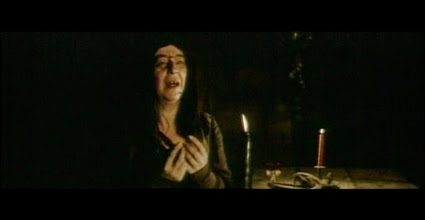
Showing posts with label Witches. Show all posts

Friday, March 07, 2014

The Witches


The Witches
Directed by: Cyril Frankel
UK, 1966
Horror/ Occult, 90min
Hammer Horror

Missionary schoolteacher Gwen Mayfield [Joan Fonatine] escapes from a terrifying and traumatizing attack during her time in Africa. Back from Africa, and following something of a breakdown, she moves to the small rural English village, Heddaby when Alan Bax [Alec McCowen] and his wife Stephanie [Kay Walsh] invite her to come take a position as head teacher in the village’s school. At first all is fine and Gwen quickly settles in, despite the fact that Bax wore a priests collar when they first met even though he’s not a man of the clergy, and the fact that the village still hasn’t rebuilt the burned down church ruin that stands on the hill above the village.
During her fist class she goes through the names of the pupils and reacts to the fact that young Linda Rigg [Ingrid Boulting] has her doll with her to school, something that she feels Linda is way to old for. The next day, Linda is absent and Gwen finds a note in one of the children’s textbooks claiming that Linda’s Granny treats her cruel. Here comes the first sign of odd behaviour in the village as Gwen learns about Linda’s Granny forcing her hand into the mangle! Not to worry says the chuckling old Granny Rigg [Gwen Ffrangcon Davies, who also starred in Terrence Fisher’s magnificent The Devil Rides Out two years later], she’s given Linda a nice brew of herbs to ease the pain.
Although Linda’s hand-in-mangle isn’t the thing that is worrying Granny Rigg the most, it’s her concern over young Ronnie Dowset [Martin Stephens] running after Linda, especially as they are at “That” age. If one was to be prejudice, Gran and her cat – who just happens to trail Gwen after Granny Rigg whispers into it’s ear to follow her and the talk of herbal medicine, home made sherry and chutneys – it would be easy to think that the old woman may just be a witch!
Ronnie suddenly falls into a coma, an effigy of him is found in a tree with pins stuck in it and the head missing, Gwen awakens from a sleeping pill slumber and screams in terror as she mistakes a feather duster for one of the Voodoo statues from her terrifying encounter in Africa. With the strange events occurring all around her, Gwen comes to the conclusion that Granny Rigg must be planning to use Linda as a virgin sacrifice in an occult ritual!
Slowly, slowly devilish things start happening to villagers, a man is found drowned, sheep attack Gwen and the African effigies start to turn up in dreams – or is it real? Guess the confusion and shock as Gwen awakens after fainting only to be in a nursing home and not Heddaby and under the supervision of the odd Dr. Wallis [Leonard Rossiter]. Is Gwen going insane or is there a conspiracy lead by Granny Rigg and the witches of Heddaby? Prepare yourself, because as the movie shifts into the third act, suspicions are overthrown, truths are exposed and the real constellation of the Heddaby coven is revealed!
This is classic Hammer occultism, gradually building the presence of the unnatural elements, letting paranoia grow, exposing our leading lady to the horrors of Heddaby, voodoo dolls, creepy cats, mystic happenings, Sabbaths and virgin sacrifices!
 
No stranger to the world of the weird, screenplay writer Nigel Kneale delivers the creeps and eeriness perfectly with his adaptation of Nora Lofts’ (under the pseudonym Peter Curtis)  The Devil’s Own, and Cyril Frankel dispenses it well. The Witches was the final big screen performance for Jean Fontaine, which she also co-produced as she’d bought the rights to the Loft story. Fantastic Hammer Horror creepiness and low key shocker filled with wonderful paganism and occult dabbling make this a movie I feel can be classed as something of a underestimated Hammer gem well worth seeking out!


Wednesday, May 15, 2013

The Lords of Salem


The Lords of Salem
Directed by: Rob Zombie
Horror, 101min
USA, 2013
Distributed by: Scanbox


Rob Zombie, a musician to divide the fans and a filmmaker to divide the fans, but always a man who pays his dues and respects to the artists and filmmakers that inspired him on his own ventures.

The Lords of Salem is a film that like all previous Rob Zombie pieces will divide the audiences, although this little gem will perhaps be the one that stands high above the previous ones. There’s a potent value in Zombie returning to his own universe and leaving remake city behind. The Lords of Salem will become a seminal work in this director’s catalogue.
Radio Dj Heidi Hawthorne [Sheri Moon Zombie]  both works and parties hard. Together with her colleagues Herman “Whitey” Salvador [Jeff Daniel Philips] and Herman Jackson [Ken Foree] she is part of Salem’s most popular radio show. One day a vinyl record addressed to Heidi containing raw primitive ambience of a band calling themselves The Lords of Salem, is delivered at the station. No press release or explanation is given with the record, just the record in a wooden box with a cryptic logo on the front. The sound of the record evokes strange visions and nightmares of ancient witch trials. Before the night is over there are ghosts lurking in the corridors of the house Heidi lives in, and the ritual is just about to begin once again.

Zombie knows how to tell a story. If you ask me, he’s matured into one of the greatest indie horror storytellers out of the US in a long time. He knows that taking time to present the unique universe, establishing characters, breathing mystery into the narrative and delivering realistic twists and shocks are key to making it work. Neither is he a stranger to flipping conventional roles on their heads and offering alternative angles to the classic protagonist/antagonist roles, which gives an interesting dimension to characters. As said, Rob Zombie plays for keeps and he’s building up quite a catalogue of work in the last few years.
Right off the bat, Zombie sticks it to us with two short but important presentations (well three if you count the initial shots of Heidi driving to work) as Reverend Jonathan Hawthorn [Andrew Prine] puts ink to paper swearing that he’ll spend the rest of eternity destroying all who pledge a legion to Satan. Cut to Margret Morgen [Meg Foster] and her coven of Six. They chant, hail the unholy father and prepare to desecrate their false bodies… slipping out of their tattered robes they dance round the fire, scream hysterically and rub the dry hot soil against their aged naked bodies. A tone is set that is almost hypnotic. Hypnotic and uncanny and I’d go as far as saying that this is the initial attack, because the movie can be seen as being about the several hundred year battle between Margret Morgen and reverend Jonathan Hawthorn more than it’s about Heidi, after all their arc is one that spans decades and only now is the time right for the witches to take their revenge…

The ordinary world is set up delicately. We learn of Heidi’s living conditions, life at work, local celebrity and all that jazz. The dog is a great way to bring realism to the presentation of Heidi. When she tells him to get down off the table it’s obvious that Zombie has a vision for this character, and she’s not just a sloppy slacker but also someone who has some integrity, and holds some rules about things. A few scenes later he adds some dimension to the character when she goes to a Narcotics Anonymous meeting  - Although if she really was trying to stay away from drugs, she’d probably want to stay away from the booze too…

But with this paradox there’s also an opening to interpret the film as nothing more than Heidi’s decent into madness… the horror may well just be imagined. For all we know the nightmares and visions may just as well be hallucinations from drugs, the witches’ figments of Heidi’s imagination and the finale a simple orgasmic death splutter.
The uncanny seeps in delicately in a great scene somewhat reminiscent of J-Horror storytelling… the threat of the piece is already in the room but as Heidi never reacts to it, it becomes more of a threat to the audience than the protagonist. It kind of plays along the line of Hitchcock’s classic “bomb under the table” trait where the audience knows of a threat that the victim is oblivious to – tensions builds! Room 5 is also important to establishing the threat. Strange noises, strange sights and odd events that we see and experience with Heidi, are dismissed when Landlady Lacy [Judy Geeson] tells her that there is nobody living in Room 5.  From that moment all it takes is a single shot of the corridor leading towards Room 5 to threaten the audience.

Subplots to be found come in the shape of co-worker Salvador who acts as something of a helper and a weak love interest, and historian Francis Matthias [Bruce Davison] who in contemporary times investigates the arc of Reverend Hawthorne and Margaret Morgan bringing important backstory to the story. His investigation brings a framework to the film from which the legacy of The Lords builds off. Ok so with all this in place we need an inciting incident. When the strange record of pagan ambience is delivered to Heidi, the real horror starts. AS the music taps into her subconscious, the decent starts – just as one can presume that the listening women also are snared up by the guttural sounds that the The Lords vinyl evokes. An enchantment hidden away in the audio and that’s what brings all the Witches into the final climactic reveal at the theatre.
It's great fun to see how Zombie uses and blends his influences to come up with some really effective tricks – and the Black Metal beat is awesome and who doesn't love a La maschera del demoino (Black Sunday) reference. Mixing stuff like The Shining, The Devils, Suspiria and a fair deal of Carpenter, Cronenberg and Michael Winner’s underestimated The Sentinel. You could add any number of alternative European psychotronic flicks could be added to the list of possible influences, as Zombie has, on record, stated that he finds European genre of the 60-80’s to be more open minded and freaky.

The subplot with the mystic audio that Heidi is given is great, if not genius. Not only a haunting chant, but also a gateway into the flashbacks portraying the Witches’ coven fronted by Morgan as they chant and meet their deaths at the hands of Hawthorne’s team of executioners. A fine detail that’s presented is also that the audio affects other women in the town. There’s a montage that show’s how other women are affected by the audio and in an extension of that I’d also imagine that they too start to have hallucinations and vision similar to that of Heidi. This due to the sound waves of the primitive chants that evoke something hidden away dormant within the women of Salem for decades. And when on the topic of audio, I don’t think anyone’s actually used the dynamics of audio in the same way since Dario Argento screamed his noise performance with Goblin at the images of Suspiria. Holy Crap does Zombie and his sound designers hammer this baby down hard, going from deep rumblings drones to high pitch screamed dialogue. It’s fantastic and I really love what Zombie and John 5 have done with the audio.
Let’s talk about cast. So many times do genre directors get great stars of the past to do a bit part where they just walk on and off. Just enough to wet the appetites of genre gourmands, giving them the opportunity to go, Oh look there’s so and so… Now Zombie does this too, and part of the hype built up beforehand was the massive list of former genre actors who where going to be part of this project. Some have gone missing completely (one can only hope for a special edition at some point so that we get to see Udo Kier - who starred in Michael Armstrong's seminal witch hunter movie The Mark of the Devil very early in his career, Clint Howard, Camille Keaton and the late Richard Lynch’s scenes). It is great to see Ken Foree work his magic, as it is the brief cameos of cult icons like Sid Haig and Michael Berryman. But the absolute delight - and possibly a huge part in why this film is sooo tainted with eighties horror atmosphere - is the coven of Witches. Judy Geeson, Patricia Quinn and Dee Wallace as you’d never expect to see them. Not forgetting Meg Foster. Holy screaming crap, that’s one creepy witch indeed and I’m totally sticking this performance as one of the greatest eerie antagonists in a long time.
It’s obvious that The Lords of Salem is a personal film. It’s also very obvious that this is a movie done in the precise way Rob Zombie wanted it to be made, and that can only be applauded – if nothing else it’s a rather delightful and somewhat unique little film he’s come up with. It has some great shocks, some awesome visuals a couple of delightful mind expanding moments and definitely tells a seductive and sinister story. The only bone I have to pick is the way Zombie tells stuff during the end credits that I’d have loved to see in a closing scene. I find that this would have taken the edge off the Psychedelic dreamy rock video montage that climaxes the movie and wrapped it up more in a conventional fashion. I dig the ending, but at the same time I find that spending so much time to establish the ordinary world, characters and the pending threat, I feel kind of snubbed when it finally comes – even if paint FX, nineties music video aesthetics and vector based CGI images may just become the next retro cool way to go!
The Lords of Salem is a rockin’ rollin’ flirt with witches, satanic cults and the fever dream genre moods of EuroGoth and classic old school horror! Rob Zombie has matured into a great filmmaker and a force to rely on.


The Lords of Salem is evoked on Swedish DVD ad Bluray release on the 17th of July!

Sunday, June 03, 2012

Outcast

Outcast
Directed by:  Colm McCarthy
Ireland/UK, 2010
Horror/Drama, 98min         


Low-key horror isn’t a bad thing; it can be quite the opposite when done in the right way. If you master the skills to tell an entertaining story and keep things interesting, you can be as low key as you want. Scotsman Colm McCarthy, with a firm background in directing for TV, presents a spellbinding and captivating tale of ancient rivals, pagan rituals and mythical magic in his feature debut Outcast.
Mary [Kate Dickie] and her teenage son Fergal  [Niall Bruton] move into a housing project area in Edinburgh. In the flat next to them lives Petronella [Hanna Stanbridge] and Tomatsk [Josh Whitelaw], who Petronella takes care of, as their mother is an insufficient. Petronella, a rather tough girl, soon takes a liking to Fergal, who responds to her emotions. The two of them struggle with their feelings, whilst ignoring the warnings and reprimands of Mary. Beyond the housing project, come Liam [Ciarán McMenamin] and Cathal [James Nesbit], searching for Mary and Fergal. Cathal covered with tattoos of ancient symbols granting him magic power, fully intent on finding the “boy” and killing him. But there’s also something dark and violent hiding in the dusk corners of the housing projects that has just started to prey on the residents there.
Fantasy, magic, supernatural, dark force themed horror can go terribly bad if it’s done in the wrong way – Supernatural may have run a number of seasons, but it’s still shite in my eyes, the wrong kind in my oppinion. Colm McCarthy manages to hammer this one right and brings a great little film to life. Characters are introduced during the first act: Petronella is not only a gentle character caring for her retarded brother and alcoholic mother, but she also has a reputation for being a tough lass. She takes no shit from former boyfriend James, and even taunts him in a way her that her friend Ally [Fifth Doctor Who's, Karen Gillan, and also first victim of the monster] reacts to being a possible danger for her. Petronella is a character with dimension, fully capable of doing good, and doing bad if needed, which makes it easier for the audience to empathize with her. Life is complex, and so should movie character be too.
Although the highlight of the piece is given by Kate Dickie as Mary, witch and mother of Fergal. If there’s one person’s torment I empathise with is hers. A single parent on the run with a teenage son. If there’s was ever a character to make me feel as if I was watching a piece of English social realism drama about the struggle of every day life, then it’s the Mary character, and Dickie’s great performance. But where others go amiss, Mary has her pagan powers. Her powers as a witch are proven throughout the movie, from early on where she performs a ritual, painting protective runes on the wall with her own hair and blood. The way she put’s a curse on the Housing Officer [Christine  Tremarco] is haunting, cold and right to the point. No Hollywood messing around, a few words chanted and the woman is cursed, no sound effects to be heard, no silly visuals, just two stern performances that sell the illusion completely and create a magnificently eerie scene. It’s damned good stuff and she contrasts the witchery with a concerned mother performance that hit’s the mark perfectly.
But for all this to work we need a stern set of rules. Outcast has stern rules, rules for Cathal, rules for Fergal and most likely unspoken rules for Mary too. What I really liked about this film is that the rules are never exaggerated or proclaimed in a way to be completely clear for everyone, but told more in an intelligent way, as if the characters where merely reminding each other of the rules. Fergal is told to  "stay out of fights and stay away from girls", a rather generic set of rules, but in the larger picture definitely rules to obey, especially as there’s something lurking in the darkness of the projects. After the magic runes are tattooed into the skin of Cathal, he only has a month to hunt “the boy” before the magic wears off, He can only use them to hunt down the boy and kill him, none other. We all know that as soon as someone proclaims a set of rules, they will be broken and there will be consequences, which brings a natural driving force to the film and builds a sublime suspense.
Several Sub-plots are used to keep the movie alive, such as the one concerning the monster in the back alley. There’s a brief, but scheming sub plot, which gives a larger image concerning Laird [James Cosmo] who Cathal at first must ask permission to go on his “hunt”.  There’s also a well used subplot focusing on a monster that lurks in the dark, before pouncing on it’s unfortunate victims, bringing them a violent gory death. This sub plot obviously drives the question of who the “monster” can be. Is it Fergal, Cathal, Toma, Petronella or someone else in the terrace? Amusingly the monster sub-plot of the movie more or less takes a second seat to the story arcs concerning the constellations of characters. The backstory of how most of them are connected is hinted at and not written on the viewers nose.

There are some good jump scares and a decent level of violence, which is often pretty cold, hard and completely lacking remorse.  James Nesbit breaking some unfortunate youth’s fingers is a rough moment, and then there are some fast effective gore scenes to keep that part of the audience at bay. Keeping the Creature off screen as long as possible is a great trick and that’s exactly how McCarthy plays it. Only showing us titbits of an anatomy keeps whatever’s out there more intimidating that anything he can show us, and it also keeps the identity a secret too. When it’s all revealed it still is in such a restrained form that it never really becomes one of those classic anti-climaxes where you clearly see what’s what. Good confusion still works like a charm.
Outcast could possibly have taken some inspiration from Romeo and Juliet. Petronella, is warned not to pursue her relationship / fling with Fergal, but does so anyway, and there's a price to pay. It also has a coming of age theme, as Mary on several occasions warns Fergal from “being around girls”. One could take a Freudian approach to the subject matter and refer to it as a metaphor for puberty, when young bodies change, and transform into other shapes than those they have been used to.  It could also be read as a Mike Leigh, or a Ken Loach toned homage. It has that look and feel to it that those great English kitchen-skink realism movies have, but with the horror angle. You know the feeling, you can never really relax, you are always tense, because the bottom can fall through and everything can go to hell at any moment. I’d also say that there’s a Let the Right One In/Let Me In vibe the movie too, as the audience can have an emotional recognition with Mary and her despair, but also the frustration, excitement and teenage lust, despite the punishment of breaking rules between Fergal and Petronella.
Colm McCarthy’s Outcast was an impressive surprise. I though it would be a mediocre time killer, but found a captivating and engaging movie instead. I would definitely recommend it and eagerly look forward to seeing McCarthy’s next venture into horror genre cinema.


Wednesday, December 14, 2011

The White Reindeer

The White Reindeer
Original Title. Valkoinen peura
Directed by: Erik Blomberg
Finland, 1952
Horror, 74min


Say the words “Genre movie from Finland” and most people will think of Pete Riski’s Dark Floors 2008, Jalamari Helander’s Rare Exports 2010, or perhaps even Antti-Jussi Annila’s Sauna 2008 but they will probably not mention Erik Blomberg’s 1952 early shocker Valkoinen peura (The White Reindeer).

Blomberg was a Finnish documentary filmmaker with background in cinematography. After lensing several feature films and short documentaries – several of them award winning - Blomberg took the step up to directing. Obviously he perfected what he already knew, and co-directed documentary Porojen parissa (With the Reindeer) 1947, a movie which went on to win Blomberg a Jussi Award for best editing together with his co-director and co-editor Eino Mäkinen. Six documentaries later, he made his debut feature with The White Reindeer, a movie that he co-scripted with his wife, actress Mirjami Kuosmanen – who also won a Jussi Award for her performance in The White Reindeer.

His final movie, Noc poślubna (Wedding Night) 1959, a Finnish, Swedish, Polish co-production based on Émile Zola’s L’attaque du Moulin. Despite an international cast of amongst others Bergman muse Harriett Anderson and Ignacy Golowenski; the movie was a devastating failure. After screening in Poland and Finland, the critics thrashed the movie and Blomberg so profoundly that the movie never opened in Sweden, and Blomberg left movie industry. Looking back at his career, the obvious highlight is winning the international prize at the 1953 Cannes Film Festival with The White Reindeer, a movie I’m taking a closer look at today.
There’s no wasting time in The White Reindeer, as soon as the opening credits are finished, a singing voice comes in and delivers otherwise awkward exposition and more or less establishes the setting, the mythology, the genesis of the curse. Song ends and it’s all fun and games as the Lapps race sleds drawn by reindeers. Pirita [Mirjami Kuosmanen] stands out, as she’s the only woman competing in the race, and she certainly gives the men a run for their money. Although to keep gender roles at bay, Aslak [Kalervo Nissilä] ropes her in and gives her a snog – suggested inoffensively off screen, after all this is still the time of innocence.

Alsak asks Pirita’s father for her hand in marriage and all seems to be leading towards a happy conclusion for the young couple… but, and there’s always a but… shortly after their wedding night, Aslak has to take the herd off to roam, and leaves Pirita alone at home. Disappointed, Pirita wanders the snowy plains visiting the Shaman Tsalkku-Nilla [Arvo Lehesmaa] to ask for a love charm to be cast, helping her keep Aslak at home. But mid-chant the Shaman pulls back in fear and screams that Pirita is a witch, the spell goes wrong, she becomes cursed instead and the shaman tells her that she will kill/become the first living thing she encounters… which just happens to be a white reindeer.

Later that night in the light of the full moon, Pirita turns into a white reindeer, and such a reindeer is a prized trophy amongst the Lapps. Aslak’s mate, Niilo, sees it, chases after it and wrestles it to the ground. As he brings the animal into submission he hears a familiar laughter. The Reindeer has turned back into Pirita, and her lustful gaze seduces him completely. As he moves in for a kiss, we see how Prita sports fangs... The vampire has claimed it’s first of many victims…
That Blomberg would choose to set his first feature in Lapland, as this is where the majority of the documentaries that he’d worked on where set comes as no surprise. He undoubtedly knows his nature shots, which bring a lot of added production value to the movie. I find myself thinking of oddities like Gunnar Höglund's Kungsleden (My Love and I) 1964, Trier’s AntiChrist 2009 and André Øvredal’s Trolljegaren (Troll Hunter) 2010. Movies which all utilise a lot of nature and location shots to create mood. I have a friend who will remain unnamed, as I’m not sure how official his work on the movie was, but when he was requested to go through Trollhunter and tighten the movie up, it was under the strict order that he was not to trim any of the nature shots. They had to stay at any cost. Never underestimate the importance of your location and the impressions it brings with it.

Basically the movie is about greed, obsession and envy. Pirita challenges conventional gender roles, and is therefore punished. She’s punished for wanting more, not being content. For being aggressive, and not the common passive housewife. She captures the alpha male, but then grows weary of his long absence when he’s herding the reindeers. Again challenging gender roles, she takes action instead of being content. She makes that pact with the village shaman to become irresistible for any man, with the intention of luring Aslak back and keeping him there. A pact that goes wrong. It’s also a stern warning, as the desire for more – or perhaps even the at the time provocative “female lust” leads to a certain death. I can’t say that Blomberg intended this, but it’s definitely a way to interpret the movie and what happens in the narrative. After all this is a movie made before female sexuality took control of the Scandinavian cinema screens, and old values where still valid. The movie could also be seen as a metaphor for the fear of the threat from within. Within the family, within the community, with the individual.

A lot of the tension in The White Reindeer comes from the slow and steady build towards the inevitable hunt the Lapps all engage in. They know that there’s a cursed white reindeer roaming their snowy plains, they know that there’s a witch slaying the men of the village, they know that they have to put an end to the troubles, but they don’t know that Pirita is the vampire witch.

Being something of an old movie, the in-camera effect and editing bring a lot of the in all fairness, cosy, atmosphere to the piece. There’s a lot of old universal vibe here and it’s an enchanting movie that certainly impressed me. God knows, I’ve seen worse stuff that this. The White Reindeer managed to grab my attention and delivered an interesting story.

At times the movie manages to come in close to the feeling of the gothic flicks Italians such as Riccardo Freda, Mario Bava and Piero Regnoli would be making in a few years time and to some extent even certain Hammer movies. But this was all before that, it’s most likely that the old Universal and Weimar movies where the largest influence on the imagery and style. Suggestive lighting and cinematography by Blomberg make an ironic statement, as the most impressive moments of the movie all take place on a set – I would have expected the outdoors “documentary” footage to have looked better. In any way, there are moments in the later half of the movie that really stand out and deserve to be re-discovered, this is a lost gem worth seeking out if you want to see what the Finns where doing in the fifties.

Sunday, June 27, 2010

The Witchmaker


The Witchmaker
Aka: Legend of Witch Hollow
Directed by: William O. Brown
USA, 1969
Horror/Satanism/Black Magic, 97min
Distributed by:
Midnight Video

William O Brown who only ever directed two features and later wrote a book on the subject – Low Budget Features, made his movies and then vanished from the scene never to be heard of again… but he left us with a very impressive movie; The Witchmaker definitely one of the lost classics of American Independent Horror.

The tone is set instantly as a woman bathing in the everglades climbs out of the water, wriggles into her clothes only to be stabbed down, have a symbolic sign etched into her white flesh, hung upside down and bled like a pig whilst a manic man laughingly goes about his dirty task. The man is Luther the Berserk [John Lodge – who also starred as a Russian Agent in Gordon Douglas’ James Coburn super spy spoof sequel In like Flint 1967], and the poor woman is his eighth victim in two years. Roll credits…
Dr. Hayes [Alvy Moore, a good old classic character actor, who also made a brief appearance as one of the elderly cops that answer the initial call to the police in Scott Spiegel’s Intruder 1989, and associate producer on The Witchmaker] and his team of paranormal scientists are taken out to the swamps by guide Leblanc [Burt Mustin] who takes them to their drop off and warns them against trying to leave the Swamp by their own hand, as "There’s nuthin’ but gaters, moccasins and quicksand” out there. The boat ride not only establishes the dangers of the nature setting – the swamp – but also is used to explain the rules of The Witchmaker universe, how the witch mythos works and by which set of laws they work. It also presents characters such as Dr. Hayes most loyal assistant Maggie [Shelby Grant who starred against James Coburn in the original Our Man Flint 1966], young students Owen [Tony Benson] and Sharon [Robyn Millan]. Then there’s the key players, the sceptic Journalist Victor Gordon [Anthony Eisley from Al Adamson’s Dracula Vs. Frankenstein 1971, Ted V. Mikel’s The Doll Squad 1973 and the brilliant Samuel Fuller’s The Naked Kiss 1964], and then there’s finally his love interest – yeah you got to have one of them to make your hero character take to arms - the “sensitive” Anastasia [Thordis Brandt] Brandt who not only had a minor role in William Wyler’s Funny Girl 1968 as one of the Ziegfried girls, but also starred as one of the Amazons in… Gordon Douglas In Like Flint. Brandt was once the long time girlfriend of James Arness, and after retiring from acting she returned to her original profession as a nurse. "Sensitive" being their word for emotionally frail psychic – think Pamela Franklin’s Florence Tanner in Legend of Hell House or Julie Harris’ Eleanor in The Haunting.
So this bunch of scientists arrive at the house in the swamp where they aim to conduct their research and experiments – much to Vic’s questioning, after all is it right to bring women to a place where eight other females have been murdered? Dr. Hayes, Owen and Vic prep for the session to take place later that night, and the chicks – Sharon and Anastasia –whip out their bikinis and start to lap up some sun. Just beyond them, in the shade of the woods lurks Luther who simply can’t take his eyes off Anastasia works some good old black magic on her that has her running off screaming through the swamp in slow motion whilst Luther satisfied goes back to his cave and prays to his lord Satan. At the same time he summons up the old witch Josie [Helene Winston] who claims that with the initial spell cast, she can control Anastasia who Luther wants for his coven.
Then stuff really starts to take off, Luther and Josie take power over Anastasia, who lures young Sharon out to the swamp where Luther, just like in that opening sequence, jumps her and steals her away. The blood is offered up to Josie, who drinks it and rejuvenates into an embodiment of her younger self played by Warrene Ott from here on. Ott, who starred in T.L.P. Swicegood’s hilarious pre-splatter fest The Undertaker and His Pals 1966. Young Owen is designated guard after the team of scientists bury the remains of Sharon, and Anastasia doesn’t waste any time in her seduction of him. He willingly follows her into the murky woodlands and in a superbly light scene Josie is awaiting him with a big ritualistic dagger!
With two of the team dead, Dr Hayes, Maggie and Vic, now less of a sceptic than earlier, confront Anastasia whilst she is under sedation. She summons Luther, and Vic get’s right into a fight with him. Then a blast of thunder and lightning reveal that it’s not Luther, but the body of Owen that Vic is fighting with! Ultimately the movie moves into it’s last act and the research team plan how can they take out the vile Satanist Luther and save Anastasia at the same time that Luther summons up the rest of his coven cultists – more playboy playmates amongst them – and have Anastasia go through the final ordeal, make her pledge and become one of the thirteen of the faithful. So in the end it’s all comes down to that age-old battle Good versus Evil - but not before Luther has a feast with his coven.
Rather low on the classic low budget, grindhouse traits of fast action, spontaneous nudity and gratuitous violence, the main ingredient to The Witchmaker is atmosphere, and it holds an atmosphere so rich that it could be sliced and put on a sandwich. Not to say that the movie is completely lacking pacing, nudity and violence, because it does have all those traits even if the sex and violence is pretty sparse... although there are three Playboy Playmates amongst the cast. But the controlled approach to the themes actually works in favour of the movie. I have always said that showing less is more in certain cases, and as the restriction is continuous throughout the movie it works for the narrative of The Witchmaker in a great way. Much of the atmosphere comes thanks to the location – Marksville, Louisiana, and cinematographer John Arthur Morrill’s at times superb camerawork and lighting. Morrill ended his career shooting several movies for B-movie legend John “Bud “Carlos.

And there’s a reason why movies like John Hough’s The Legend of Hell House 1973 and Robert Wise masterpiece The Haunting 1963 come to mind, as they too play off the same theme of a Parapsychology investigation that takes a turn for the worst and sets the crispy academics up against the real deal. There’s also a splendid feeling of Hammer/Amicus/Tigon vibe throughout the movie that definitely helps the movie along. Not forgetting that pretty eerie soundtrack by Jamie Mendoza-Nava.

The Witchmaker script originates from L.Q. Jones - Justus Ellis McQueen Jr the American character actor who starred in several of Sam Peckinpah’s movies and also directed a bunch of low budget flicks like A Boy and His Dog 1971 and The Devil’s Bedroom 1964, and The Witchmaker on which he was executive producer. Holding a fascination for the occult and witchcraft and at the time weary of acting within the system, Jones decided to focus more on producing his own self financed movies instead. So he started outlining a story that later would be completed by Brown as The Witchmaker.

But the real enigma here is that of director William O. Brown. There’s almost nothing to be found on the guy if you where to go searching for information on him, apart from his two Producer/director credits on The Witchmaker and the earlier One Way Wahini, a comedy from 1965 and the before mentioned book on low budget filmmaking. For a guy with so little on his public resume, Brown certainly is an intriguing character. And the screenplay to The Witchmaker is very satisfying.

There’s interesting complexity to several characters – Vic the sceptic, Anastasia who is confused by her two states of being, Dr. Hayes who knows that he’s ultimately responsible for the deaths. There’s also a fine balance between action and exposition, it would have been easy to just chuck stuff in there, but Brown takes his time to establish and set up characters and explain the rules so that we understand what is happening and where it’s all leading – well enough to keep it intriguing at least And there’s a final surprise twist in the finale that is rather unexpected when it looks as if everything is cleared up and back to normal again. It’s an impressive and smart little movie that really hold up well even with today’s’ standards

Even though The Witchmaker was made as an independent feature, it was eventually picked up by Excelsior Pictures – a division of United Artists through which they distributed their low budget, semi grindhouse titles – and was rolled up on 63 Southern California drive in theatres during the summer of 1969. It did pretty well and just like the great irony of early independent filmmaking, it made a few bucks for the owners of the film and not a lot for the actual filmmakers. After that initial run the movie, like so many others, The Witchmaker faded away and was rarely mentioned ever again.

Still to this day there is no "official" company bullshit release of William O. Brown’s impressive lost gem The Witchmaker. Which is why the Midnight Video Special Edition is the only real way to see an official version this movie in all its fascinating glory. And you should see it because it is a very entertaining piece that for some reason went missing from the conscious mind of genre fans. A sad loss of a piece that is very high on atmosphere, tells a great story and is a damned fine movie indeed, well worthy of a rediscovery.

Image:
Widescreen 2.35:1

Audio:
Dolby Digital Mono 2.0, English Dialogue.

Extras:
Original Theatrical Trailer - under its other title Legend of Witch Hollow, and theatrical Trailer for David Cass’ Disciples of Death 1971 and a small poster gallery.

Disney Star Wars and the Kiss of Life Trope... (Spoilers!)

Here’s a first… a Star Wars post here.  So, really should be doing something much more important, but whist watching my daily dose of t...