Sunday, October 17, 2010

Orgasmo


Orgasmo
Directed by: Umberto Lenzi
Italy/France, 1969
Mystery/Thriller, 91min


Umberto baby – what a trip! As customary I’ll start by saying it again, stick Make them Die Slowly back in it’s case, and seek out the older Umberto Lenzi Gialli and thrillers, because they are some really excellent movies back there that give a better insight into the arts and crafts of that fantastic director.

Lenzi’s career more or less follows the trail of many other great genre directors. He started out way back in the fifties when he used to write critical essays on film in magazines and newspapers whilst he was attending school with the plan of becoming a lawyer. He also penned several adventure and detective stories under a different name. The obvious step to take after completing school and realising that he held a passion for cinematic storytelling led him to landing a job as assistant director on Renzo Merusi’s anti-communist movie Apocalisse sul fiume Giallo (Last train to Shanghai) 1960 starring sexy Swedish export Anita Ekberg.

Following his directorial debut with a pompous period piece – pompous in a good way that is – Le avventure di Mary Read (Queen of the Seas) 1961. From there on he busted onto the scene with a string of Spaghetti Westerns, period pieces, action thrillers, sword and sandal adventures before he rekindled with that genre he’d been so fond of previously – the mystery genre. He did this with a loose trilogy all based on the themes of deception, double-crossing and death. Orgasmo (Paranoia) 1969, Così dolce… così perversa (So Sweet… So Perverse) 1969 and Paranoia (A Quiet Place to Kill) 1970. See some knob somewhere decided that Orgasmo should be called Paranoia which screws things up for that later movie doesn't it, and don't be misled by the title, Orgasmo isn't a screw movie, it's a genuine mystery thriller.

Orgasmo starts off the trilogy of mystery, and also sees the first of four collaborations between Lenzi and actress Carroll Baker. She would go on to star in the following two and the later early Giallo Il coltello di ghiaccio (The Knife of Ice) 1972. Lenzi show’s that he completely understands that there’s no need to waste valuable time on exposition and starts off with Kathryn West returning to Rome after her husband has suddenly died in a freak car accident – there’s no pointless funeral and wishy washy going on, but instead he cuts right to the chase and starts it all off. Some time is spent on establishing Kathryn and her world, her close friend Brion Sanders [Tino Carraro] who deals with all the paperwork following husband Robert’s death and Teresa [Lilla Brigone] who runs the mansion. A soon as we know the setting, Peter Donovan [Lou Castel] makes his entrance. Honking his horn and shouting aloud it’s a fair bet that he’s the antithesis of all Robert once was and it’s no wonder that Kathryn is drawn in by his rough charm and arrogant frankness.

But as soon as Kathryn find’s happiness, there’s going to be something negative to shake that foundation of pleasure. This comes in the shape of the late Robert’s relatives who don’t take to fondly to the young wife he once had and a bickery bitch fest is on the way. Luckily for Kathryn she has the trusty Brion at her side to pick her up when she faints. A rather innocent and deceptive subplot is set in motion when Brion starts to vaguely express his emotions towards Kathryn. But, and there’s always a but, Kathryn is all about her new young stud Peter who at the most unexpected moment surprises Kathryn with the arrival of his sister Eva [Colette Descombes].

From here on the movie takes a plunge into subtle and lusty exploration, there’s a delicate, provocative and suggestive eroticism between the three characters which slowly shifts into a sadistic deconstruction of Kathryn’s mental state.

In the last act, Kathryn uses all her strength to break free from the now abusive couple and certainly put’s up a great fight, but weakened both mentally and physically from long sessions of drink and drugs this is one battle she appears to be loosing. Never the less, Lenzi and co-writers Ugo Moretti and Marie Claire Solleville have a series of surprising twists and shocks up their sleeves before the movie finally comes to it’s crashing climax.

The editing style of Enzo Alabiso (wonder if he's related to Eugenio Alabiso?) is evident and a vital component of the movie. It moves rapidly and forcefully without taking unnecessary breathers that would have slowed down the pacing of the piece. Lenzi would use the talents of Albiso on several movies to follow. So keep your eyes on the screen because Orgasmo moves fast. Adding to the determined forward movement of the piece is cinematographer Guglielmo Mancori’s effective bag of tricks. Orgasmo is riddled with delicate dolly moves, fast swoosh pans and crash zooms to corner in the vital moments – most often focusing on Carroll Baker’s various facial expressions. Mancori and Lenzi would work together on at least seven more movies and Macori would go on to shoot some great genre pieces before calling it a day at the end of the eighties.

There’s the score. A vibrating and quirky score by the majestic Piero Umiliani who you know from such great pieces as Luigi Scattini’s Svezia, inferno e paradiso (Sweden Heaven and Hell) 1968, Mario Bava’s 5 bambole per la luna d’agosto (Five Dolls for an August Moon) 1970 and Corrado Farina’s Baba Yaga 1973 – which also starred Baker in a leading part. The score starts of very suave and quirky, but develops alongside the tone of the movie, the darker the movie gets and the deeper Kathryn falls into her mental decent.

The vocal piece of the movie Fate had Planned it so sung by Lidia MacDonald (the Scottish born singer who also sings on the Sweden, Heaven and Hell album - a must if you don't already have it) is used rather sparsely and holds a wonderful cynical mood that fits the movie, the more rockier track Just Tell Me performed by Weiss and the Airdales is the one that sticks out, but with reason, as it’s used several times to mark a rift between the very young Paul and Eve and the middle aged Kathryn.

An interesting final note on Orgasmo can be found in the fact that the Italian version differs from the American version. The ending of the American version brings a satisfying justice to all ending, but leaves certain valuable information out of the conclusion. Where as the original Italian ending stays closer to that cynicism that we all love about Italian genre cinema and ties in with the references to Robert’s sudden death in that car accident which is mentioned on several occasions. Without the conclusion to this important arc, the referents seem odd and out of place, and rather posing the question what happened to Robert? Well the answer, as told in the Italian version, is that Kathryn isn’t quite the hapless victim that she seems, but rather the initiator of an previous scheme outside the main narrative to claim the entire will and estates of Robert for herself. His death makes her a terribly wealthy widow! I can’t tell you why the decision to change Kathryn's character was made, but perhaps it was in a move to make her a more empathetic victim rather than a cold hearted and complex villain. Lack of dimension and polarisation has always been a favoured trait in American cinema so I’d guess that’s why. Also the Italian version is a preferred piece as it also has a lot more of the sensuality and nudity that comes with the blooming relationship between Paul and Kathryn and later Eve, which the American version exorcises on at least three occasions. We can’t have our empathetic victim being a sexual predator, enjoying both straight and lesbian sex can we, because we all know that bad girls go to hell and we have to keep it easy to follow…

Orgasmo is a riveting movie, which definitely demands that someone salvage it from poor quality copies and re-releases it in a pristine version because it’s a true gem that most certainly will find a new audience. It’s high on entertainment value, effective and still has a decent surprise ending even though there’s an endless amount of movies been made in the same niche both before and after this one. But if you are looking to explore early Umberto Lenzi, the mystery trilogy is an excellent place to start before following the path of evolution towards the splendid Gialli to follow. Just make sure to enjoy the Italian version not the American one will you.

Monday, October 04, 2010

Psalm 21


Psalm 21
Directed by: Fredrik Hiller
Sweden, 2009
Horror, 114 min

This is something quite unique – a good scary movie with some heavy atmosphere that stems from Sweden! If I was asked which Swedish horror flicks are good I would blurt out two or three and then have to search my mind, because there are not too many of them.

The obvious one is Thomas Alfredsson’s smash hit Låt Den Rätte Komma In (Let the Right One In) 2008, and then it gets tricky. Mikael Håfström’s Strandvaskaren (The Drowning Ghost) 2004, Anders Banke's Frostbiten 2006 and Martin Munthe's Camp Slaughter 2004 all fall deep into a pit of ridicule and predictable genre conventions. But at least Camp Slaughter has Fred Andersson giving the performance of a lifetime to make up for it. Someone needs to give Andersson a real acting gig because with each performance I see him in the more he shows his wide repertoire.

But even though there may not be a lot of Swedish horror, I’d definitely point you towards some earlier stuff that I find interesting. 1988 Jack Ersgård directed a kind of schlocky flick called Besökarna (The Visitors) that, in a nutshell, is a haunted house movie with a slow build, a monster hidden in the shadows and pretty all right movie when it all comes around. When I first saw it in the eighties I hated it, and someone wrote that the most scary thing that happens in the movie is that the wallpaper falls off the walls in the children’s nursery. Partially true, but when I revisited it a year or two ago, I was surprised at how well made it actually was. The slow build really established the characters well as they take a plunge down mentally, and then the constant reluctance to show the ghost. Well back in the day this was what I felt wrecked the movie, but in hindsight it’s actually what makes it still stand the test of time. It actually works and becomes a decent little moody piece, which relies on me as an audience to fill in the blanks, and the entity that I imagine is by far more shocking than the one actually revealed in the end. Then I’d definitely point you to sexploitation director Torgny Wickman’s Skräcken har 1000 Ögon (Fear has 1000 Eyes) 1970 even Gunnar Höglund’s Kungsleden (Obsession) 1964. Kungsleden is a sombre headfuck that manages to engage and challenge its audience. That’s two more movies that you should look into if you want to see some interesting stuff.

Arne Mattson made a wonderful and superb suite of Hitchkockian thrillers with a typical Swedish farcical tone that hit a few high notes. Amongst the adventures of the married couple and detectives John and Kajsa Hillman, [Karl-Arne Holmsten & Anna-Lisa Ericsson] there is one that stands out supremely – Mannekäng i Rött (Mannequin in Red) 1958. Its magnificent stuff and I shit you not when I claim that this movie more than likely had some influence upon the later Italian Gialli! The characteristics are all there and even the vibrant colour schemes pop out of the screen in the most magnificent way. It’s even said that Hitchcock at one time presented Mattsson with cigars and the praise that he had made a most splendid movie indeed. Watching that one is more of a demand than a suggestion.

Ingmar Bergman. Even though I constantly moan about the other directors that unfortunately disappeared in the shadow of the great Ingmar Bergman, even he couldn't keep his grubby little fingers away from the horror genre. Amongst his canon there are two that stick out as horror flicks – he even referred to them as his horror flicks – even though he made some really scary stuff where he explored the human psyche too. But never the less Vargtimen (Hour of the Wolf) 1968 and Jungfukällan (The Virgin Spring) 1960 are pretty grim stuff. Vargtimmen tells the tale of a man who sees demons and drags his wife in there with him, and Jungfrukällan is very much indeed one of the first rape revenge movies posing the question when is it right to take another persons life. It also supplied Wes Craven with a story to base his Last House on the Left 1972 with. By the way, both movies star Max Von Sydow and Liv Ullman and are required viewing if you want to talk about horror and Sweden from now on.

Obviously stuff like Benjamin Christiansen’s Häxan 1922 and Victor Sjöström’s Körkarlen (The Phantom Carraige) 1921 don’t pack much of a punch these days, but at the same time they are great movies to watch whilst you listen to your favourite music as none of them have dialogue. There is a version of Körkarlen with an audio track by KTL side band of Stephen O’Malley of Sunn o))) which is awesome, but still at the time they where made they where the cutting edge.

Anyways, what’s the state of Sweden these days? Well there certainly is some interesting stuff at work. Kristian Petri – who also made the documentary Brunnen (The Well) 2005 about Orson Welles relationship to Spain, his movies and the well that he was buried next to, giving Jess Franco an opportunity to talk on his friendship with Orson – just released Ond Tro which pretty much takes Giallo traits (especially Dario Argento’s Four Flies on Grey Velvet) and puts a modern spin on it. He’s also slated to bring John Ajvide Lindqvist’s Hantering av Döda (Handling the Undead) to the screens pretty soon, and then there’s Fredrik Hiller’s impressive debut feature Psalm 21.

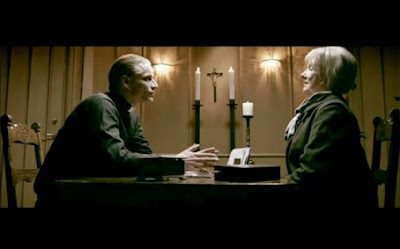
Quck fix for you before we get into the heavy stuff. A Young priest, Henrik Hornéus, [Jonas Malmsjö] is a beloved priest who holds sermons on the love and happiness that heaven will bring. Yes people, there is no hell in his religious view as the Swedish Church abolished Hell during the late eighties (true it did happen). His world is at its best when he is in his throne in the Church as his cold relationship to his son he has with his ex-wife. This is shown as he clumsily tries to talk to his son a few moments before his ex comes to pick the young lad up. It’s also here the movies weakest moment is found as the relationship between Henrik and his new biddy Karolina [Julia Duvfenius] coldly passes by. The phone rings and Karolina tells Henrik that his father has drowned.

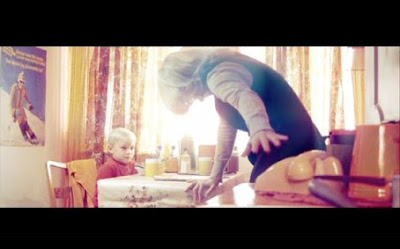
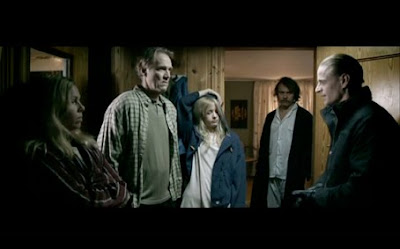
The moment that Henrik leaves the sanctuary of his safe Stockholm parish, odd things start to take place. On his nocturnal drive to his fathers last resting place he encounters his first “ghost” and also whips out his cell phone to check for coverage – why oh god why do we need to show that characters have cell phones but they can’t use them… wouldn’t you be better off not showing them at all? Anyways he walks to a farmhouse near by and after seeing a child demon he get’s some assistance from the damned odd family living there. They are obviously concealing some serious stuff from Henrik. Later that night he has a second cryptic encounter with the child demon – which will fall into place if you think about it after the movie – and Olle [Björn Bengtsson] starts to insinuate that Henrik’s Father Gabriel didn’t die accidentally but was actually murdered! This sets up the movie, establishes Henrik’s ordinary world and slowly introduces a perhaps not to original protagonist, but its done in a really good way. And it goes to places I never thought it would go from there.

Psalm 21 is a pretty decent piece of cinema within the context of Swedish genre movies. It surprised me because I wasn’t expecting a movie of this complexity, not to mention the scares, surreal dream imagery and excellent special effects – even if they are CGI and made by the same people who did the Harry Potter movies FX. Sure it has a few flaws but actually does deliver some scares and has a rather interesting line of question. It relies heavily on religious themes – Faith being the obvious one. Now I’ve been living here since the seventies, and never actually understood that the Swedish church abolished Hell. Not that I’m much of a religion guy anyways, man is a conscious being, we chose to do wrong or right without any pending threat of going anywhere after life. It’s a heck of a lot more complex than doing right to go to heaven… But Psalm 21 uses this abolishment of Hell and uses it effectively in its narrative. At first I thought the movie ended with Henrik loosing his faith – which would have been cool as the mother of all Religion themed movies, The Exorcist sees father Karras' regains his faith – but it’s more of him questioning the set of rules his religious ground is based on. He still keeps his faith, but he can’t go on under the premise that there is no Hell. Instead he has to face the facts that people actually do bad things just for the sheer pleasure of if. There is a hell and that shakes his perception of the world under God completely out of whack.

Guilt is used pretty much and primarily as a force of antagonism. It’s explored though Henrik’s back-story, and also motivates Henrik to widen his views at the climax of the movie. His mother [Lena B. Eriksson] dies in the opening sequence – through a really good looking flashback he keeps returning to that day, and then his mother starts to turn up in his hallucinations. One of them is a pretty shocking twist to an erotic encounter with Nora [Josephine Ljungman] that would have Oedipus jumping with joy. But that parental death never really left Henrik and it’s a pretty strong motivator to his nightmares and self-image. Yes, he thinks of himself as a demon, which is probably why he’s preaching the love of God and heaven so intensely. Sure his father is a Priest too, but I guarantee you that the guilt of his mother’s death is what made him chose the profession.

The usual good versus evil symbolism is pretty sparse, instead it’s represented through a pretty darned clever use of various interpretations of psalm 21 which has different reasoning in the various sources that it can be found in, older editions vs. newer editions of the bible, psalms and Psalteries.

On the down side there are some actors that don’t really measure up here. Unfortunately they are the ones that you would expect to be able to pull it off the best. But the problem is that some of them are established Bergman theatre actors and not genre actors used to acting with small means, which is probably that they act more overdramatically than realistic. Luckily there are only a one or two of them and they are only in a few scenes early on. Jonas Malmsjö gives a great performance as the tormented Henrik, and Per Ragnar [Håkan in Let the Right One In] is dark and disturbing as Henrik’s Father and regional priest Gabriel – although he better be careful that he doesn’t get trapped in a typecast hell because this one has similarities with that other movie he starred in. And I now hold a theory that this movie may have had some kind of effect on Let the Right One In as I was in production at the same time… I’ll say no more to avoid spoiling anything here. Even Görel Krona who I usually think is a crap actress does a great job here. Adding Nicklas Falk (who you will recognize from those damned Millennium trilogy movies if you have seen the original Swedish versions) and up and comming starlett Josephine Ljungman to the mix is great – they present some wonderfully complex characters that are very believable.

But my hat is off to Björn Bengtsson who does a marvellous job as Olle. Olle has some very concrete thoughts of what has happened to Gabriel and as he too is an aspiring priest it causes some serious contradictions for him. And being in the position he is he can’t quite deal with them, or react to them, by his own hand alone. It’s a great supporting character.

I have read comments that the effect of the Demons wears off as the movie goes along. And yeah it does, but I’m convinced that this is Hiller’s intent too as the demons at first serve a function as a shock device in the early stages, then transform to metaphors of Henrik’s mental decent. Finally they are as much a part of the Hell he’s living in as non-demon characters.

Fredrik Hiller has made a really interesting and good movie here, and I think it’s fair to say that this also proves the power of independence. For many years Hiller has been a background actor and voiceover artist featured on cartoons. Following a break in Hollywood where he starred in Robert Zemeckis' Beowulf against Ray Winstone and Angelina Jolie, he buggered right back to Sweden and spent his earnings on the project he’d been yearning to do for almost two decades, direct his own horror movie. The result, Psalm 21, is a good honest old school shock fest with some great use of themes and questions that you really want to check out when it comes around. Because this is one of the best Swedish Horror flicks right now.

Psalm 21 hits Swedish cinemas in early November 2010.


Sunday, October 03, 2010

Fantastic Film Festival 2010

So, I just spent three fantastic days in Lund at the Fantastic Film Festival.

Gave one lecture – Horror Storytelling at the Lund Film Accademy

Saw two movies - Simon Rumley’s disturbing and brilliant piece Red, White & Blue and Yorgos Noussias’s zombie comedy Evil in the Time of Heroes.

Talked with three filmmakers – Jake West, Simon Rumley and Sarah Caldwell (Who also writes for us on ConstructingHorror.com)

Hung out with loads of friends, fellow geeks and colleagues – Kim Newman and Phillip Bergson among them.

Had a great time in other words. A small, but wonderful little festival, that I certainly want to go back to next year… as a visitor and not a guest there to work. Because there where a lot of interresting movies that I unfortuntately missed.


If anyone wants’ to see the lecture that my mate Steve and I gave, drop me a mail and I’ll send you a link to the feed which was aired live over the net.

With all that out of the way, I can get back to focussing on stuff that’s been neglected!

Stay tuned.


Thursday, September 23, 2010

Let Me In... [Let The Right One In - Remake]

Nope, I haven't seen it yet droogies, but after seing yet another trailer I'm declaring it dead!


Sure it will probably work fine in the Unitedstates of Dumbasses as they obviously took the decicion to make it "horror for dummies" and have Abby explain that she needs blood to live.


"I Need blood... ...to live"
Way to go fools, stomp allover the unique reason the first one works so well.


The fact that they never declare what Eli is in the original - although people suspect it, and Oscar asks her in the scene recreated in that trailer - nobody ever confirms that it's a vampire.

Now don't get all worked up, I'm sure that the movie will do just fine, but it's not going to be the suave classic that the Alfredsson flick certainly is, and I'll most likely watch it due to the Hammer connection. Oh and because I like the original so much that I have to give the remake the benefit of the doubt. But as said, with that trailer in mind, I'm kinda questioning it allready.

Anyways, here's some stuff that I've written on the original previously and also a second chance to check out the interview I did with author John Ajvide Lindqvist about his books.

-On Children and Horror.

Sunday, September 19, 2010

Henry: Portrait of a Serial Killer


Henry: Portrait of a Serial Killer
Directed by: John McNaughton
USA, 1986
Drama/Horror, 83min

I was checking out the premiere entry over at Jenny Spencer’s The Bloody Iris, and at the end of her entertaining piece on Bill Lustig’s classic Maniac 1980, Jenny recommends a bunch of other stuff. One title on her list is John McNaughton's Henry: Portrait of a Serial Killer. And that alone made me go back and re-watch Henry, as I’ve been longing to get back to that one for a shit long time now… and it was well worth it.

Ok, so here’s a headfuck for your Sunday leisure – How John McNaughton registered death without taking sides.

Henry: Portrait of a Serial Killer has been an important movie for me quite some time. It was during my film studies in the early nineties - when Laserdisc’s still where the preferred choice of cineastes - that I was grated some money by my tutors to purchase some titles within the horror field for the school library as they had none. As I was paying for the selection of second-hand discs I’d picked out, the guy who ran the shop, recognizing that I was into horror, asked if I had heard of Henry: Portrait of a Serial Killer? Well of course I knew it from the genre mags, but I still hadn’t seen it, so when he presented me with the disc fresh from the latest titles I had to pick it up. Back at the university, my tutor and I sat down to a double feature and discussion about Night of the Living Dead and Henry. After NoTLD we compared notes and talked at ease about the symbolism, metaphors and narrative. We carefully placed the next bigass disc on the tray and hit the play button.

But following those last lines “Yeah I killed my momma” I looked down at the sparse notes I had taken down and turned to my tutor for further discussion. He sat there with his hand to his mouth as to hold back his gagging, managing to blurt out that this was the most disturbing and vile movie he had ever seen. He also pointed out that he have no choice but to fail my paper if I chose to write about this movie, as he found that there was nothing positive to say about the movie what so ever. It was merely a showcased of depravity. I subjected an essay on the movie, and he obviously rejected it forcing me to write a second one on another movie instead. When I finished my studies some years later, I even took the Laserdisc with me as he still felt I had nothing to do in the library the university had assembled.

Needless to say Henry: Portrait of a Serial Killer became my “you HAVE to see this” movie for some years and here’s a reminder of that horrible movie to refresh your memory – or lure you into seeing it for a first time in case you may have missed it.

Chicago, USA. Serial killer Henry shares an apartment with his jail buddy Otis. Becky, Otis sister, moves into their apartment after walking out on her “difficult” husband. At the age of fourteen Henry was incarcerated after murdering his mother, a disturbed prostitute who forced her son to wear women’s clothing and watch as she had sex with men. Henry persuades Otis to take part in his killing spree, and one night when Henry leaves Otis and Becky alone to go out and buy cigarettes, Otis rapes Becky. Henry walks in on them and in a fury kills Otis. Henry cuts up the body, and together with Becky throws them from a bridge, before checking into a motel. The next morning Henry checks out and leaves a bloody suitcase by the side of the road.

After revisiting the movie, it would be easy to use the description of realism film theoretic Louis Gianetti explains in his book Understanding Movies; "existing sound, central dominance within the frame, open and long takes, and synchronous sound" - all of them forms that John McNaughton has used in his debut feature Henry: Portrait of a Serial Killer.

For this reason it would be easy to place the movie within the realistic film theory category, as Henry: Portrait of a Serial Killer almost comes off as an observing documentary, and for some odd reason the Mayles' brothers Salesman [1968] comes to mind several times as I watched the film. But then something starts to shift in my mind, I recognize the theory of realism as described by Gianetti - but they don’t quite add up in relationship to the language that the film talks, or the techniques used in it. Upon a second viewing the traits of the classical narrative are more obvious, deliberate zooms in and out of scenes as they start and come to an end. Edits are hidden away in sound, audio flashbacks, non diegetic sound and “fade-to-blacks” in-between acts – all characteristics that give the movie away as having a classical narrative.

It’s an easy mistake to make, taking the classical narrative as a piece of realism, which rings true for many of the movies in the “extreme” fringes of the horror genre. One of the few sincere tricks to expose a snuff movie is that there are edits. If you start cutting off someone’s arm, you are not going to be at the same spot after the edit to the close up. Real life atrocities are almost always shot in a wide master shot as there isn’t a though given to dramatizing the terrible events being shot. If you focus on the images and not on the “craft” you will fall for the tricks of the trade. In the case of Henry: Portrait of a Serial Killer I should mention that Allen and Gomrey point out “classical Hollywood narrative is passive” in their book Film History, Theory and Practice. This means that all we need to know is presented in front of us, but this is not the case with Henry, also there is no cause-chain effect that releases the events and wrath of Henry upon his victims. Neither is there a clear protagonist / antagonist pointed out which are common traits of the classical dramaturgy. Sure, in some scenes Henry comes off as “the hero” at certain moments compared to Otis who seems to be “the villain” in the same scenes. Within the classic narrative there is often an obvious hero/heroine to which the audience can identify and bond mentally with. McNaughton takes measures to make sure that we don’t bond with the characters in Henry: Portrait of a Serial Killer, and doesn’t let us identify with any of them. This evokes an almost drama/documentary mood as we are thrown into the lives of these people without any obvious start, nor a typical closure to the movie. Henry is a killer in the beginning and is still a killer at large at the end of the movie. The fraction observation of slice of life affects us in such a way that we experience the movie to be realistic.

After finally establishing that the film has a classic narrative, I still can’t get my head round that feeling that the movie is told with a realistic viewpoint. I’d like to claim that it’s all because of the way McNaughton showed the events happening in the film, from a distance and an objective stance. There are rarely any shots where he forces experience or opinion towards his audience by force feeding us deliberate shots; all he does is subtle zooms towards where we would be paying attention. Everything that we learn in this movie happens in the now, and that previously mentioned end scene proves that McNaughton leaves all conclusions and interpretations to us, the audience. This position, a registering one, is typical for the documentary genre, which adds to the difficulty of categorizing Henry: Portrait of a Serial Killer, as it simultaneously with the registering stance, also has a classic narration. Together they both make up the realistic feeling of the movie, which is a major influence on the way the movie is experienced.

The cold disassociated emotional setting that among others the late Chas Balun commented in I Spit in Your Face: Films That Bite", The DEEP RED Horror Handbook confirms that the movies hold is definitely an emotion awoken by McNaughton’s deliberate distance to the narrative.

As McNaughton takes an objective point of view to the events unfolding on screen, he takes the registering position, as does the audience. This registering position makes the hideous crimes we see less emotional for us, as we don’t step into the victim’s character or suffering. We have no emotional bond to them and neither have we made an investment into their character. It’s quite unsettling when you think about it, because this makes us dismiss the seriousness of Henry’s killing spree easier, as we more or less accept them as his pastime activities. The second thing that builds up that uncomfortable feeling is that somewhere in out subconscious are still getting the signals that what he is doing is wrong. Unconsciously this scares us as we start to fear our own feelings and reactions, startled by our own indifference. The fear is all of a sudden much closer to us, among us. Consequently the registering position of the film contributes to a paradoxical self-examination within the audience. A third device is the way the movie moves forth, which also adds to the alienation. During the first part of the movie we never see the killings. Bodies pile up and Henry [Michael Rooker] keeps his back to the camera, always in motion, always keeping a distance as he keeps ahead of us at all times. Also McNaughton edits away in the midst of camera movement. The camera rarely lands at its steady destination before he cuts to the next image creating unease with the audience. Not to mention the six murders before the Otis [Tom Towles] and Becky [Tracy Arnold] story is presented.

But we are not completely passive against the position McNaughton forces us into as it also induces frustration with the audience. An example of this is the rape of Becky. Here McNaughton chooses to position the camera in the far corner of the room, and show the terrible episode from a wide master shot. We the audience want to act - help her - instead of just observe the action, but the camera won’t allow us to step in closer. We are held so afar that it’s impossible to help Becky, which is why our frustration engages us in her suffering.

It’s important in this context to note the difference between taking a registering position and not taking a standpoint. McNaughton was accused several times for not taking a standpoint towards the atrocities shown in the film. This critique is in my opinion somewhat naïve and shallow, because not speaking out on one’s standpoint does not mean that you don’t have one. By not speaking out is in its self actually a position. More than often we see serial killer movies that try to explain the events that lead up to the killers state of mind and raison d’être, and it’s always so unsatisfying that it starts to annoy instead of give some sort of sympathetic insight to the killers mind frame. In McNaughton’s case I feel that the choice of not exposing the back-story and just mentioning it briefly adds to the uneasy feeling that you get from the film. McNaughton indicates that a terrible childhood “might” be the reason behind Henry’s killings, but it’s a poor excuse. Again through not commenting on Henry’s reason for being Henry, which a film told with a classic narration would have done, the movie is accepted as realistic. So you shouldn’t confuse a registering position with not having a perspective on what you show.

Through the registering position we never make any close bonds with the characters in the story to identify with them. This has us instead of seeing “us” in them, just observe “them”. This enhances the “peeping tom” feeling that often is referred to as Voyeurism. Film Theorists like Metz argue that discourse disguises itself as story with in the classic narrative. This invites a voyeuristic approach to the movie as it becomes an object presented by a sender (McNaughton) who hides rather than confronting us. As we are only registering the events on screen and can’t emotionally interact with the characters, we subconsciously feel like peepers getting insights into things we shouldn’t be seeing. As the characters aren't aware of our presence while they go about their evil deeds, our interest into what they are doing is enhanced. At the same time there is no danger to us as we are hidden voyeurs.

In Henry: Portrait of a Serial Killer we observe the darkest sides of humanity. But we never quite understand that, as we don’t relate to Henry or his victims. Yeah, we do recognise some of Henry’s emotions, but because of the positioning McNaughton has chosen – the objective – we never connect with Henry and his victims, which make the movie even more unnerving, as the unexplainable and non-identifiable scares us more than our personal traits that we easily recognize.

The observing gaze that we take on throughout the film almost makes us look upon the victims in the same way as Henry does. He does not know them, has no feeling for them and therefore sees them as items with no human value. What we instead react to is the graphic violence – the mutilated bodies and blood. As we rarely actually see Henry kill a victim in the movie, we neither get that emotional reaction, that empathy for human suffering.

The single time that we feel for one of the characters is in the horrific scene when Becky is raped by Otis, her own brother. To explain WHY we feel emotion first here, I need to backtrack over previous events. Becky is the only character to show any human emotions. She does what she thinks is the right thing, to give Henry the female love he never received from his mother as a child. As Henry tells her about his mothers death you will notice how the camera moves in closer and closer, on Becky and Henry as he opens up for the first time. We understand by the look on Becky’s face that she sympathizes with Henry. This single intimate moment is shattered and the camera quickly withdraws shoving us back into the objective spot, and we realize that off camera Becky has put her hand over Henry’s to show her compassion. Also note that in line with the registering position that McNaughton wants us to hold, he resists the urge to affect us or influence our emotions by laying down a romantic score, or giving the lighting and lenses a softer edge. But back to Becky; from this moment on she takes a more obvious feminine attitude, she wears dresses instead of pants, she changes her makeup, and accepts her womanliness. Not even here does McNaughton waste time to explain this transformation, he doesn’t explain that Becky loves Henry, he sticks to his registering camera position and never enters the characters minds. It’s the audience that are challenged to make the decisions, and what we don’t see on the screen we look for in other conventions, i.e. patterns we recognize from other movies. "...the memory of every film one has enjoyed acts as a model for the next one." as Metz states in his Story/discourse: Notes on two kinds of Voyeurism, (Movies and Methods Vol II 1985, ed Bill Nichols). In our knowledge of classic narrative we know that girl meets boy, feelings are responded to and we end up with a happy ending. So we associate to these conventions and subconsciously start hoping that Becky will have Henry and that’s why we understand, even though the camera is only a registering device, that Becky loves Henry.

This is also the first time we sympathize with a character, we want Becky to get her happy ending and that’s why we feel so strongly for her in the rape sequence, why we want to get in there and rescue her, and why we almost cheer Henry on as he slays Otis. Becky's the first sympathetic character on screen, and as a character playing on the audience’s sympathy she has to pay the ultimate price. She may have been saved for now, but she will not become emotional luggage to Henry, which is what the symbolism and metaphor of the suitcase is in that grim ending of the movie. As if you never understood what’s in there! Our sympathy means nothing in the context of the forced approach the movie is told under. This audience empathy means nothing in the world of Henry, and it has no effect on him either. Hence the darkness.

I just want to clarify that these emotions are not aroused by anything that McNaughton’s positioning does, but rather the opposite. By holding his registering position and not adding value to what we see, the audience is forced into certain situations as the lack of directorial comments make us fill in the blanks with our own associations. If he had used classic narration, I can assure you that there would have been a montage there to lead us by the hand into the emotional state wanted. McNaughton does nothing to manipulate his audience, it's all done by themselves.

The storytelling position of Henry chooses not to give any answers or explanation concerning the events of the plot. McNaughton unleashes Henry without taking a position. He neither condemns nor applauds Henry’s actions. It’s all cold and observing leaving that uneasy gut feeling with the viewers, as it’s us who have been passively watching the events unfold. Perversely feeding our voyeurism, as we aren’t let to engage in the discourse.

The narrative is non-passive and there is no obvious cause-chain-effect as mentioned earlier. This all adds up to making the movie live on longer in the audience, it almost becomes an unsolvable riddle, as you can’t quite let the movie go before figuring out the answers. Henry: Portrait of a Serial Killerleaves the audience with a lot of unanswered questions. It evokes a mental inner space with the viewer where it lives on, feeding off the associations, experience and questions they have. Questions that they usually get the answers to within the classic narrative, which is why Henry: Portrait of a Serial Killer is such a gem of American independent horror cinema. One that without compromise still delivers a hard kick to the gut and shows no traces of aging in the twenty-four years passed since it was made. It’s a dark haunting timeless classic that could be one of the most provocative movies ever made.

Note that no human beings where harmed in the making of this movie, and if you where provoked by the graphic imagery in this piece, then you obviously didn't read the warning before entering the site - which leads me to believe that you where only here to look at the pictures in the first place.


Disney Star Wars and the Kiss of Life Trope... (Spoilers!)

Here’s a first… a Star Wars post here.  So, really should be doing something much more important, but whist watching my daily dose of t...