Showing posts with label Ernesto Gastaldi. Show all posts

Wednesday, May 05, 2010

The Big Alligator River


The Big Alligator River
Original Title: Il fiume del grande camano
Directed by: Sergio Martino
Italy, 1979
Horror/Drama, 86min
Distributed by: NoShame

There’s something about mammoth sized “real” animals that take revenge on mankind movies that just doesn’t work for me, with a few exceptions of course. I can never really seem to get into them in the same way as a monster of the fantastic (i.e. Godzilla or Alien or Zombies) or something like a plague of smaller critters and all that stuff. But the big bastard lone predator never ever got under my skin. I saw Spielberg’s original Jaws 1975 when I was something like seven or so and I dared not go for a pee that night as I was sure that the head of that bloke who’s head floats up and scares the crap out of Richard Dreyfuss would float up out of the crapper and scare me to death. See, it was the human element and not the big shark that got to men that time, and that’s quite the way it’s been since then.
Saying that, Sergio Martino’s The Big Alligator River hasn’t got the best starting position when I finally settle down to watch it. But it’s not all bad. Sure it’s pretty slow, has an obvious Jaws complex, and a strange subplot with alligator worshiping natives that decide to kill humans that never really get’s explained in a proper way. It goes something like this…

Photographer Daniel Nessel [Claudio Cassinelli] arrives at the Tropical Tourist Paradise soon to be opened to the first batch of visitors, and is happily greeted by owner and cynical businessman Joshua [Mel Ferrer]. Even though Daniel has a spiffy photo model Sheena [Geneve Hutton] with him for the promotional shots he’s been hired to shoot for Joshua, he is more prone to setting his focus on Joshua’s assistant Alice [Barbara Bach]. After a few obvious set ups and some needed exposition such as Joshua being a greedy moneybags who cuts corners on safety so that everything can be set when his first bunch of paying guests arrive. There’s also a subplot that involves Joshua exploiting the Maccuma tribe as cheap labour on his resort, and not giving a damn about laying their surrounding nature to waste as he expands on his paradise island, there’s going to be a major payback later on… a strange on, but still a payback.

Alice takes Daniel and Sheena out for a tour of the area, and Daniel continuously shoots photographs of the working tribesmen, Sheena and on every possibly chance shoots of a candid shots of Alice. Later that night Sheena takes off on the lake with one of the natives that she previously danced seductively with during yet another photo shoot. Strange drums are heard over the waters (well really a primal and crap disco track by Cipriani) and Alice tells Daniel of the tribe who worship the giant crocodile god on the other side of the waters… Obviously it’s the set up for the initial attack as something attacks Sheena and her lover whilst they frantically paddle back to shore dragging them under the waters.

The tourists arrive and a new batch of secondary characters are introduced, sleazy youngsters only there for romance, elderly couples who mostly complain about the disco music and scantily clad youths and a little kid called Minou [Silvia Collatina – who later starred as Mae Freudenstein in Fulci’s Quella villa accnato al cimitero (The House by the Cemetery) 1981. Obviously none of these characters really mean anything to the plot except perhaps Minou who Daniel later rescues, but all in all it’s just another annoying red-haired freckled kid in an Italian genre piece. Daniel goes out to search for Sheena and obviously Alice goes with him, and at the same time the disco dancing youngsters hit the waters all reassured by Joshua that there’s absolutely no threat at all in the water… sound familiar? Alice and Daniel arrive at the island inhabited by the crocodile cults who are mourning a warrior – obviously Sheena’s suitor. The tribe tell them that they have woken the crocodile god Kroona, and he’s here for his booty, which leads them to the only “white man” to have seen the monster and survived – Father Jonathan [Richard Johnson], a hermit that lives in a cave deep in the jungles. As they make their way back to the resort they are attacked by Kroona, who chomps down on their native guide. Joshua is furious that they took off outside the restrained areas and refuses to have anything to do with the fact that there’s an enormous monster in the waters – after all he’s invested three million dollars into his paradise and will not cause a panic amongst his guests.
With all that set up the movie moves into its final act and it’s an act that finally sees some action taking place. Joshua takes all his guests out on the lake for the Tarzan’s Raft boat party, the tribe of croc worshippers decide to make a sacrifice to the god of the rivers snatch Alice, and Daniel is caught in-between with the dilemma of who to save. The boat now under attack by Kroona or Alice submerged in waters as an appetizer for Kroona. Panicked the tourists jump from the boat and swim to shore, as the monster easily guzzles them down and as if that wasn’t enough, the lucky bastards who make it to the shore are attacked by the crocodile cult – it’s a complete massacre. No action adventure is complete without its climax, and The Big Alligator River definitely has one, one that sees Daniel and Alice venture back down into the deep waters to take on the gigantic Kroona in a final battle.

The Big Alligator River isn’t one of Sergio Martino’s better films. It has severe problems, one of them that it takes too long to set stuff up. There’s to many minor subplots that never really come into play, it moves way to slow to make it a fierce piece of genre cinema. Which is a shame, because the last quarter of the film is pretty intense and riveting, and if only the rest of the movie had been as fast and ferocious then the movie may have had a chance at making an impression.

Cassellini get’s his job done as the heroic character, Bach is pretty boring as usual, Ferrer overacts a few times and Richard Johnson delivers what may be his most freaked out part ever in an Italian movie. Italian bit part actors like Bobby Rhodes and Romano Puppo have decently large parts and a few action scenes, but still nothing that really makes any difference to the narrative. Which is odd as Puppo’s Peter character is the only real antagonist posed towards Cassinelli.
Needless to say the movie is heavily influenced by Spielberg’s’ Jaws where the cynical and greedy resort owner is more interested in milking his paradise guests for their cash that caring for their safety, and pays the price. Unfortunately where Jaws does have some great scenes and a brilliant narrative, The Big Alligator River doesn’t. Considering the stuff that screenwriters Ernesto Gastaldi, Cesare Frugoni, Mara Maryl, Martino and George Eastman (as Luigi Montefiore) had written previously and would write in the future, I’m surprised that they didn’t really go for the true core of the inspirational source, as it’s just as much about the character development of the lead characters as it’s about the big friggin’ shark, or like here an alligator. This is a key point that The Big Alligator River completely misses. I feel nothing for any of the characters or their troubles. There's never really any direct values or such at stake either, which doesn’t exactly help the movie along.

As said the movie moves terribly slow with way to many tedious slow-motion effects, which definitely don’t create suspense. Not even with the constant referents to there being crocodiles in the waters, as it’s not enough to make it exciting, not even that initial attack that clocks in somewhere just after twenty-five minutes of sapping movie plot. Then there’s the problem with the alligator or crocodile... it’s never really explained in a decent way, more as one single line of dialogue in Father Jonathan’s cave. Just like the reason for the tribesmen suddenly killing off the tourists and then finally just walking away as day breaks leaving several survivors to question why. In all honesty it feels like a major fuckup and sloppy writing, and it’s bad in every possible way.
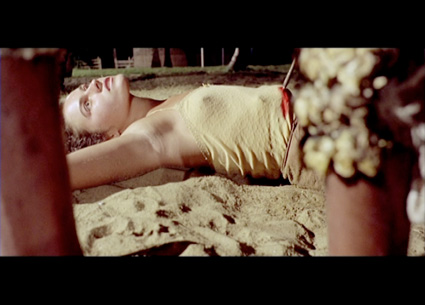
Not even the great editing of Eugenio Alabiso - who I have to hold responsible for the tedious slowmo scenes. Possibly in an attempt to bring some juice to the movie - or Stelvio Cipriani’s score, which is a really weak on to say the least, manage to salvage this one, which appart that final act is a really poor movie. Perhaps it’s best suited for a Saturday matinee or a late night slumber flick as it never really grabs hold of you in any way and pretty much just chugs along… slowly without a bite.

Finally… that the prosthetic alligator is kind of impressive in some screwed up way, and there’s no doubt that Martino could have gone all in with stock footage if he wanted, but instead there’s a big toy croc in the waters. Even if it does look fake in some shots, so does Bruce in Jaws, and this movie is made on a fraction of that budget.. So give credit where credit is due and acknowledge Carlo De Marchis’ monster alligator for the splendid piece of junk that it is. De Marchis was also part of Carlo Rambaldi’s special effect team on Ridley Scott’s Alien 1979, and special effects supervisor on Claudio Fragasso’s awful Leviatán (Monster Dog) 1984 starring he one and only Alice Cooper.

I don’t know what magic Sergio Martino had during that impressive run of stunning Gialli and Poliziotteschi a few years earlier, but The Big Alligator River sure lacks it. Sadly it’s quite a disappointment on many levels, which disturbs me, as I really wanted it to be a good classic Sergio Martino movie.

Image:
Widescreen 2.35:1 /16x9

Audio:
Dolby Digital Mono, Italian or English Dialogue with optional English subtitles.

Extras:
Well being a NoShame disc there’s a great bunch of extras, In the Croc’s nest features interviews with Sergio Martino (who also gives an impression of not quite liking the movie) and production designer Antenello Geleng. The Italian trailer, Poster Gallery, and a booklet on animal revenge movies and talent biographies.

Don't be fooled by the trailer, but check out Bobby Rhodes early on. And yeah this is about as good as it get's and it's all in the trailer...

Tuesday, May 04, 2010

So Sweet… So Perverse


So Sweet… So Perverse
Original title: Così dolce… così perversa
Directed by: Umberto Lenzi
Italy/France/West Germany, 1969
Thriller, 88min


For each Umberto Lenzi interview I see in documentaries, supplement material or on stuff like Mike Baronas' excellent Paura: Lucio Fulci Remembered Vol1, I get the feeling that he’s becoming (or perhaps is already) something of a Gene Simmons of the Italian genre-flick scene. There’s an ”I invented that, I was first” “I’m the prime innovator” tone to him – not that I’m going to argue him – it’s just that I’m always amused by people who claim to have invented, shaped and broke the mould for so many various areas. Just like Gene Simmons, who still to this day can’t see that the hard metal he thinks they invented was only makeup and disco at it’s worst.

Never the less, where Kiss music is complete tripe and could possibly only appeal to ten year old kids who didn’t have their own identity during the seventies and never once interested me no matter how hard I tried to see what’s supposedly so great about them, Umberto Lenzi did indeed stand amongst the forerunners of Italian genre cinema, and on many occasions did try out new terrain. It’s ironic that he’s so strongly associated to those gut munchers and tacky zombie flicks (not that there’s anything wrong with them) because I still seem to find myself becoming more and more impressed by his Gialli, and has a hard time forgiving myself for never quite taking the time to check out these impressive pieces back in the day.

But back in the day meant waiting almost a month for Greek Ex-rentals to fall through the letterbox, or gambling with Dutch imports or trading umpteenth generation copies with your mates and rarely stretching far enough to find these rare delights, but sticking close to the good old gut munchers and gore fests that initially drew me into the world of Italian genre cinema. Thank god for DVD and Internet traders, making all these fascinating films available in excellent or at least something that resonates as third-generation VHS dupes once again. It’s a thrill to settle down on the couch and get into a piece of forty-year-old Italian cinema for the first time.
Like many of the titles that get sold off as Gialli, Umberto Lenzi’s So Sweet... So Perverse is unquestionably not a Giallo. And even though is has a great title, it’s neither sweet nor perverse. But it is a pretty entertaining little movie that stays safely inside the thriller sphere and comes off more like an extended twist on the Boileau-Narcejac novel Celle qui n’était plus (The Woman who Was). Yes just like Henri-Georges Clouzot’s masterpiece Les Diaboliques 1955 and Alfred Hitchcock’s Vertigo 1958 and many, many more. Which makes Jean-Louis Trintignant’s choice of doing this movie odd as he’d starred in Giulio Questi’s La morte ha fatto l’uovo (Death Laid an Egg) 1968, a movie which plays of the exact same premise, just the year before. A movie that just like So Sweet… So Perverse adds a fair amount of the Italian seasoning that story which the original lacks.

Jean Reynaud [Trintignant] is a player kind of bloke who runs a chemical plant – but jus like most other movies of this kind, he never actually works – instead he spends time between his many mistresses and his depressed wife Danielle [Erika Blanc]. On several occasions he hears strange sounds from the apartment above his and Danielle’s. He also see’s a blonde woman rushing to the elevator and taking it up to that flat above theirs, but she’s dropped a piece of jewellery. One night he hears a woman screaming and goes up to investigate; finding blood outside the door he uses the key the previous tenant has left him. Inside he first finds a series of instruments, well knives, handcuffs and a good old cat o’nine tails that obviously make up someone’s kinky fetish, before surprising Nicole [Caroll Baker in her second of four movies directed by Lenzi] She tells him a sad tale of despair and how photographer Klaus [Horst Frank] holds her as a sadistic sex toy ever since raping and tormenting her during a photo shoot years ago. All shown in a great boldly coloured surreal flashback. Jean, being stupendously gullible falls head over heels in love with her and they take off for a few days to get Nicole away from the fiendish Klaus.

But their love escapade quickly goes sour when Nicole during a moment of serenity decides to spill the beans and reveals that she’s merely bait in a sinister plan to lure Jean into an affair with her and then kill him. Her former lover Klaus has been paid 25.000 to get rid of Jean, but she has no idea of who paid the killer. Jean comforts her and says that he lays no blame on her. Later that night in the one scene that has any Gialli quality to it Klaus wanders the flat, flips the switches on the power and tries to kills Nicole. Returning home, Jean tells his wife Danielle that he wants’ a divorce as Nicole is the one he really loves, at the same time he’s interrupted by a desperate phone call from Nicole who claims to have proof of who wants’ Jean dead.

Jean waits until midnight and then goes upstairs to Nicole’s flat only to find Klaus waiting for him. A fight starts that even wakens Danielle, who obviously also goes up to the flat and get’s there just in time to see what looks like Klaus knifing Jean.

So with Jean presumably dead and his body disposed of, the plot tightens, and even Danielle receives some wonderfully stylish death threats which all seem to be coming from Jean! There’s the Boileau-Narcejac novel coming back to make itself reminded. Danielle the wife is left to inherit nothing as Jean decided to leave it all to his new mistress Nicole. But as there’s still a third of the movie left, there’s a snag, and Klaus wants’ more money not to expose their deadly liaison.

From there on though it takes off in a complexly new direction, which isn’t part of the original source, but unfortunately not original enough to break new ground. You will find that you are triggered to solve the plot and figure out who’s playing whom for the wealth of Jean Reynaud, as it could be anyone of the three suspicious characters behind the fiendish plot. But that’s about it and when the climax has been reached it’s somewhat unsatisfying. Sure there is a decent twist to the end, but as mentioned not one that stands out but one that had already been done before and would be done again.

So why do I say that this isn’t a Giallo? Well first and foremost it holds no traits from that genre, and where there’s no red herrings in the shape of masked murderer or strange characters sneaking around, no cryptic devices or visual keys either, and it becomes more of a classic thriller than anything else. With that said though it’s definitely one of those movies that easily could have become a Gialli and does use a few convention gimmicks such as Trintignant’s snooping around in the first two thirds, which automatically designates him as an amateur sleuth of kinds. But that’s as far as it goes, and like I mentioned above the one single scene to be reminiscent of Gialli is the one with Klaus in the apartment, but Lenzi chooses to reveal that it’s Klaus before one has a real chance of starting to ponder who it may be. If it where to qualify into Giallo territory, he should have kept Klaus hidden and indicated that it might have been Danielle, or someone else who was stalking the couple.

There are several of these small scenes that make me feel that the movie misses the ball on some occasions. The first woman that we see Trintignant in bed with is his “rival” Mr Valmont’s [Giovanni Di Bendetto] wife Helene [Helga Liné], there’s an obvious tension between them, and even in the scenes where Reynaud’s family socializes with the Valmont’s. There’s even a scene where the two men shoot clay pigeons and Mr. Valmont “accidently” fires off a shot that just misses Jean’s head. So in that minor subplot there is a great source of red herring material that I feel is completely unused. They could have easily used one or both the Valmont’s as a possible suspect for wanting Reynaud dead, but unfortunately don’t.

But keep in mind that the Giallo was still not defined in any concrete way at this time, and So Sweet… So Perverse certainly does explore images and lines of narrative that are close to the Giallo. It is a movie that undoubtedly is delicately moving towards the Giallo area, but Lenzi still needed a few years to get all the pieces into place before perfecting his Giallo traits.
The masterful Ernesto Gastaldi wrote his screenplay from a story by producer Luciano Martino and Massimo D’Avak. D’Avak who would together with Francesco Barilli script Aldo Lado’s Chi l’ha vista morire? (Who Saw Her Die?) 1972 and Lenzi’s first cannibal flick Il paese del sesso selvaggio (The Man From Deep River) 1972. Two years later D’Avak and Barilli would write the script to Barilli’s debut feature, Il profumo della signora in nero (The Perfume of a Lady in Black) 1974 at which time the Giallo had found it’s tricks and traits.
Executive producer Sergio Martino may have worked side by side with Ernesto Gastaldi on some great movies previous to this one, but it would be the string of magnificent movies that they would make between 1971-1975 with Martino directing that would be their landmark pieces together. In only a few years the genre had become more firm in its language and most of the classic devices and visuals that So Sweet… So Perverse lacks had become standard.

One of the main things to irritate me with this movie is the opening sequence. It starts off with Ortolani’s great score, this time in its’ theme version with lyrics by Norman Newell who wrote the lyrics to Ortolani’s hit More off Mondo Cane 1962, and sung by J. Vincent Edwards. The tempo is fast, showing Trintignant’s Jean Reynaud driving his yellow car through along the roads of Paris – so once again the movies plot space is shown through the opening credits.

Editor Eugenio Alabiso throws in some random images as the scene moves forth, and this is where I start to question what’s going on, as these seemingly random images – the hunting rifle in the back seat and a close up on Helene Valmont’s earring – and having seen a couple of these vehicles, you know that there’s always indicators and referents to important stuff being flashed at the audience every now and then… but these things have absolutely nothing to do with the movie or it’s plot! It’s irritating as it instead leads thoughts off on a trail that never is intended, and possibly another reason why I feel that the Valmont's are underused too...
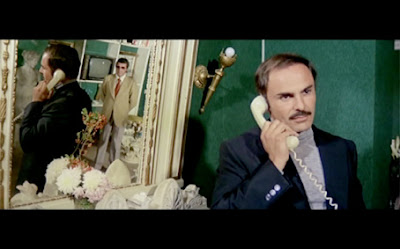
And what about that Riz Ortolani score? Well it’s a real wonderful piece, especially the suave and lush croonery vocal version, but unfortunately the rest is mostly a variation on the theme that returns in various forms. The track Why? is so lush that Lenzi reused it three years later in the movie which may possibly be his best Gialli of them all, Sette orchidee macchiate di rosso (Seven Bloodstained Orchids) 1972. Never the less it’s once again a testament to the great Ortolani who sadly still hasn’t really received the recognition he should be having. Where Morricone still can pack the likes of the Royal Albert Hall in London, UK, I’d happily pay money to see Ortolani conduct a full orchestra playing his great scores.

Even though I say that So Sweet… So Perverse isn’t a Gialli, it is an important movie in the evolution of Lenzi’s filmography that lead up to those great Gialli and Poliziotteschi films he made only a few years later. It’s an entertaining piece, that definitely get’s you involved, even though you may be able to foresee where it’s going at an early stages. And despite the fact that it’s more of a thriller than Giallo it’s still a neat piece of stylish cinema that you should check out if you are into Umberto Lenzi’s great movies.

Image:
2.35:1 Anamorphic

Audio:
Mono – English dialogue presumably lifted from separate source as there still is not a widescreen, English language version officially released yet.

Extras:
None. But instead you get a splendid presentation of the movie, as this is one of those great FanDubs where one enthusiastic genius has taken the audio from one source and used the great widescreen image so that we can all enjoy this film without the shitty cropping that most old video tapes used to present the movies in.

Here's that annoying opening for you, and that grand vocal track by the great Riz Ortolani and Norman Newell featuring J. Vincent Edwards.

Monday, April 19, 2010

The Magnificent Dare Devil


The Magnificent Dare Devil
Original Title: Troppo rischio per un uomo solo
Directed by: Luciano Ercoli
Italy, 1973
Thriller, 110min

I like the films of Luciano Ercoli. I like the ones that he produced, and even more, the ones he directed. I’ve said it before and I’ll say it again, Ercoli only ever directed some eight movies, and produced almost a dozen, and then mysteriously vanished from the industry, of which you can read more here, but I still consider his petite catalogue of work among my favourites of Italian genre cinema.

Unlike many other of his peers, he wasn’t coming off a background as a newspaper critic and neither did he have any family bonds to the industry. Instead Ercoli was a student of Law and was supposedly to be a lawyer. But finding that he grew bored with the world of academia, Ercoli was lucky enough to get a break from a friend of his who worked in the movies.

Stepping into the world of cinema as a production assistant on Primo Zeglio’s Capitan Fantasma (Captain Phantom) 1953, Ercoli found his new passion and progressed rapidly from production assistant to assisting the director, to editing and then finally getting behind it all and setting up as a producer. As a producer he made a few movies with Totò (the Italian
comedian who can easiest be compared to Jacques Tati and who also starred in Lucio Fulci’s first future I Ladri (The Thieves) 1959) before moving into the Spaghetti Western genre where he produced three movies for Duccio Tessari (his two Ringo Westerns, both 1965 and the action thriller Kiss Kiss… Bang Bang 1966). After a couple more Westerns it was time due for Ercoli to move out from behind the desk, roll up his sleeves and take on the part of director.
This is where the string of Gialli movies that I enjoy so much starts with the interesting Le foto proibite di una singora per bene (The Forbidden Photos of a Lady Above Suspicion) 1970. For the rest of his eight movie run all his films would in one way or another use the traits and move within the Poliziotteschi and Gialli genre.

The Magnificent Dare Devil was shot between the Giallo La morte accarezza a mezzanotte (Death Walks at Midnight) 1972 and the gothic horror Il figlio della spolta viva (roughly The Son of the Dead is Alive) 1974 under the pseudonym André Colbert, and just like it’ predecessors uses some of the traits belonging to those genres. Starting out with a great sequence at a Formula 1 track in the UK where even great legends like Jackie Stewart and Emerson Fittipaldi are seen, you would think that there’s a chance that it might be movie that will take place in the high-speed world of Formula 1. But enjoy those fast cars as long as you can, because within ten minutes, after a terrific stock footage crash, the movie takes us away from the track and into a devious web of life on the run, as race car superstar Rudy Patti [Guiliano Gemma who starred in several of the movies Ercoli produced, and was Ringo] is framed for a murder he didn't commit.

Rudi comes away from the pileup without a scratch and makes plans and celebrates with his best friend and mechanic Piero [Ventantino Ventantini – Antonio Margheritti’s Apocalypse domain (Cannibal Apocalypse) 1980, Lucio Fulci’s Paura nella città dei morti viventi (City of the Living Dead) 1980, and Umberto Lenzi’s Cannibal Ferox 1981]. During the party Rudi gets a phone call from his diplomat girlfriend Nina [Nieves Navarro or here Susan Scott] who he later meets at the airport – watch the matching luggage - and they go back to her place in London for a good old romp. The happy couple pass out from their immense lovemaking and when Rudi wakes up again, there’s a full blown party going on. Uncomfortable with the situation, he tries to leave, but Nina convinces him to stay and have a drink… An unfortunate choice as the drink is laced by a menacing bloke and handed on to Rudi, needless to say e rapidly becomes profoundly intoxicated and leaves the party. Unable to drive his car that he earlier left outside Nina's flat – in a no parking zone – he’s given a ride home by flamboyant homosexual Donald [Giancarlo Zanetti] in his pink VW. With no memory of last night Rudi steps outside to fetch his yellow suitcase from the back of his car, but the car is missing and when he goes up to the nearby police officer to report his car as stolen, he’s nicked and stuffed in the back of a police car… arrested for a murder he has no recollection of committing!

There are several subplots that play throughout the movie, one is the murder and then there’s the missing suitcase. Rudi is the prime suspect for the murder, and all evidence points right at him. At the same time he is convinced that if he only finds his yellow suitcase – the one identical to Nina’s, he can prove his innocence. But as there was an obvious mix up with the suitcases at the airport, there are also two rival organisations searching for the suitcase – as they are certain that it contains a large shipment of heroin – Nina’s been a naughty girl, using her diplomatic immunity for smuggling. So as Rudi – who’s assisted in his dramatic escape from jail by one of the two organisations without knowing which one, it’s all part of yet another subplot – who and why – is not only trying to prove his innocence and stay one step ahead of the police who are searching for him, he also has to stay way ahead of the two rivals that are trying their damndest to lay their hands on him and that missing suit case.

The two fractions, one run by insurance magnate Brauner [Michael Forrest – who dubbed loads of classic Italian pieces, and has for the last fifteen years been doing loads of video game and anime voice work] and Mitridates [Mario Erpichini – from Umberto Lenzi’s Spasmo 1974 and Enzo G. Castellari’s La polizia incrimina la legge assolve (The Marseilles Connection) 1973] are all after Rudi’s suitcase as they want the contents, and he’s stuck in the middle trying to clear his name.

The Magnificent Dare Devil may not be a Gialli or a pure Poliziotteschi even though Inspector Forrest [Carlo Gentil, another Ercoli regular] does his best to play a tough cop, but it does have a script by the great Ernesto Gastaldi who worked with Ercoli on The Forbidden Photos of a Lady Above Suspicion and La morte cammina con I tacchi alti (Death Walks on High Heels) 1971. And that script is a damned fine piece of work. The movie moves fast, has a fair amount of action laden fight sequences, plenty of car chases that ended up entitling stunt co-ordinator Rèmy Julienne with his own credit in the opening titles. Julienne is that legendary stunt man who has worked on everything from Lucio Fulci’s action comedy Operazione San Pietro 1967, Alberto De Martino’s Blazing Magnum 1976 to John Glen’s A View to a Kill 1985 (remember that stunt with the Renault, the one that gets stuck in the tree… that’s him), John Woo’s Once a Thief 1991, and Ron Howard's The Da Vinci Code 2006.

Gastaldi’s script – written together with Ercoli - is pretty logic and nothing really sticks out as a quick fix to move things into a new direction, which some Gialli tend to do. Instead we find an intriguing plot to keep you interested in how Rudi is going to get out of the mess he finds himself treading deeper and deeper into. I mentioned earlier that most of Ercoli’s films use Gialli or Poliziotteschi traits. I choose to see those three Gialli as his learning the ropes and keeping what he liked from them. It’s easy to see Rudi as the amateur detective, the prime suspect attempting to clear his name and catch the real culprits of the piece as he works his way through he narrative. His mate Piero is an obvious comic relief, not that the movie needs it, and you never know until the last moment who the killer really is.

The worst thing with The Magnificent Dare Devil is the soundtrack, as there are really only a few tracks used throughout the entire movie. Giampaolo Chiti only ever scored three movies, and it’s painfully obvious as the same melodies keep returning over and over again. But never the less, The Magnificent Dare Devil is a pleasant little action thriller that get’s the job done, has some suspenseful moments, never feels like a waste of time, packs a good mystery tone, delivers a few good laughs.


Image:
Widescreen 16:9

Audio:
Stereo 2.0

If you feel an urge to see it, you can get it from The Giallo Goblin!

Monday, February 22, 2010

The Cynic, the Rat and the Fist


The Cynic, the Rat and the Fist
Original Title: Il cinico, I’infame, il violento
Directed by: Umberto Lenzi
Italy, 1977
Poliziotteschi, 100min
Distributed by: Alpha Digital


Of all the genre’s that Umberto Lenzi tried his directing skills in, I feel that the Poliziotteschi flicks are among his finest. Obviously there are several brilliant entries of his to be found on the other sphere’s – Cannibal Ferox 1981, Nightmare City 1980, The Oasis of Fear 1971, Seven Bloodstained Orchids 1972 and Eyeball 1975 to name a few, but it’s the Poliziotteschi that I find myself returning to and rediscovering with a new passion that wasn’t there the first time around. The Tomas Milian pieces, like Almost Human 1974, Rome; Armed to the Teeth 1976 and The Rat the Cynic and the Fist, stand out and have against all odds stood up to the tests of time.


The Cynic, the Rat and the Fist is a fantastic piece of Italian genre cinema where the title possibly refers to Sergio Leone’s splendid spaghetti western The Good, The Bad and The Ugly 1966 and saying that, there’s more to the movie than just a cryptic title. Maurizio Merli is obvious the Fist as he slugs his way through the antagonists of the film, then there’s Tomas Milian in one of his finest performances ever, as Luigi “the Chinaman” Maietto, without a doubt the cynic of the piece, leaving John Saxon as the rat, or rather the Infamous as the original titles call him. Some stuff just get’s lost in translation doesn’t it.

Performances are tight, and well acted, Merli is great in this sequel to Lenzi’s previous piece Rome: Armed to the Teeth, which also sees Merli in the role of Inspector Tanzi. But the movie definitely belongs to Tomas Milian in a performance that out shines both Merli and Saxon by yards. He owns this piece with his sneering, sinister criminal who just oozes cynicism towards the law officials, the mob Boss Frank Di Maggio and even towards his once cohorts that he eliminates on his struggle towards the top of the food chain.


As usual, here’s a quick fix on the movie to remind you, or wake your interest for the film: Leonardo Tanzi, once Rome’s most feared police inspector has handed in his badge and now works as an editor of murder mystery novellas. (Watch the scene closely and you’ll see that its Gialli books he’s working with) When he learns that upcoming criminal Luigi “The Chinaman” Maietto has been released from the pen, he’s not so surprised to find his own obituary waiting for him under his door when he returns home. Shortly there after Maietto’s hit men make their entry [Bruno Corazzari and Claudio Undari], and after taking a few shots at Tanzi, they leave him for dead. Once a cop, always a cop is the pathos that Tanzi lives by, and after his former boss, Commissioner Astalli [Renzo Palmer] forces him into hiding so that they can lure the guilty by claiming that the legendary Tanzi is dead, Tanzi becomes a one man vigilante working outside the law. Obviously Tanzi doesn’t hide from anyone, and pretty soon he gets himself involved in rescuing a colleagues young sister from the hands of a pornographer who keeps his models/prostitutes on a strict diet of smack. (Bo A. Vibenius Thriller - A Cruel Picture anyone?) Herein also lies the connection to Maietto.

Trying his damndest to move in on American mobster Frank Di Maggio’s [Saxon] turf, Maietto is pushing the good old “Protection” racket, which obviously clashes with Di Maggio’s interests and Tanzi’s morale values. Slowly but surely the three opposing parts twist and grind their way through a grid of double crossing, enforcing violence, cunning heists and sadistic actions towards a climax, a climax that comes with a splendid blaze of glory as the three leads finally stand face to face.

What I feel makes this piece quite entertaining is that there are so many rifts and conflicts on both sides of the law. There are the conflicts on the criminal side, Di Maggio vs. the newcomer Maietto, and there’s certain tension between Tanzi and commissioner Astalli, which gives a deeper dimension to both the characters and the narrative. It’s an amazingly entertaining ride which I already said stands out among both the genre and Lenzi’s work.

Along the way there’s some great supporting cast performances by Bruno Corazzari, Claudio Undari, and the man who is almost everything worth watching Fulcio Mingozzi makes yet another short appearance. It’s a pretty male dominated movie, as nearly no women hold any specific role in the plot, other than scared victims for Merli to rescue and save, although Gabriella Lepori does have a bit of importance as she brings the narrative to an important junction, and connects the pornographer’s mischief to the racket Maietto has going.

Now there’s no way to discuss this movie without mentioning the great Ernesto Gastaldi. Ernesto Gastaldi’s name in the screenwriting credits is enough to make me want to watch the movie. If you are a regular reader, you will now that I can rant on about on his resume – Bitto Albertini’s Human Cobras 1971 and all those great Sergio Martino, Luciano Ercoli and Lenzi movies to name a few names - and there’s no doubt that Gastaldi is among the greatest of the Italian screenwriters. He frequently manages to bring depth, and complexity to the characters that so usually are mere generic personality. Just take a look at what he did to Maurizio Merli’s character police detective Leonardo Tanzi in the two movies of that series. In the second of the films, The Cynic, the Rat and the Fist, he injures the lead character, Tanzi, early on in the movie only to have him rubbing his sore wound over and over again. It also works as an instrument to give the character some personality and bring him down to a human level. He is vulnerable, but still doesn’t back down from busting up a few criminals despite his injuries, even if his actions make him sore. It’s something that action hero’s seldom consider as they move from one scene of severe damage to full fledged ass kicking without any side effects in the next scene. If you pay attention to the names of the writers in the opening titles, you will also spot Dardano Sachetti among the writers. With movies like Dario Argento’s Cat o’ Nine Tails 1971, Mario Bava’s A Bay of Blood 1971, almost everyone of Lucio Fulci’s classics, Murder to the Tune of Seven Black Notes 1977, Zombie 1979, City of the Living Dead 1980 and the others, Antonio Margheriti’s Cannibal Apocalypse 1980 and many many more, it’s no understatement that Sachetti is quite possibly the greatest of them all, and with the two giants of Italian screenwriting working off a Sauro Scavolini story, on the same movie, there’s no more reason to hesitate about this one. The Cynic, the Rat and the Fist is a must see movie with an excellent script, great actors, and a terrific entry into the Poliziotteschi genre.

Franco Micalizzi’s score is excellent, and holds some strong reminders of Stelvio Cipriani’s scores for movies within the genre, although with Micalizzi’s unique fully orchestrated funk jazz umph to it. For some strange reason the Soundtrack is available under the name Violence… Once again Eugenio Alabiso’s editing is tight and ferocious, adding to the rapid pacing of the scenes, and thanks to the widescreen presentation that I recall wasn’t there in the previous vhs version I used to have of this magnificent movie, Federico Zanni’s excellent cinematography come to it’s right. Certain scenes could actually be lifted from this movie to show cinematography students the power of composition and value added to a scene by simple effects as framing the shot in the right way.

The Cynic, the Rat and the Fist is a definitive statement to the craftsmanship of Umberto Lenzi, a guy who easily get’s lost as a second rate director among the many cheesier of his movies, especially the later ones, but this one is a gem and proves that Lenzi really had the knack for putting forth tight action movies that still work perfectly to this day.


Image:
Widescreen 16:9

Audio:
Dolby Digital Mono, English Dubbed version, which will give you a few laughs with the voice Saxon has been given.

Extras:
Nothing special, just the original theatrical trailer.

Disney Star Wars and the Kiss of Life Trope... (Spoilers!)

Here’s a first… a Star Wars post here.  So, really should be doing something much more important, but whist watching my daily dose of t...