Wednesday, June 16, 2010

Demons Of The Night Gather To See Black Widow


Demons Of The Night Gather To See Black Widow
Directed by: Michael Leckebusch
Germany, 1970
Music, Occult interests
Distributed by: Mystic Records


Finally I put my hands, eyes and ears on the DVD release of the black magic show that once was part of one of my long-time favourite bands; Black Widow. A fantastic progressive, early hard rock band consisting of a bunch of theatrical young men who released a few albums before being dropped by there label, CBS, and slowly fading away before the middle of the seventies… and you know me and underdogs… I love ‘em!

Black Widow are a superb old British band from Leicester that quickly earned a reputation in the early seventies for their debut album Sacrifice 1970, which was filled with references to the occult, Satan, Astaroth and other fiendish beings. But they where also notable for their theatrical live performances that incorporated a fully authentic black magic ritual complete with mock sacrifice of naked maiden. A live show that was composed with the help of English occultists Alex Sanders and his wife Maxine. But obviously they where stopped in their tracks by the powers of bureaucracy, and after their debut single “Come to the Sabbat” was tipped to go to the top of the charts the BBC placed a ban on the group so that the kids of Great Britain wouldn’t be smitten by the powers of black magic. Shows where also picketed and hassled by clergymen shaking crucifixes and crying out warnings the youth of the dangers of witchcraft, and the tabloids went wild in their hunt for sensationalism!
Unfortunately the album only made it to the mid-thirties in the charts and that’s about all the impression that the band ever made in the world of music charts, and following the Sharon Tate /Charles Manson murders, the American tour was cancelled when US authorities decided that it was way to dangerous to let a band take stage and promote black magic… another band that also released it’s debut album in the same time got the slots instead as there management promised that their band wouldn’t promote the dark forces... Tony, Geezer, Bill and Ozzy.

Needless to say Black Widow where commonly confused by that other brilliant band of the time – Black Sabbath, but where Black Sabbath’s occultism was merely a marketing gimmick of their record labels art department, Black Widow where into it for real.

In all honesty it’s only that first album that appeals to me, as it very much indeed is one of the first concept albums in music history. Fuck The Who and their Tommy album, because even though Black Widow released the fabulous Sacrifice in 1970, they had already recorded a version of the album early 1969 with Kay Garret who used share lead vocal duties with Kip Trevor before she left the band (that where calling themselves Pesky Gee! at the time). The lads continued on under the name Black Widow and released one of my all time top ten favourite albums. A definitive early progressive sound sometimes bordering on that early heavy rock that later would be defined by Led Zeppelin and Black Sabbath.

But now, there’s a DVD of a one off German TV performance, one that has been missing for decades, one that documented Black Widow live, one final performance as the band abandoned the black magic antics shortly afterwards and headed in other directions. Thanks to flute and Sax player and songwriter Clive Jones who has been hard at work to keep the legend of Black Widow alive these past forty years, he set out on a mission to find the recordings that where made of the show. Finally contact was made with Birte Zywko who once worked for Beat Club – famous German TV show created by Gerhard Augustin and Mike Leckebusch in 1965 the first of it kind on German telly, and would feature acts like The Rolling Stones, Arthur Brown, Alice Cooper, T-Rex, The Doors, Zeppelin and Black Sabbath – you get it, anyone that was anything. It later evolved into Musikladen and if you ever have watched a vintage live studio performance that wasn’t The Old Grey Whistle Test, I’ll assure you it was one of these two shows. Anyhow, Zywko told Jones that they had found a print of their gig, but it was in terrible state. So the time consuming process of re-mastering the performance was put into action, and some while later Jones could sit down to see the band perform that infamous show…only to discover that they actually performed the full set, the Sacrifice album in it’s entirety, the full show with all the chanting, the summoning and the ritualistic sacrifice of a naked woman in the part of Astaroth, instead of the one "hit" that Jones thought they performed... Wunderbar, as the krauts say!
So if you are up for some great, old satanic progressive rock live performance which at times feels like watching one of those old Video Search of Miami releases of Jean Rollin’s movies with a soundtrack by a trippy mix of Goblin, Black Sabbath and Jethro Tull - then get yourself over to Mystic Records and buy this show now. Oh and the DVD package – titled MYS666 – also comes with a CD of the performance.


Image:

Fullscreen 4:3

Audio:
Dolby Digital 2.0

Extras:
Booklet about Black Widow and the live performance, written by Clive Jones.

Here's a little teaser for you... now go get it.

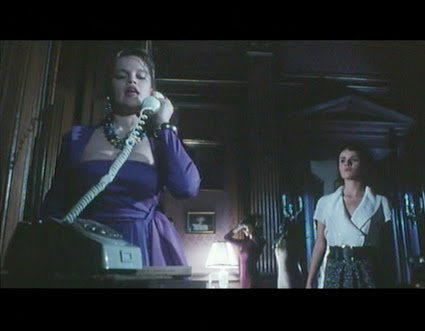
Monday, June 14, 2010

The Washing Machine


The Washing Machine
Original Title: Vortice Mortale
Directed by: Ruggero Deodato
Italy /France / Hungary, 1993
Thriller / Drama, 87 min
Distributed by: EVS Entertainment


Years ago when I was working in an underground video store that stocked, supplied and distributed uncut import tapes of great genre pieces, I once read a synopsis that said that this movie was all about a haunted washing machine. Obviously I tossed it to one side and decided that Deodato had lost it completely – how could the man responsible for such beautiful and grim masterpieces have sunk so low to make a movie about a haunted washing machine?

Fifteen years later I can laugh at my naive arrogance and actually enjoy this movie for what it is and finally get over that faulty synopsis that made me stay away from this piece for a decade and a half.
Inspector Alexander Stacev [Philippe Caroit] finds himself in an unnerving and disturbing place when he arrives at an apartment housing the three Kolba sisters; the eldest, Vida [Katarzyna Figura – a polish actress who almost made a lead part in Robert Altman’s The Player 1992 - lost it to Greta Scaachi, but later starred in his Prêt-à-Porter 1994 and Roman Polanski’s The Pianist 2002], middle sister Ludmilla [Barbra Ricci] and little sister Maria [Ilaria Borrelli].
The three women have a complex tale that they tell about businessman Yuri Petkov [Yorgo Voyagis – also seen in Ugo Liberatore’s Nero Venazio (Damned in Venice) 1978 and the Augusto Caminitio directed Klaus Kinski oddity Nosferatu a Venezia (Nosferatu in Venice) 1988] who is supposedly Vida’s boyfriend but has gone mysteriously missing. Drunken Ludmilla claims to have found his body chopped up and stuffed in the washing machine – hence the English title – but the police find no obvious evidence and more or less laugh at the women who apparently have no case for the cops to get involved in. But there’s obviously something more going on than is being told here, as the sisters start to lure Alexander into a complex web of mystery, seduction and treachery. One by one they approach him with strange tales of what happened that night, and even though he’s resistant at first he can’t help himself from being drawn in as they one by one seduce him.

At the same time Alexander’s assistant Nicolai [Laurence Regnier in his only ever screen credit] starts picking up Intel that leads back to the missing Yuro Petkov. A suitcase filled with jewellery and cash is obtained during a heroin bust, there are indications that Petkov was involved in counterfeit rackets and other dodgy business. And it also becomes apparent that Petkov had insatiable lusts for all three of the Kolba sisters which further complicates the possible murder case, as it could have been any one of them that might have killed Petkov him… if he’s dead that is, because there’s still no body found. Stacev get’s drawn into their web of deception as he tries to figure out what actually happened to Petkov and at the same time tries to keep a professional distance to the three women constantly trying to seduce him, although that barrier is breaking down for each encounter he has with them…

I feel that many of the Italian post Giallo movies - not all, but many – that came in the late eighties, early nineties had lost the flamboyant style and image system of the great Gialli period. Instead they had become diluted messes that depended more on cheap shots of nudity, poor effects and piss poor scripts rather than using the traits as beneficial characteristics to the narrative. It’s almost as if they couldn’t’ really get over the Giallo genre being dead, and just fused it with all the wrong things, instead of being arty and lustful pieces they became silly and sleazy in all the wrong way flicks. Although some directors took did step away from the Gialli traits and go for the good old classic thriller that once inspired the Giallo instead, and in that move they took all the seasoning that is associated with Italian genre cinema with them. Ruggero Deodato’s The Washing Machine is one of those movies and instead of trying to be a wishy washy post Giallo flick, it goes right into the thriller genre and gives it a decent Italian make over.
It’s fairly obvious that what we are dealing with here is a very Italianized take on Paul Verhoeven’s Basic Instinct 1992. But where that movie only had one antagonist and that one scene that made it infamous, Deodato’s The Washing Machine triples the raunchiness and chucks in three insatiable and seductive female antagonists instead. It would be easy to say that the women here are objectified and only seen as male fetishes for our voyeuristic obsessions, but that would be wrong, as this movie is indeed about strong, powerful women who all share a common goal – to open their own burlesque club. And you can’t criticize a movie that tells a tale of strong, determined women for being chauvinistic and sexist can you!

The Washing Machine surprises me, because it’s a lot better than I imagined it to be. Compared to the likes of the exceptionally poor Phantom of Death 1988 it’s easily one of Deodato’s better later works. It catches my interest with its enigmatic story and it’s who dunnit narrative. And this is exactly how flashbacks should be used, as part of the puzzle, for with each flashback we are given further clues to who and why, even in the red herring flashbacks that deliberately throw us of course.

Script wise it’s a decent little piece that Luigi Spagnol put together. Spagnol had previously worked with Aldo Lado on Rito d’amore (Love Rituals) 1989, and after a brief presentation of characters there’s a natural interest to see where this movie will go. And the age old question Who Dunnit? is still posed. Even though Deodato himself may not be very fond of the movie and find it one of his weakest pieces – mainly due to weak actor performances and a rushed production, I rather enjoyed it, and sure there are some pretty awful acting moments, but overall it’s all good and there’s no feeling of it being rushed at all.

I only have one major question with the movie, and that’s whatever happened to the Irina [Claudia Pozzi] character? She has that shock reveal, threatens to take her life and then vanishes from the movie with Alexander’s gun... It leaves some questions that never really get answered, but at the same time it works as an effective tool to show the arc of Alexander’s character, and prepares his final descent as the ending moves in. A cynical ending that sees him walking away from the positive values through degeneration to negative values.

Being a co-production between the Italian ESSE. CI Cinematographica, French EuroGroup Film and Hungarian Focus Film; the choice of shooting the movie in Budapest was a wise decision as the location brings an automatic, cold, dark Gothic aura to the piece. There’s a few beautiful shots of authentic Budapest locations, like an outdoor baths, and the bridges. And I love the wide shots of the huge stairwell where Vida handcuffs Alexander to the railing before forcing herself upon him. There’s quite fair amount of somewhat Argentoesque visuals throughout the flick. High angles looking down on the action, which give an enhancement to the voyeurism subplot. For what it’s worth Sergio D’Offizi’s cinematography is certainly some splendid work, and the movie does look really good. There’s a lot of shadows and depth to the compositions which surprisingly, or rather not as D'Offizi usually delivers some excellent cinematography, but in the context that this is commonly referred to as a bad movie, look absolutely superb.


There’s a great use of suggestive subplots running through the movie, such as the S&M theme – which could have been explored further, especially after the one major reveal that Alex shoves in the face of his long-time girlfriend Irina. As she’s devastated by his confession of having affairs with all three of the Kolba sisters, he opens up his closet and exposes a large collection of whips, spank panels and other S&M attire. She obviously freaks and takes off, but then it’s never discussed again. But this is how subplots work, and it’s also a possible key to why Alexander falls for the sister’s fiendish erotic game. He’s obvious into the kinky shit, and when they one by one more or less dominate him, he falls hard. Vida dominates him, Ludmilla throws herself at him repeatedly – which he sees no real challenge in, and Maria seduces him and taunts him until he almost cut’s all bonds with his former career to be with her. This leads up to the series of sudden twists at the end of the movie, and his underlying sexual preferences may possibly be what finally becomes his downfall.

Claudio Simonetti’s score is brilliant. It’s very much in the vein of his previous – and later – electronic scores. It definitely brings a very Italian aura to the movie, which I’m convinced helps it along. Because the soundtracks to these movies are terribly important, and there’s something that is significant of the time period, but still not as determined as say the periodic hard rock that many others went with at the same time. Instead the rather powerful and potent score that brings some of the Goblin magic with it to the movie enhances the overall Italian atmosphere that this movie holds.

Then there’s that piss poor and deceptive English title, The Washing Machine. What moron decided to call it The Washing Machine? Wouldn’t a straight translation of the original title Vortice Mortale have been better, wouldn’t Deadly Vortex have worked just fine? Sure there may be some line of thought that the cryptic title The Washing Machine was suggesting some metaphorical and symbolical innuendo like many of the classic Gialli did with their titles, but I still feel that it’s a piss poor title and Deadly Vortex would have been a much better choice.

The Washing Machine was the last feature that Ruggero Deodato directed before returning to the world of Television. It’s a decent last flick, as it’s quite entertaining, it’s got a good enough and engaging story, a fair amount of nudity and eroticism and a little nod at Deodato's previous cannibal themed movies, which make it a great entry into the late thriller – post Gialli catalogue. The latest feature project that he Deodato's been connected to officially these past years is Cannibals, a loose sequel to the 1980 masterpiece. But this is also a movie that’s been proposed for half a decade without any major progress, so only time will tell if Deodato will succeed in presenting us with yet another fascinating piece of Italian genre cinema.

Image:
Widescreen

Audio:
Dolby Digital 5.1, English dialogue or Thai dubbing, optional Thai subtitles.

Extras:

Trailer.

Here's the opening titles and Simonetti's score.

Friday, June 11, 2010

Samurai Princess


Samurai Princess
Original Title: Samurai purinsesu: Gedô-hime
Directed by: Kengo Kaji
Japan, 2009
Splatter/Chanbara/Sci-Fi, 82min
Distributed by: Njuta Films

...and on the topic of splatter movies, there’s no hesitation at mind when I say that the Japanese are rightfully making an impressive claim to the throne of innovative splatter flick makers. Some of the stuff that is coming out in Japan and finding it’s way across the ocean thanks to enthusiastic distributors is absolutely fabulous. It certainly does ooze with that same aura of a over energetic kid jumping up and down waving it’s hand, screaming look at me, look at me, and they certainly are fun.
Being a fan of both Higuchinsky’s amazing Uzumaki 2000 and Yoshihiro Nishimura’s Tokyo Gore Police 2008 – which both saw Kengo Kaji involved with their writing process, I obviously was curious of what he would have come up for his first theatrical feature with when I initially heard of Samurai Princess. Also the fact that he was teaming up with Nishimura again, this time with Nishimura producing and supervising the special effects obviously saturated the movie with a certain attraction.

In a quick fix let’s say that the movie is all about a young woman - the only survivor after bandits rape and murder twelve schoolgirls - get’s the chance to be reborn as a Cyborg and take revenge on the band of killers. And that’s the starting point for a violent and entropic journey that will leave a river of mutilated corpses and rivers of blood in its trail.

What at first may seem like a pretty shallow and simple story is somewhat evolved take and ironic gaze upon the age-old legend of Frankenstein. You can’t play God and create life without paying the ultimate price. It’s when the realisation that the person giving Samurai Princess [AV starlet Aino Kishi] her chance to avenge her friends – even if it is reanimated as Cyborg with a stern operative programme – the enigmatic scientist Insanity, is at the same time responsible for unleashing the gang of foul murderers roaming the lands that the ironic twist becomes apparent. And in the quest to take out the people responsible for murdering and raping her eleven friends, the path leads right up to Insanity.

Samurai Princess may be pretty low on story and packed with glorious ultra violence, but at some point I feel that these movies in many ways are linked to those great movies that spawned that brilliant series of female avenger movies. Movies like Shunya Itô’s Female Convict movies [1972-1973] and Toshiya Fujita’s Lady Snowblood [1973-1974] films starring Meiko Kaji and obviously come to mind. Nothing is as empathetic as a gorgeous young woman out for vengeance. And taking the best of Japanese cinema I find the mix of old style feudal Chanbara and modern cyberpunk sci-fi to work like a charm.

There’s also an aura of Edogawa Rampo seeping throughout the movie – everyone is disfigured in one way or another, not to mention modified to their Cyborg states which are almost never the beautiful glossy Cyborg that we are used to, but slimy, grotesque and disfigured modifications – which definitely brings a Ero guro style to the movie.

God knows that mixing genre’s sometimes can go terribly wrong, but in Samurai Princess it works pretty well, and it’s a pretty interesting approach to set futuristic cyberpunk elements inside an obvious feudal state complete with Shogunate laws and Buddhist philosophy. In a way it is reminiscent of some of the more innovative scenes from Takashi Miike’s misunderstood IZO 2004, or may very well be looked upon as a wild mix of Ridley Scott’s Blade Runner 1982, Yukio Noda’s phenomenal Zeroka no onna: Akai wappa (Zero Woman: Red Handcuffs) 1974, and Ryûhei Kitamura’s breakthrough Versus 2000. And you can’t get into this movie without thinking of Tetsuro Takeuchi’s Wild Zero 2000 as Samurai Princess partner on the journey, Moonray [Dai Mizuno] has a very interesting weapon of choice, an electric guitar that can summon up whirlwinds of lethal riffs.

So yeah, it’s not a movie made to impress with it’s immaculate screenwriting or fascinating plot if that’s what you are after, but then you shouldn’t be on this blog either, but in the library reading some book without illustrations that discusses the theoretical aspects of off-screen framing in the works of Yasujiro Ozu. Which is a fascinating discussion in it's own right, but not something that’s going to be taking place here any day soon. Instead what you get is almost an hour and a half of hilarious in-your-face gore fest that takes the ball and runs with it.

Samurai Princess may have some technical flaws – I can never really get used to movies shot on Digital Video as I’ll always be a sucker for the old grain of celluloid, but then again it does give the filmmakers unlimited possibilities to fuck around with digital effects in post even when restrained by a tight budget. And that’s exactly what Kengo Kaji and Yoshihiro Nishimura have done with Samurai Princess, you get used to the crispy video look, the effects sweep you away and the magic of moviemaking is simply fantastic. Mixing prosthetics with CG is fine by me if it’s done in the right way. Breast Missiles, Chainsaw legs, scissor feet, fountains of blood, entail Kusari-gama, screwed up mutants you name it and you get it.

Certainly in the same style of Tokyo Gore Police or even Noburo Iguchi's Kataude mashin gâru (The Machine Girl), Samurai Princess gets the job done. It’s a blast of a little movie, and to top things off Kaji makes the most of his adult video star Aino Kishi and works some nudity into the movie by letting her have a little erotic fantasy about Moonbeam in a scene that should have earned the movie the under title Do Androids Dream of Naked Action Heroes.

All hail Japanese Extreme Cinema as these guys are rushing ahead when it comes to taking classic narratives and using them in a new inventive fashion. Long live the new blood!


Image:
1.85:5 Anamorphic Widescreen.

Audio:
Dolby Digital 5.1, Japanese audio, Swedish, Norwegian, Danish and Finnish Subtitles are optional.

Extras:
Original Trailer, a twenty minute Making of featurette and trailers for other movies released by Njuta Films.


Kengo Kaji’s Samurai Princess hits the Scandinavian DVD shelves at the end of June thanks to the enthusiastic boys and girls at Njuta Films.

Intruder


Intruder
Directed by: Scott Spiegel
Horror, 1989
USA, 88min
Distributed by: Njuta Films

Nostalgia is a pretty powerful word. The correct sense it’s meaning is : Nostalghia: 1. Sentimental yearning for the past. 2. Homesickness [from the Greek nostos – return home + algos pain]

There is unavoidably a certain amount of nostalgia connected to certain movies – such as the old school splatter movies – movies like Dawn of the Dead 1978, Evil Dead 1981, Evil Dead2 1987, Re-animator 198, From Beyond 1986, Hellraiser 1987, Day of the Dead 1985, Maniac 1980, Bad Taste 1987, and many more. There's a reason why it's referred to as the golden age isn't there... These movies punched the collective horror audience hard in the face, rammed it’s fist down our throats and pulled our guts out of our mouths. These movies showcased devastating scenes of death and carnage in the most realistic and blood drenched fashion unlike anything that we had seen before. Gone where the cheesy but ever so atmospherically haunted house with their moonlit cobwebs swaying in the wind, and instead there was a blood lust so ferocious that audiences where shocked into submission and addiction…

…an addiction that never really went away.

Those movies take me back to the days of competing with mates for who could come up with the most violent, shocking and provoking titles, and watching them in a pack like animals squatted in my first apartment that I shared with a mate from school. There was something extremely potent with that milieu, gathered round that 14”TV. There were no widescreen; surround sound bollocks back then, and no desire for crystal clear BluRay prints. It was all about freaking each other out and tormenting the crap out of who ever flinched during the exposition of hardcore violence on screen. What once was a form of initiation rite is now a secure source of escapism. A chance to unplug the responsibilities of being an adult and kick back to a goofy shock fest and hopefully evoke a few scares, gasps or laughs.

One of the movies I saw during this time was Scott Spiegel’s Intruder. A movie that by reputation made it seem like the Citizen Kane 1941 of splatter flicks, a movie that supposedly had such startling special effects that it would blow your mind. Well that was pretty much the same reputation that all these flicks had before the play button was finally hit and the show got on the road. And the last movie seen was pretty much always the Citizen Kane of splatter flicks and had the most mind-blowing special effects.

Intruder does have a couple of really far out effects and it is a prety generic splatter movie, , but in later years I’ve begun to look at Intruder as the tragic story of the underdog director and the successful producer... a story that proves that Hollywood is a bastard to conquer even if you have some great stories to tell.

For some reason director Scott Spiegel, just can’t get a break. He’s still waiting for that one project that will bust the frame and launch his career into the major league. It’s odd that it hasn’t yet happened as he has been surrounded with big time genre names since he was a young man. He went to school with Sam Raimi, with whom he later shared a flat. In the same flat there was also the Coen brothers, actresses Kathy Bates, Frances McDormand and Holly Hunter. Spiegel’s been active in the movie making business since the early eighties, both as director, screenwriter, producer and actor but still has that big break to come. But that doesn’t mean that he’s not a familiar name to fans of hardened horror, he wrote the screenplay to Sam Raimi’s Evil Dead 2 1987 – which storytelling guru Robert McKee calls the greatest horror movie of all time – he wrote and directed Intruder - which any self respecting fan of horror has seen at least twice, he served as executive producer on both of Eli Roth’s successful Hostel films, but compared to his buddies in the same sphere he still has a far way to go. He’s a classic underdog struggling for recognition.

Now place that next to the producer and co-writer on Intruder, the young Laurence Bender... does the name sound familiar? Well after working as a grip on a few episodes of Tales from the Darkside, Bender tried his skills at producing, and what better than the movie that he and mate Spiegel had written - Night Crew. The movie was later renamed Intruder to ease into the same mould of titles that many of the movies in that niche had gone before. Just three years later Bender would produce a movie for a young energetic director that Spiegel had introduced Bender to at one point in time, and this was of course Quentin Tarantino. The movie Reservoir Dogs 1992, and Tarantino and Bender quickly became the leading names in contemporary American movie making. Bender has since produced every single one of Tarantino’s flicks except Death Proof 2007 – which many claim to be the weakest of Q.T.’s flicks.

Intruder is a splendid example of the golden age of splatter film. Very low on story – but high on cliché’, shock tactics and excellent old school special effects supplied by Robert Kurtzman, Howard Berger and Greg Nicotero, who have done the effects on almost every American movie that made you go Whoa! in the last three decades. And it’s Nicotero who’s in charge of the effects in what is my most anticipated serial this year – Frank Darabont’s adaptation of Robert Kirkman’s brilliant The Walking Dead. Anyways, Intruder tells the tale of a bunch of kids who all work at a Walnut Lake Market where an initial confrontation between Jennifer [Elisabeth Cox] and her ex. Craig [David Byrnes] who turns up and threatens her sets a threatening tone that will seep through the rest of the movie. They throw Craig out of the store and as they are shut inside the store waiting for the squad car promised to arrive, managers Bill [Dan Hicks – Jake in Evil Dead 2] and Danny [Eugene Robert Glazer] ask them all to stay behind and down mark all the goods in the store as they have decided to sell the shop. The kids all moan and mope, but soon get to work – Renée Estevez (sister of Charlie Sheen and Emilio Estevez and later a regular on West Wing), Sam and Ted Raimi amongst them, and also cameo’s by Spiegel, Bender and Bruce Campbell – and as they go about their tasks, surprise, surprise there’s a killer amongst them. Going by the book the audience is invited into a simple but entertaining challenge to figure out who the killer is amongst the ensemble as they one by one, meet grim and horrendous fates. It doesn’t have to get any more complicated than that. Set it up, present the gallery of characters, pose a threat start slapping down the red herrings and let the bloodshed begin.

Sure, it takes a while to build up until the shit kicks in, but there’s several effective scares until it get’s going for real, some further establishing of the characters a few gags which definitely show that Spiegel wrote that Evil Dead 2 script as the most of them hold a lot of the three stooges comedy that one associates with Sam Raimi’s movies. There’s several amusing little Argentoesque nods with sometimes corny but in line with the tone of the movie POV’s: inside a shopping cart, from air vents and the keypad of a telephone to name a few which may have been suggested by Spanish cinematographer Fernando Argüelles, or simply as a homage to those great visuals that Argento movies commonly serve up. Like a lot of the grand movies in the sub genre, Intruder also has a brilliant creepy minimalistic electro score that fits like a glove.

Intruder is still a great old school splatter flick. It’s a nostalgic rollercoaster ride, it’s grim, it’s evil, it’s sinister and it’s still a whole lot of gore-drenched fun, which ends with a last shocking twist.

Image:
4:3 Fullscreen

Audio:
Dolby Digital Stereo, English Dialogue. Swedish, Danish, Norwegian and Finnish Subtitles are optional.

Extras:
Twp deleted scenes – or rather two longer versions of two scenes, two trailers, a slideshow and trailers for other releases from Njuta Films.

Tuesday, June 08, 2010

Four Flies on Grey Velvet


Four Flies on Grey Velvet.Original Title: 4 mosche di velluto grigio
Directed by: Dario Argento
Italy/France, 1971
Giallo, 102 min
Distributed by: Mya Communication
It’s been said that Dario Argento used to find inspiration for his moves in the books and newspapers he read. The smallest little article could generate a series of thoughts that would finally develop into a full-fledged movie. This may be true, but the newspaper article that laid the basis for the title of Four Flies on Grey Velvet is even for Gialli standards pretty far fetched, although on the other side modern technology – even if pretty imaginative and fabulous – is sometimes quite important to the Gialli and fills it purpose.
Argento’s third movie; Four Flies on Grey Velvet, is somewhat of a curiosity amongst his works, because it is one of his coldest of his movies, focusing on a more distanced voyeurism and almost holding the audience at arms length and never really letting us get involved with the characters... and when we do it’s for the wrong one.

The third and final instalment of what is loosely referred to as the "Animal Trilogy" sees rock musician Robert Tobias [Michael Brandon who later narrated kid’s show Thomas the Tank Engine for several years] being stalked by an odd character. Roberto has had enough and decides to follow the man instead, and his path leads him into an abandoned theatre. Inside the theatre a struggle takes place and Roberto accidentally stabs the man, who falls dead to the ground. A masked figure sitting upon a balcony [played by co-screenwriter and assistant director Luigi Cozzi] photographs the “accident” and starts torturing Robert by mailing pieces of information about the dead mans identify to him as to show that he knows that Robert is a murderer. Robert's wife Nina [Mimsy Farmer] and his friend Godfrey [Carlo Pedersoli under his more common name Bud Spencer] are the only people who he can trust, so he confides in them. But when the taunting continues and his maid is murdered too, Roberto hires private detective Gianni Arrosio [Jean-Pierre Marielle] to help him solve the case and find the blackmailer… Then the murders start piling up, and a piece of sci-fi technology can take photographs of the last image seen by the latest victim which finally tightens the noose round the neck of the killer.

Four Flies on Grey Velvet is in every possible way an improvement to the previous Il gatto a nove code (The Cat O’Nine Tails) 1971; the fancy camerawork is back, the pacing is back, the narrative flows forth like clockwork, archetypical Argento characters are back more clearly, and there’s a very clear personal involvement in the quest that makes it more engaging than the previous movie.

But there is one thing that makes Four Flies on Grey Velvet such an enigma within the Argento universe – Roberto Tobias. Roberto isn’t much of a likeable protagonist. He’s a pretty shallow and unlikeable guy. He’s not really interested in busting the mystery, only clearing his name, that’s why he refuses to go to the cops. He is also is unfaithful to his gorgeous wife with her cousin Dalia [Francine Racette] in the same instance that she leaves town which definitely harms his character, and pushes his arc down into the negative realm. It’s an odd approach because it also makes it difficult to indentify or sympathise with the leading man – whom the movie after all is supposed to be about. So instead when the killer’s identity is revealed – in one hell of an impressive performance – it’s easier to take sides with that character instead. Which is kinda confusing, but then again if you know the ending, you will understand why I think that this was intentional of Argento. Having finally presented us with an unfortunate character to empathise with, there’s still the shocking ending to pack a final punch, and a shock ending it is.

Being the bookend of the “trilogy” it’s easy to look upon these three movies as the breeding ground for Dario Argento’s traits. Everything that is good with these first movies is what developed the attributes that would build the magnificent stem and style of Profondo Rosso, the unchallenged masterpiece of Dario Argento’s Gialli. It’s even possible that the progressive rock band that Roberto plays in served as an influence after Morricone and Argento fell out with each other and Argento needed to search elsewhere to score Profondo Rosso. As you probably know Profondo Rosso contains that fabulous score by Italian rockers Goblin and doesn’t have a typical classic score like previous Gialli.

Already in the opening title sequence the style of Argento is hurled back upon the viewer as we see the camera being forced into seemingly impossible locations; inside a guitar, on the neck and so on. The opening sequence also sets up the mysterious bloke, Carlo Marosi [Calisto Calisti] who is stalking Roberto and get’s us right into the mood for what is to follow. As soon as the opening titles are through – with that great beating heart image – the plot kicks in. Roberto follows the man stalking him and in a scene prevailing Terror at the opera, the red velvet curtains leading into the womblike orifice that is scene of the initial crime, and the show is on the go. Much like the two previous films, Four Flies on Grey Velvet is all about interpreting what our senses let us experience. In L'uccello dalle piume di cristallo (Bird with the Crystal Plumage) 1970, its all about what Sam Dalmas thought he saw, in The Cat O’Nine Tails it’s all about what Franco Arno thought he heard and in Four Flies on Grey Velvet, it’s all about what Roberto Tobias though he experienced – because you know there’s a twist in there don’t you.


Just like The Cat O’Nine Tails there’s a very limited use of conventional gloved hands and straight razors. Although there is one shot of a razor just before the killer takes to the park to kill Roberto and Nina’s maid Amelia [Marisa Fabbri], and that leads elegantly up to the scene where it starts to become apparent that in Dario Argento’s world it’s never enough with just a simple murder. There has to be some element of squeamishness in there to get under the skin of the audience too. Even though we never actually see Amelia being killed, we do see a shot of her fingers scraping the concrete wall as the nails burst off all over the place, a very nauseating assault on our senses as most of us hate that sound of nails scraping against rough surfaces. When Dahlia later falls victim to the killer, she’s not only murdered, she’s first slashed across the forehead, then pushed down a flight of stairs, the camera follows as her head bangs into each step with a loud bash, bash, bash. Then the knife goes in. There are no simple deaths in Argento’s movies, and it’s a trait that he started using here in these initial movies and stuck with for many of the movies to follow.


And while I’m on that murder of Dalia, I have to point out that this scene is one of my favourite Argento scenes. I love how he used the silence of the attic, the pending threat of the killer being in the house, and then that aggressive burst of audio as the phone rings. It’s a fantastic little scene that easily makes it into the top ten of best suspense and shock moments in Argento’s movies.

Common for the Gialli are, flashbacks or surreal dreams that are significant for the narrative. There are two such devices used in Four Flies on Grey Velvet, the back-story of the murderer which is explored by both visual flashbacks of an asylum and through audio, as we hear a parent scolding a child for not being what he wanted it to be – and when you know, check out the killer’s clothing. Apparently the killer never quite got over the childhood abuse as it still dresses in the clothing of the gender that the parent wanted it too be. Then there’s the metaphoric execution that reoccurs in the dreams of Roberto. It’s both a symbol of his brewing guilt, and a symbolic prediction of things to come. Crime does not pay, and in the case of extremes one can loose ones head.

The cast - well, I don’t really see the similarity between Michael Brandon and Dario Argento that others seem to find, and it takes more than appearance for me to see what the supposed autobiographical connection is. But I do feel that Brandon kind of sells the part and is a pretty decent leading man, even if he’s a pretty boring and passive one. Which obviously leads to the stunning Mimsy Farmer. Farmer has in my opinion never acted or looked better at any other point in time than in Argento’s Four Flies on Grey Velvet. She’s absolutely gorgeous here, and undoubtedly one of my favourite Dario Argento leading ladies. I also find great sympathy for the fascinating character of Gianni Arrosio. I’d completely forgotten all about the constant recurrent gay characters in Argento’s movies until Ninja Dixon pointed this out on his eminent blog a few weeks back, and sure as said, here’s a gay character once again. But this time the character is not as much of a caricature but more of an authentic and effective character, even though he does manage to have a little flirtatious meeting with another gay bloke during his investigation. Arrosi is a fascinating character that has a great character arc, as he, despite never solving a case, is full of optimism and hope. It’s quite a moving scene when he finally succeeds to figure out whom the killer is but doesn’t live long enough to see the rewards of his actions. Ironically dies in a restroom, pumped full of poison distributed by the killer. As he fades away he congratulates himself on solving the mystery. Keep your eyes open for yet another appearance by Fulvio Mingozzi in the movie, this time as a studio engineer.

As for the technical bits of this flick, well needless to say Franco Di Giacomo’s cinematography is certainly up to Argento standards, and the script by Argento, Cozzi and Mario Foglietti is intriguing, although I’m not convinced that the withheld approach to the leading man was the right way to go. Foglietti would later write and direct one of the best parts for Argento’s TV serial La porta sul buio (Door Into Darkness), with the episode La Bambola (The Doll) 1973. For reasons unknown, Ennio Morricone and Argento  had a falling out during the production which may have affected the score. The lead theme is certainly ferocious and groovy, but the rest – and there’s not much – is mainly varaitons on the theme and never really stands out as their earlier collaborations. But it's still a great score, albeit a weaker one, and it is possible that Argento had to make do with what he had been given.

So summing up the “animal” trilogy, it sees the traits of Dario Argento come into shape. The pacing, the symbolism and the visual style are sternly constructed within these three movies. It’s the last of the Morricone soundtracks, although they would work again twenty-five years later on La syndrome di Stendhal (The Stendhal Syndrome) 1996. It certainly is a suite that establishes the style, traits and atmosphere of the classic Dario Argento Giallo, one that soon would peak with the magnificent Profondo Rosso (Deep Red) 1975, but first Argento was to venture into TV serials La porta sul buio and the historic comedy Le cinque giornate (The Five Days) 1973.

Image:
2.35:1 (16x9 anamorphic)

Audio:
Dolby Digital Mono. English dialogue, although Italian in reinserted scenes where English subtitles are available.

Extras:
Alternative English opening and end credits, Original trailers, poster and photo gallery.

Here's a few American trailers...

Disney Star Wars and the Kiss of Life Trope... (Spoilers!)

Here’s a first… a Star Wars post here.  So, really should be doing something much more important, but whist watching my daily dose of t...