Sunday, December 11, 2011

Crazy Desires of a Murderer


Crazy Desires of a Murderer
Original Title: I vizi morbosi di una governante
Directed by: Fillipo Walter Ratti
Italy, 1977
Giallo/Horror, 85min
Distributed by: Redemption Films, (Oop), ZDDVisualMedia

Giallo. I really love Giallo. I also love taking long periods of time where I don’t watch Gialli only to have them make such a larger impact on me when I return to the genre and get that “Oh shit, this is why I really love Gialli!” rush. I guess you could compare it to not smoking for a while, and then returning for that kick the first couple of drags gives you. I love movies that I can’t predict and the Giallo genre is filled with that kind of beautiful movies… not even ones I saw on video half a lifetime ago.

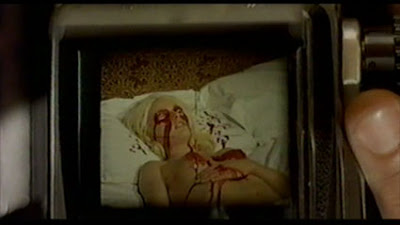
There’s something off kilter in the De Chablais castle. Young jet setter Ileana De Chablais [Isabelle Marchall, also seen in Sergio Pastore’s Sette Scialli Di Setta Gialla (The Crimes of the Cat) 1972 and Luciano Ercoli’s Troppo rischio per un uomo solo (The Magnificent Dare Devil) 1973] brings a bunch of shady types back to the castle for a weekend of party and fun. It’s obvious from the start that some of them have other intentions with the weekend, such as Pier Luigi [Roberto Zattini] who we see co-horting with mobsters he apparently owes money to. Bobby [Gaetano Russo – who’s only starred in some two dozen flicks, but still managed to score a parts in Stelvio Massi’s Cobra Nero (Black Cobra) 1984, Richard Donner’s fantasy classic Ladyhawke 1985, and Bruno Mattei’s second flick L’isola dei morti viventi (Island of the Living Dead) 2008] is a pusher who’s used his suave charm to exploit Ileana’s naiveté and smuggle drugs into the country through the antique vases she’s brought home for her father the Baron. Elsa [Patrizia Gorzi], refuses the invites of her husband Frank [Beppe Colombo – who only starred in a handful of movies but went on to become a successful producer on amongst other things Dario Argento’s La Stendhal Syndrome 1996] after he’s been intimate with Gretel [Adler Gray] and instead ends up bedding Pier Luigi instead… so you get the jest of things, they are not a very sympathetic bunch adding more reasons to suspect them all when the shit hits the fan, which it does so quite soon after the first night of sinful charades. White gloved hands wander the corridor, a knife is pulled forth… soon the knife is bedded into the soft silky stomach of Elsa, as she bleeds to death the killer shifts focus to her eyes. The knife that moments ago sliced trough her gut, sadistically slices out her eyes too!

From here on it’s all fun and games kids, we guess frantically which of the sinister characters can be the killer, and become acquainted with new characters such as inspector [Corrado Gaipa – who you will recognize from shitloads of flicks], family doctor Dr. Olsen, the horny housemaid Bertha [Annie Karole Edel], the house janitor Hans, and the obvious one, Ileana’s weird brother Leandro – who mysteriously enough has something hidden in a box on the shrine he has in his bloody workspace... Several flashbacks point to Leandro, as he’s been strange since he witnessed his mother in several compromising situations when he was a child. The mother – even though only seen in flashbacks and the large looming portrait that hangs in the castle - also acts as a motor for the narrative, as she was supposedly buried with an emerald worth 150 million lire… with the dodgy bunch of characters presented, and the possibility of walking away with a large amount of dosh in hand, the plot can start to unwind.

Surprise twists, unexpected events, background traumas, roofie spiced champagne, double-crossing partners, sultry ladies pouting their way towards fast riches, yes, it all here. The traits that separate the Giallo from the common thriller; there’s a character tampering with taxidermy, there’s saucy ladies and suave dudes who get their kit of if the opportunity is given, a glove bearing psycho wanders the hallways at night, a greed plot focusing on the jewels of the late Baroness, a funky soundtrack and lovely wide-angle shots of lightly dressed women running in poorly lit corridors.
There’s an oddity to be found in the opening attack, which establishes Ileana – one yet another of her trips, and the Baron, and a suggested threat. A pair of bloodied hands roam the corridor, whilst it’s owner stay safe in the off-screen space. The hands wander into the Baron, who gasps and the movie titles – rather crap ones, but at least accompanied by Piero Picconi’s decent score – kick in. A strange opening sequence as the rest of the movie will show that it was all merely one of may red herrings laid out to trick the audience. Picconi’s score in all respect, but there’s more than one scene where I find my mind rushing off to connect the, either blatant rip off, or similar tunes from other movies of the time.

Extreme close-ups on eyes. A trait familiar from the world of Lucio Fulci, who indeed was a master of cutting to reactive images of eyes to create emotions within the audience. Similar shots find their way into Crazy Desires of a Murderer, which is kind of fitting, as there’s a killer who removes eyeballs in the plot.

But despite a lot of common Gialli traits, Crazy Desires of a Murderer choses not to use the familiar one of the amateur detective. Instead we the audience are invited to figure out the mystery from the clues that are given. Well, being a later and lesser Gialli, there’s an obvious lack of vital ingredient that muddles the narrative. There’s nobody to root for, and none of the characters are that sympathetic. Now in almost any other genre this would be a major problem, but within the Gialli it works, especially as a lot of the charm is the who-done-it approach. As long as there’s some murder, some mystery, a cool score and some kinky romps, then I’ll stay with the movie and try to solve what’s going on.

The movie looks every bit the part, cinematographer Gino Santini, gives the movie a treatment that certainly mimics the look and style much like similar, movies of the time. The corridor and cellar scenes are perhaps not originally composed when it comes to the lighting, but the shadow play of figures lurking down in the cellar is splendid.

One area that I find to be lacking is the moments of sexual tension. Gialli needs a healthy dose of tantalizing or seriously perverse sexuality to keep it interesting. It goes with the territory, some movies more than others, but in Crazy Desires of a Murderer, the few moments of sexual activity almost feel forced into the movie and completely random. Even the soundtrack is sloppily pushed aside for something that sounds completely different to the otherwise rather groovy score. Oh, although there is a highly evocative scene concerning Elsa, Pier Luigi, and a candle, that really pushes the envelope of suggestive juxtaposition. Yes, it’s fair to assume that this DVD-R sourced from the old Redemption video release of the movie was a cut one, and most likely heavily exorcised version too as the writer of the script Ambrogio Molteni was on something of a high at the time with screenwriting credits on stuff like Bitto Albertini’s Emanuelle Nera, (Black Emanuelle) 1975 (and you know how that series took off from there on), Mario Gariazzo’s L’ossesa (The Sexorcist) 1974, Bruno Mattei’s Violenza in un carcere femminile (Violence in a Woman’s Prison) 1982 amongst others. Another curious fact concerning Molteni is that he’s commonly listed as the co-director with Jean Josipovici on Delitto allo spechio (Death on the Fourposter) 1964. Information is sparse on what he did to deserve the credit, as he’s only stated as “ American version directed by” on the rare print available. It’s odd, as he never directed another before or after that one. But back to Crazy Desires of a Murderer, the movie certainly works but there’s a feeling that something’s missing with those quick cuts, coitus interrupts and sloppily edited soundtracks, and you don’t have to look far to find a possible solution to that mystery.

Searching the net for information on the movie, I revisited Johan Melle’s excellent euro fever where he reveals that there was more to the movie and exposes images taken from the considerably much more explicit photo novella of the movie. You should check that out for the whole image of what this movie could have been like.

The title of the movie, Crazy Desires of a Murderer, is a decent title, and definitely tap’s into the mood of Gialli names of the period. In many way I’m glad that they decided on something other than a mere translation of the Italian title, as this would have been more of a spoiler perhaps leading the audience to expect a movie more erotically daring than the horror themed violent Gialli… which reminds me again of euro fever’s article and images. Johan will even tell you more about the movies history and reasons for being exorcised into the shape it’s available on bootlegs today. I think it’s time you paid a visit there now.

Try this for a mood reel...

Wednesday, December 07, 2011

Turtle Vision

Turtle Vision
Original Title: Nusumidori Report: Insha!
Dir: Hisayasu Satō
Japan, 1991
Pinku, 62 min
Distributed by: ShinToho (VHS) Oop, (Japan Eiga)

Hisayasu Satō… why isn’t his name more known and out there? I find this to be a real mystery as his movies are powerful stuff, mixing Pinku, drama and thriller traits to create some really captivating stories. Sure, his movies are somewhat hard to find, but they are out there, and you can get a hold of them if you like your movies on the alternative side of the spectrum. Perhaps we need to rally and demand a Satō retrospective, screen his movies and get his name out to a wider audience... because they are missing out on something.

Turtle Vision, the name that Satō gave the fourth out of six movies he directed in 1991 really gives no insight into the movie’s plot in the way other titles have. Hence the studio, ShinToho renaming it Hidden Camera Report: Sleazy Pictures, before it finally seeped out to video under the new name High-School Girls Next Door: Selling themselves and Peeping… becoming more and more obscure with each step.

Turtle Vision concentrates round the traits I’ve previously pointed out define the cinema of Hisayasu Satō. The movie opens with a very classic Satō image; that of the television screen, alt viewfinder of a camera. On the blurry static image we see a man and woman being intimate – the image is almost distorted beyond recognition, as the camera zooms in on the projected images. A hard cut later we are watching a young woman being violated by three masked men. She looks right into the camera and cries out in pain. Within mere minutes, Satō has started up the movie, presented us with clues to the narrative of this film and established two traits that define his style of cinema. Voyeurism and a backstory, which uses sexual violation to motivate future actions.

Eiji [Kouichi Imaizumi] videotapes prostitutes and their clients. These tapes he later sells to a pornographer who edits and sells them on. Eiji is amongst his best suppliers, and his assignments are many. His latest mission is to shoot girls – prostitutes - dressed in traditional schoolgirl garb. One night whilst he’s filming just such a scenario, the schoolgirl [Miki Fukada] who gives an appearance of being somewhat distant, almost like hypnotized, pulls out a razor and slashes the customer across the eyes. Eiji becomes obsessed by the schoolgirl and her violent actions against the men who pay to be with her. It’s also here a classic Satō twist is presented, leading up to his characteristic triangular structure that features in most of his work, and the introduction of the character called Maki [Satō regular Kiyomi Ito], or as I call her “the hiding girl”. This is a complex character in a lesbian relationship with the Schoolgirl, and who never leaves her apartment but for the observation of the outside world through a telescope she has peeking out from behind the curtains. Eiji’s obsession leads him to take the Schoolgirl with him to see a scientist who through the use of a new technology called Video Therapy starts to dig into the reason behind the murders committed by the schoolgirl. Amusingly enough the technique is compared to that of videotape, which picks up static interference from large magnetic objects – such as all of us who used to meddle with VHS know, keep them away from the speakers… There’s a bond between the schoolgirl and Maki, which is much more profound than simple lovers. And as with most of Satō’s flicks of this period, the rush of insight that comes with this moment and its conclusion is pretty devastating. It also presents us with the genesis of Eiji, Maki and the Schoolgirls traits. Who they are, why they are the way they are and where they go from here, its strong stuff, and impressive in the way Satō movies are. There’s more to it than just getting smut up on screen.

It’s becoming fairly obvious that the movies Satō was making at this period in time – movies with scripts by Shirô Yumeno and like this one, Taketoshi Watari – are noticeably influenced by Michael Powell’s Peeping Tom 1960, Turtle Vision is undoubtedly Dali/Buñuel’s Un Chien Andalou 1929 and it's ocular assault similar to those found here, and quite possibly even by Hitchcock’s Psycho also from 1960, as that too uses something of a voyeurism approach to it’s subject matter. Voyeurism is an important part of Satō’s cinematic vision. Almost every movie of his uses the camera to observe the world and separate wrongdoers from taking responsibility for their actions. Much like Peeping Tom, the world of the observer comes crashing down when the camera is turned on them.

What constantly fascinates me with these movies is that there is a yearning and a tenderness that explodes when narrative and insight culminate. Despite having rather cynical and harsh characters, they often tend to transform into something much more vulnerable once the façade is torn down. This kind of makes these movies work for me, despite them becoming somewhat predictable. Although they do entertain, and they certainly do leave an impression.

Character arcs are interesting in these movies. There may not be too much character development taking place, but the journeys they make are captivating. Eiji who hides behind his camera becomes more humane when we learn why he’s hiding. Maki, who hides behind her curtains only observing the world through the protective filter of her telescope. It’s logic why she hides when you know why, and the reason for leaving her safe heaven is understandable when you know why she does it. The schoolgirl, well, I’m not sure there, but she manages to make love without killing her partner, which in some Pinku style way is kind of fitting, and when you think about it, it does make sense. She too has a journey from sleepwalking slave, to free individual during the course of the movie, so there’s some small development to be found in all characters when you look closely at it.

Finally, that title. Perhaps it's a metaphor for hiding one's head inside a protective shell, and only peeping out from therein that Satō is getting at with the original title... which kind of makes sense when you break the movie down like this.

Turtle Vision certainly is a fascinating piece of ocular tainted Pinku that comes highly recommended and definitely would be one the half dozen Satō movies I’d advocate be screened at that retrospective.

Sunday, November 27, 2011

Make Them Cry Slowly - The Vocal Sounds of Italian Cinema


Well, it's the first of advent, and how better to celebrate the countdown to Chrystmas than with the great lounge muzak sounds of Italian music.


Enjoy.

Thursday, November 24, 2011

Underwater Love

Underwater Love.
Original title: Onna no kappa
Directed by: Shinji Imaoka
Japan/Germany, 2011
Drama/Comedy/Musical/Pinku, 87min


You can stop with the Hentai jokes as of now. From here on it’s all Kappa! The Japanese water spirit, renown for being malicious troublemakers, with a bag of tricks ranging from breaking wind, peeking up women’s skirts, pulling kids into the water, rape and drowning people. Keep a cucumber handy as they are addicted to the vegetable, and tossing it in its direction could be what gives you the extra minute to escape the claws of the Kappa.

You may have seen him before in woodprints of the Edo period, or as the lurky turtle monster in Kimiyoshi Yasuda’s and Yoshiyuki Kuroda’s Yokai movies of the late 60’s, possibly even in Takashi Mike’s Yôkai daisenô (The Great Yokai War) 2005 … but you have never seen him like this. Stop what you are doing and come meet Kappa… you won’t regret it.

Middle aged Asuka [Sawa Masaki – who starred in Barbet Schroder’s, to date, last movie, Inju, la bête dans l’ombre (Inju: The Beast in the Shadow) 2008 based on a Rampo Edogawa novel] works at a fish processing plant. She’s got a pretty straightforward life, and her imminent future seems to be clearly staked out for her. Pretty soon she’s going to marry Hajime [Mutsuo Yoshioka – star of several Imaoka Pinku's], who runs the factory she works at and is something of a jerk. One day whilst rescuing a fish that has miraculously survived into the plant, she encounters a Kappa at the nearby harbour. Although Kappa waves at her, she tries to ignore it, even though she’s delighted by the fact that she’s seen a real live Kappa. But Kappa want’s more than a wave, he wants to talk to Asuka, and has a very determined agenda. Confronting her as she’s about to leave, Kappa reveals that he used to be her school friend Tetsuya Aoki [Yoshirô Umezawa] who after dying in a drowning accident several years ago, was reborn as a kappa… Asuka takes him home and stores him in the washing machine, where he - staying true to legend – waters his bare scalp to keep from dehydrating. But it’s not an easy ride, and despite having a fun time with Kappa, Asuka’s moral dilemma lies in the fact that she’s engaged and planning her wedding to Hajima. Kappa is rejected, and like a love sick teenager – which Tetsuya indeed was before his untimely demise – he takes comfort on the arms of Reiko [Ai Narita] starts to show an interest in him, Asuka soon get’s jealous and realises what she’s about to miss out on. Finally one last subplot is put into play. Kappa – Tetsuya – being a spirit figure, knows that Asuka is going to die soon, and the reason for him returning to the human realm is that he want’s to save her.

Part fantasy, part comedy, part musical – with music and songs written by French/German pop duo Stereo Total, part Pinku… yes turtle boy get’s his mojo workin’ too, Underwater Love is one hell of a funny and weird movie. It never really get’s too explicit, too surreal or too far-fetched. Imaoka commonly brings a comedic tone to his movies, and Underwater Love is no exception. This is why the sudden breaking out in song – much like Takashi Miike’s Katakuri-ke no kôfuku (The Happiness of the Katakuris) 2001 – the dopey characters, and semi impressive special effects – courtesy of Taiga Ishino who’s worked with Yoshihiro Nishimura and the J-Gore gangsters on several of their flicks. But at the same time the almost naïve make-up and prosthetics of Kappa work for the movie
Shinji Imaoka has been a solid name on the later years Pinku scene. He recently, 2009, directed a remake of Junchirô Tanizaki’s short story Hakujitsumu (Day-Dream). A movie that previously was adapted and directed by Pinku legend Tetsuji Takechi twice. First in a Wizard of Oz-ish style where the wraparound was in Black and White with colour dream segments in 1964, and again in 1981 in a more graphic and daring take. If you do not know the story then let me just mention that it’s about a visit to the dentists that takes on epic proportions concerning bondage, vampirism and surreal dreams with a powerful triangular love story at the core. Definitely a movie worth seeking out if you like bizarre and kinky Japanese movies – they are certainly amongst my favourites in the Pinku genre.

But back to Imaoka, who is considered part of the “Seven Lucky Gods of Pink” circle, and like most of the people working in Japanese genre cinema spent several years working for one mentor. Imaoka’s mentor was the great Hisayasu Satō, which makes him an interesting name in my book. But where Satō holds a more voyeuristic and rough approach to the pink themes, Imaoka tends to take the themes lighter, coming at the genre with a more comedic angle where the sex scenes not necessarily are the main focus. He may have alienated a lot of Pinku viewers with his restrained approach, but he’s gained a lot of acclaim from critics and even won the Best Director Award at the Pink Grand Prix. One can see why critics would favour them, as Imaoka’s movies frequently have a serious emotional theme from which his movies build off. It’s not rare to find characters stuck in the rut of convenience and every day routine whilst yearning for something else that they at one point in time gave up on.

Which brings me to the main theme of Underwater Love. Because it’s no surprise to see how the characters interlock with each other when you know that it is a reoccurring Imaoka trait. Asuka may seem happy in her current state, but she isn’t… which we will understand as the movie plays out. Tetsuya – Kappa that is – comes to the human realm with a longing for Asuka. He’s been in love with her since he was a young man, but never proclaimed his love. In death, reborn as Kappa he has a second chance.

Let’s talk about character development, and mainly because I’m excited by the chance to talk about character development in a movie like this. Tetsuya, a shy young man in life, comes back and offer’s his reborn state as a sacrifice to save a woman (Asuka) who never responded to his silent love all those years ago. In his final moments of the movie, he even bargains with a god of death, and when he finally reaches climax – metaphorically and actually in the movie, his arc ends. Asuka is comfortable with her nine to five grind, jerky husband to be and doesn’t really make much noise. Although by the end of the movie, she will have entered deep into the sacred forest, inserted the magic anal pearl into her rectum, fought and defeated a god of death and engaged in necrophilia. A young man afraid to speak up and proclaim his love evolves into a strong personality staking his life to save his love. A woman so passive that’s she content with a lesser everything evolves into a strong warrior wrestling gods and fighting for something better. Impressive character arcs to say the least, and beyond the goofiness of the comedy, singing and Pinku, a fascinating tale of development as they progress from one side of the spectrum to the other.

Then there’s the issue of cinematography… If I throw movies like Wong-Kar Wei’s Days of Being Wild 1990, Ashes of Time 1994, Happy Together 1997, In the Mood for Love 2002, 2046 2004, Yimou Zhang’s Hero 2002, Gus Van Sant’s Paranoid Park 2007 – all of them award winners for the cinematography – at you, then back that up with titles like, John Favreau’s Made 2001, Pen-Ek Rantarauang‘s Last Life in the Universe 2003, the Fruit Chan/Chan-wook Park/Takashi Miike horror anthology Three… Extremes 2004, M. Night Shyamalan’s The Lady in the Water 2006, Jim Jarmusch’s The Limits of Control 2009 – all of them movies know and favoured for their stunning visual imagery, well then you wouldn’t even think of sticking a Japanese Pinku, comedy, love story in there would you. But you can. All of them where lensed by the magnificent Christopher Doyle - the praised Australian cinematographer who has brought some of the most beautiful movies to the big screen over the last three decades. If not for anything else, you need to see this movie for its cinematography

Shot in a mere five days – in no way unique for Pinku - the flaws of tight budget and stressed production schedule shows despite some fantastic cinematography. But a movie concerning a lovesick fantasy figure searching for a sacred anal pearl so that he can trick the god of death, doesn’t really need high production values, as that one line alone more or less motivates the reason why you need to watch Underwater Love.

This is an instant classic, a hilarious blast with a sensitive story at the core. It’s a movie that kicks those Ninja Turtles back into the sewer where they belong and leaves us with a new icon of fantastic cinema –Kappa! I officially challenge you to the Kappa dance, which will start as of now.


Monday, November 21, 2011

The Innkeepers

The Innkeepers
Directed by: Ti West
USA, 2011
Horror, 102 min

I find that I quite enjoy the movies of Ti West, or at least I think I do. I have not seen all of them; I have not even seen half of them. I saw The House of the Devil 2009 and thought it was an awesome example of mimicking a style long gone, and done in a way that wasn’t exaggerated and stale, as many of the grindhouse pastiche movies have become… (Yeah, Hobo with a Shotgun 2010, was fun, but not much more. One-liners should come naturally, not forced out with each line of dialogue.) What West did with The House of the Devil was so skilfully perfected, that if someone had sold me it under the premise that it was a long lost late seventies, early eighties flick, I would have believed it.

Needless to say, I really enjoyed The House of the Devil, and hold it amongst the best of the last decade. Mood, atmosphere, visuals, approach, narrative and storytelling aspects, it’s my kind of movie. Which obviously means that I had a lot of anticipation brewing before catching The Innkeepers.

Claire [Sara Paxton, who I hated in the Last House on the Left 2009 remake, but totally believe here] and Luke [Pat Healy] are two twenty-something’s who are the keeping an eye on the Yankee Pedlar Inn as it slips into its last week in business. There’s only a few residing guests left in the building and even the owner, Rob, has taken off. Luke has an obsession with acclaimed hauntings that are supposed to have taken place at the Yankee Pedlar Inn and runs a webpage dedicated to the legend of Madeleine O’Malley. Clair in an approach that is almost as if she is humouring Luke, helps out to record ambience sounds in various rooms during her night shifts. A fun pastime until she actually records someone playing the piano in the entrance hall… a room she knows is empty.

Much like The House of the Devil, West smoothly approaches his topic with a method similar to that of a crocodile stalking blissfully unaware prey in the waterline. Instead of jumping in head over heels, he builds the tension slowly and merely hints at strange activities in jump scare moments or shorter scene climaxes. Just like The House of the Devil, when it’s time to peak with the culmination, it comes fast and without messing around. Tension has been built up, tweaked and teased for such a long time that the payoff is inevitable. Inevitable, terrifyingly effective and once again, leaving the audience with a bitter pill to swallow. Bitter in the best possible way that is, as the storytelling and the narrative does its job effectively. When that all clicks, you know you are in for a good time. And by then there's no backing out.

Getting there is an entertaining ride. Just as West approached the Satanic Cult in The House of the Devil, there’s several curveballs tossed and sharp turns laid out in the narrative of The Innkeepers too. The legend of Madeleine O’Malley is the main subplot, the ghost story that drives it forth. Luke really want’s to make contact with O’Malley, and even claims to have encountered here in the dark hallways of the hotel one night. Claire is more restrained and doesn’t really believe in it. Regular readers will go aha – the sceptic! - and you are absolutely right. Claire is the sceptic of the movie, as she doesn’t really believe, although through slow delicate transitions she moves into the world where hauntings are possible, and as we identify with her, we go right with her. Claire is a really empathetic character, shown through her gentle approach to things, even apologetic to rude residents, and her total geek vibe when her favourite actress Leanne Rease-Jones [Kelly McGillis] checks into the hotel and the time she spends listening to the love problems of the barista [Lena Dunham] next door – time Claire doesn’t really have, all build our empathy for her. The fact that she’s an asthmatic, tells ghost stories with a flashlight under her face, is really kind of dorky – watch how she reacts when she realizes that she’s in her underwear in the reception area – and somewhat of a slacker, all make her a much more likeable character for me, as she goes against stereotypes.

Oh, one more thing on bringing the audience into the unnatural world. There’s that excellent use of the Internet viral video, which Luke shows Claire early on in the movie. She watches the spartanly furnished room, through the web camera footage, waiting for a ghost to appear and when the feed cuts to a shock screaming face, Claire falls for it big time. This happens four minutes in and set’s a tone for the movie, which stays with me throughout. We understand that she and Luke play these kind of pranks on each other, although where Luke really does want to believe, Claire still only thinks it’s a laugh. Which is why when she straps on the equipment and starts recording ambience audio in the hotel at night, at Luke’s request to help him prove that there’s something else there but them, we start to empathise with her. And it’s through her – the sceptic – which we start to move into the world where a haunting could be possible. Again the viral video and the nightmare shock play into the hand of the sceptic. Not real, but tricks or imagination it gives us the same mind-set as Claire. When Claire starts to hear sounds on the recordings and see things in the dark, we too accept them as we now realize that this is no prank, or a dream. It’s really happening.

A second sceptic is used to manipulate the audience into believing, and that’s what the Leanne Rease-Jones character is for. She’s a healer who doesn’t believe in the ghost either, so when she starts acting weird and more or less orders Claire to get her stuff and get out of the Inn, you know that shit is going to happen.

There’s an everyday geeky kind of humour in the movie, which reflects the characters well. At times it’s almost as if Claire overacts on purpose to prove to the people she’s talking too that’s there’s a ghost in the hotel. Or possibly because there is supposed to be a playful attitude within the movie, even looking at the advance art - above - I can sense a tongue in cheek approach to the movie. Because that is one of the traits that I like with the flick. It’s playful, and joyful and doesn’t take it’s self all too serious. I like that in a genre movie and at time it helps sell me the movie a lot more than the regular tricks of the trade. This is also reflected in the soundtrack, which, in the first half at least, has something of a matineé-ish tone to it. Definitely not what I would have expected from a horror flick at least. Perhaps West want’s us to watch The Innkeepers as a fun, light-hearted film as this makes the flip at the back end so much more harsh, because the laughs will stick in your throat when the horror kicks in and scares that smile off your face.

Endings. Again, like The House of the Devil - which I'm constantly comparing to as it's such an awesome movie - The Innkeepers somewhat challenges its audience. Did it really happen? I know of people who read the ending of The House of the Devil as a possible “dream state/imaginary” space as to say that the movie never really happened… strange yes, and I do not really agree with it either, but at the same time, I definitely feel that The Innkeepers does pose similar questions. Did it really happen or was it in the state of fear and confusion that brought it all on? The last shot lingers on for an eternity before presenting the answer. And I also find that last scene to be part of the intelligent narrative that West uses in The Innkeepers. It's not to unlike the viral video that was seen earlier. He builds to a climax with the exact same tricks that the viral video does. And this is a motif that I find runs vibrantly though the movie. Is it real or all just a trick? During the last half hour, I wouldn’t have been surprised to see a scene where Claire wakes up and it all had been a dream. Now this doesn’t happen obviously, but in some strange way there’s a feeling that it could have happened in the last act.

Scares. Yeah, there’s a bunch of them and they get more advanced as the movie goes along. The first being that viral video within the first couple of minutes through the hilarious “I’m standing behind you and don’t want to scare you…” moment, to the atmospheric mood that seeps in when they start to explore the basement, the really effective in-camera tricks, to the straight out grotesque moments which the movie culminates with. Yeah, West does deliver the scares, the shocks and the uncomfortable moments once again… and you know what, the second viewing is more so as you start to add together things you picked up in the first viewing with events in the second.

It’s my humble opinion that this movie will find it’s own audience and will generate a certain cult following. It’s a well-told tale with characters – well mainly Claire - that are totally believable, empathetic. Despite some of the scares being somewhat artificial – and the ghost of O’Malley does look kind of generic – they still get the job done. The power of the story takes over and the magic of storytelling sweeps me into the dark and I find myself fumbling for the light switch. Nothing is as powerful as the suggestive less-is-more approach that makes this a fantastic trip to Scareville.

I like it and I definitely will return to Ti West’s The Innkeepers as I’m convinced there’s so much more to read and explore in that great little movie.

Disney Star Wars and the Kiss of Life Trope... (Spoilers!)

Here’s a first… a Star Wars post here.  So, really should be doing something much more important, but whist watching my daily dose of t...