Tuesday, January 19, 2010

The Bloodstained Butterfly


The Bloodstained Butterfly
Original Title: Una farfalla con le ali insanguinate
Directed by: Duccio Tessari
Italy, 1971
Giallo / Poliziotteschi, 89min
Distributed by: Manga Films

Even though Duccio Tessari’s The Bloodstained Butterfly is safest placed in the Giallo genre, I feel that is has more in common with say Massimo Dallamano’s What Have They Done to Your Daughters? 1974, than the common Giallo. Sure it plays off the same who-done-it plot structure, but follows the cops methods of singling out the villain more than the regular following of one specific lead character – until we get half way through that is. Just like What Have they Done to Your Daughters? it becomes a near perfect hybrid of the Giallo and Poliziotteschi genres.

Starting with a typical genre trait opening murder, we see the poor victim rolling down a hillside after being stabbed to death by the assailant. Through a speedy montage, various witnesses see the murderer fleeing from the scene of the crime. A Man stares out of his window, a balloon seller later points the killers path of escape to the police and a woman making out with her boyfriend sees the killer as she winds down the steamy window. This is where Tessari and Gianfranco Clerici [Ruggero Deodato’s Last Cannibal World 1977, Cannibal Holocaust 1980, Phantom of Death 1988, Lucio Fulci’s New York Ripper 1982 and Don’t Torture a Duckling 1972], start laying out the red herrings for us to chomp down on as he brings us into the movie.

Pretty soon Inspector Berardi’s [Silvano Tranquilli - Paolo Cavara’s Black Belly of the Tarantula 1971, Silvio Amadio’s A Smile Before Death 1972 and Umberto Lenzi’s Violent Naples 1976 among others] hard work pays off and they bring in sport newscaster Alessandro Marchi [Giancarlo Sbragia], their prime suspect. The Victim - French exchange student Françoise Pigaut [Carole AndréVisconti’s Death in Venice 1971, Lucio Fulci’s White Fang 1973 and Massimo Dallamano’s Colt .38 Special Squad], was a friend of his daughter Sarah [Wendy D’OliveMike Nichols’ Catch-22 1970 and Joe D’Amato’s Cormack of the Mounties 1974], his fingerprints where on the murder weapon, the stains on the victims coat match the interior of his car seats , his coat – as described by the witnesses – was sent to the cleaners by his wife Maria [Ida Gali once again as Evelyn StewartMario Bava’s The Whip and the Body 1963, Lucio Fulci’s The Psychic 1977] in a rather held back performance, not to mention that his skin was found under her nails - Alessandro seems to firmly hold a one way ticket to the slammer for the rest of his life.

Enter the sub plot that will spin this movie around and get the tempo back to a firm beat. While her father Alessandro is in custody, Sarah starts dating Giorgio [Helmut Berger - from all those great Visconti movies and Tinto Brass' Nazisploitation classic Salon Kitty 1976 ] a filthy rich music student who was Pigaut’s boyfriend before she was killed – which isn’t disposed to the rest of the cast, but we know it and it’s soon going to work it’s way into the narrative. Anyhow it’s a relationship that will get ugly before the climax. Simultaneously Alessandro takes to the chair during his trial and tells how his car was broke into several weeks earlier, the knife, his gloves and a black leather bag being stolen at the time. Marchi’s defence, Attorney Gulilio Cordaro [Günther StollDallamano’s What Have You Done To Solange 1972 and Jesus Franco’s The Castle of Fu Manchu 1969], starts trashing the prosecutions case and as a favour to Sarah, even Giorgio testifies on behalf of Alessandro.

A string of event’s that expose double crossing lovers and intricate relationships are told in great Hitchcockian fashion – let the audience in on the plot and keep the characters in the dark – all lead up to a second murder and further complications for the cops. Not to mention Alessandro who is held captive, even though his Attorney Cordaro claims he’s doing everything in his power to get his set free. But when the obligatory Italian husband’s lover makes an entrance he’s off the hook thanks to a watertight alibi. Once again we are desperate to solve the mystery and expose the killers identity, and thanks to he complex weave that’s been woven into the narrative we have a whole new set of prime suspects.

In a final reel twist Tessari chucks in a brief blackmail subplot that comes kind of unexpected, but leads up to the greatest reveal of them all. You won’t see this one coming and you will be surprised as all your conclusions are once again shattered. And for a change the motif behind the killings is actually quite logic, which once again proves that Tessari and Clerici are masterful screenwriters. The two worked together on several movie’s and the results where often very satisfying.

I can feel that there perhaps are a few courtroom scenes to many in the first half of the movie, but it’s all part of the set up, as in the second half all the conclusions that we have come to make are thrown aside when Tessari kicks the movie up full throttle. We are certain that Alessandro is the killer or at least perhaps hiding the real killer, and as soon as this presumption is made, he throws us a tight series of red herrings at us when a second victim is found only to have us jumping at new conclusions – the way only Gialli can, inviting the audience to be the amateur detective.

Just like his later Giallo, Puzzle 1974, a fantastic movie in it's own right, Tessari takes a delicate approach, avoids the predictable clichés and focuses more on the characters and their development than the usual trait of violent deaths and jazzy scores sat to wild cinematographically compositions. And it’s a healthy break from the fast paced moves of other movies in the genre at the time period. The slow pace also is where Tessari manages to build his characters and give us an insight into the deceptive reality behind the fancy façade that the characters hold towards the audience upon first glimpse.

There’s a great returning gag with Inspector Berardi’s espresso that keeps coming back every time they are in the office, he can never get that perfect espresso that he craves, and it gives a neat little comic relief to the movie.

The movie features a terrific score by Gianni Ferrio [Who scored several other Tessario movies, among them the 1974 Giallo Puzzle and also Luciano Ercoli’s Death Walks at Midnight 1972 and The Rip-Off 1977], which is possibly one of his best scores. Take notice of Ferrio’s opening score and you will hear how he fuses in Tchaikovsky’s Concerto No1 into the opening scenes, and that’s not just coincidental as it will be of major importance to the rest of the movie. It’s the record that Françoise had with her before she was killed, it the record that breaks down Giorgio as he reminisces about his lost love, and it’s also the music that is of importance to the killer in The Bloodstained Butterfly. Another Gialli trait - the fine art that triggers the murderers killing spree!

Half the fun of great Gialli is trying to figure out the title of the movie, as the title often refers to a specific item, incident or scene found in the narrative. Dario Argento’s Bird with the Crystal Plumage 1970 refers to the bird in the zoo that becomes a valuable clue to solving the case, Profondo Rosso 1975 is the grizzly climax - deep red blood. Sergio Martino’s The Case of the Scorpions Tail 1971 to the photographic image that eventually exposes the killer, Fulci’s Murder to the Tune of Seven Black Notes 1977 to the melody that plays on Virginia Ducci’s watch - which is why the US title sucks so hard, Umberto Lenzi’s The Oasis of Fear 1971 to the house they spend the main time of the movie in and so on and so on. The title The Bloodstained Butterfly also has a semiotic significant within the movie. The title is a reference to the necklace butterfly that Giorgio bought Françoise before she was killed – a butterfly soon to be stained with her blood.

Duccio Tessari’s The Bloodstained Butterfly is a wonderful piece of Gialli cinema, perfectly conducted, well performed, holds a splendid plot and is a refreshing change to the common eclecticism of many other movies in the genre. Definitely a one to pop on when you grow tired of trippy, surreal Funky Jazz fests with to many incoherent killings and shifty characters – you won’t be disappointed.


Image:
2.35:1 Non-Anamorphic


Audio:
Dolby Digital 2.0 Mono, English dialogue and a Spanish dub. Spanish Subtitles are forced, but you can work around them if you search the net for the right tricky combo of buttons.


Extras:
Very sparse, only cast and crew filmographies. To be honest, if you really need this movie in it's complete uncut glory you need to find the rare Italian Medusa release, or the German release, but I can't remember which company. X-rated perhaps?

Here's that great score by Ferrio for your audio pleasure.

And here's the opening titles... with a scene not included on the Spanish Manga films release.

Monday, January 18, 2010

Lost boxes of stuff... #1

I can't really stop thinking about that "Key to Franco" piece that Dixon wrote last week over at his spot. I feel an uncanny urge to seek out a decent print of Franco's Female Vampire and just see if that movie still equals my memory of it. So I started rummaging around in my many lost boxes of stuff that I have in the cellar - so that the kids don't get their grubby little hands on them, All in due time fella's, all in due time! - I was looking for a review I wrote in a mag I used to contribute to in the nineties, and really wanted to know what I thought back then...


I found the mag and apparently I loved the movie and possibly Lina Romay even more so according to my review from more than a decade and a half ago. But even better still, I found this great iconic still from the movie in one of my boxes, and decided that this is perhaps the greatest forum to show some of my many treasures. So I start with this one.


Saturday, January 16, 2010

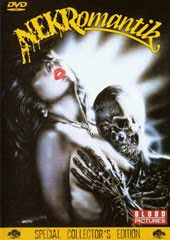
Nekromantik


Nekromatik
Directed by: Jörg Buttgereit
Horror/Comedy/Romance, 75min
Germany, 1987
Distributed by Blood Pictures (OOP)


At the end of last year, the wife and I celebrated our tenth wedding anniversary, and moved into our second decade as a married couple. This gave me the urge to go back and watch the first film that we saw together on our second date - the first date being a Dinosaur Jr. concert thirteen years ago. Luckily she didn't walk out in disgust, but instead realized what she was getting into and has been the biggest supporter of my compulsive cinephillia ever since.

And what a perfect first movie to break in a new relationship with, as Jörg Buttgereit’s taboo breaking Nekromatik is a riot, it has some brilliant scenes and is without a doubt one of the finest movies ever to come out of Germany. It’s packed with sinister sexuality, brooding angst, and wonderful dark nihilism.

Buttgereit followed up Nekromantik, his breakthrough movie, with Der Todesking (The Death King) 1990, Nekromantik 2 1991, and Schramm 1993 – a fascinating suite of movies that all focus on death, sex and the fascination we hold for these taboo crusted areas. Four movies that must be a goldmine for those wanting to divulge into psychological analysis. But that’s not what or where I’m going to go today. I dig those films at face value and take the entertainment value with me from them. Buttgereit vanished from the scene for a few years, working on TV shows, and supplying special effects on Swiss director Martin Walz brilliant adaptation of Ralf König's hilarious gay comic book Kondom des Grauens (The Killer Condom) 1996. The Killer Condom was incidentally designed by none other than H.R. Giger.

Last year Buttgereit returned to feature films with Captain Berlin Vs. Hitler 2009, a comedy based on a play written by Buttgereit,which goes in the vain of Universal Horrors, the many “they saved Hitler’s brain” movies of the fifties and sixties and good old German burlesque. – Keep in mind that it’s always a winner to sprinkle Nazi references in your alternative entertainment.

The quick fix for those who haven’t seen this fantastic film, or for those who need a refresher, goes like this: Main protagonist Rob [Daktari Lorenz – who only ever starred in two early Buttgereit shorts and Nekromantik. He also composed the music for the movie and later for Der Todesking with Herman Kopp and John Boy Walton], is a looser kind of guy, holding one of the most repulsive jobs ever – he cleans up accident places for Joe’s Cleaning Agency. Constantly in fear of his obnoxious boss, sick of his job and with very little future prospects, the light of his life is his cherished collection of pickled human trophies that he steals with him from crash sites. Not to mention his beloved girlfriend Betty. [Beatrice M – who went straight to Wim Wenders’ masterpiece Wings of Desire 1987 after this one, and later returned as Betty in Nekromantik 2 1991]. The prized trophies play an important part in the couples sexual relation as Betty takes romantic baths using the body parts as bizarre bath oils. Rob brings them home, Betty bathes with them.


When the guys at Joe’s Cleaning Agency get a call to dispose of a body found in a near by river Rob hits the mother load, and obviously takes the decayed corpse home to Betty. Needless to say Betty ignites on all cylinders and after making a prosthetic penis out of the end of a curtain rail, the three of them engage in the most bizarre ménage a trois ever put on celluloid.

Buttgereit poetically and sombrely sets this surreal scene of forbidden erotica to a minimalistic, romanticised piano score which give a strange almost blissful tone to the scene. Rob starts neglecting work and becomes the runt of his colleagues for his tardiness, but when he does get himself off to work, Betty just cant get enough of their new plaything and starts pleasuring herself with the corpse while Rob is out of the house. Rob get’s fired from work and telling Betty, she gives him a bollocking for loosing his job as she now sees her supply of entrails and corpses being shut off. This nails the rift between the two that lead to Betty leaving Rob and taking the corpse with her. In his frustration Rob burns all reminders of Betty and kills the cat he brought home for her. But as we all can relate to, letting go is never easy and he keeps the dead cat in that masochistic memorabilia game we all play with ourselves when coming out of a painful separation. Dwelling in self-pity and self loathing Rob downs a bunch of pills with booze and has a fantastically surreal erotic dream where he’s a corpse, and later in his state of depression he murders a prostitute he’s trying to screw in a cemetery when she laughs at his ability to get aroused. Only when she’s dead on the cold ground does Rob manage to complete his act finally getting that sexual release. Hitting rock bottom of his depression, Rob performs what must be the ultimate nechrophiliac ego trip; he takes his own life whilst jerking off and dreaming of that initial childhood memory which now plays backwards. As both Rob and the movie reach their climax Buttgereit presents us with images of Rob and his blood and semen spurting dick that will stay with you forever. Finally, setting it all up for a sequel, the movie ends as the camera gently sweeps over Robert’s grave accompanied by soft music only to be interrupted as a female foot rams a spade into the fresh soil…

Little things, like the Charles Manson picture on the wall, the jars of preserved pieces of bodies, the skeletal parts that decorate their bed, the slaughter of the bunny rabbit in Rob’s childhood flashback crosscut with Rob performing and autopsy all set the tone of the film in it’s initial quarter. It prepares us for the dark world, which we are about to step into, and establishes Rob’s background and that first incident that made him a nechrophilliac. Yeah, Rob got a stiffie watching that cute bunny die if you want a single line of Freudian analysis thrown in. It’s easy to understand why this movie was banned in several countries Strange stuff freaks the crap out of the censors.

The ending is by far one of the best in the genre, you gag, you laugh, but you can’t resist it. There's a forward motion in the very last scene, with the woman just about to dig up Rob’s body. And in the extension we can only imagine what Betty - cause you know it is Betty don't you - will get up to with Rob’s corpse. Ironically it’s in death that they will finally be reunited, and as I've mentioned on this site before, we always want lovers to have each other at whatever cost so you can interpret a happy ending in there if you want... in some fucked up way at least.

You cannot not like this movie, it's entertaining, fun, repulsive and delightful as it takes a very dark humoristic approach to its content. This is empathised even further by the oompa loopmaish soundtrack by Daktari/Kopp/Walton – what is it with German horror flicks and their synthesizer soundtracks? Wasn't that cheesy keyboard music but yet another reason to dislike the Andreas Schnaas Violent Shit movies? I’ve always had the feeling that the 16” film adds to the charm of this movie, as it’s soft colours and grainy grit bring a atmosphere to the film that is very fitting.

The bloody bathtub scenes, and overall look of Nekromantik where incredibly influential on me when I shot my own thesis film in early 1991. I showed my friend who created the special effects the movie and told him that I wanted the bloody bath in my own film to surpass Nekromantik. A task he pulled off with bravura, and still the highlight of that juvenile short I once made.

It’s easy to think of Lars Von Trier’s AntiChrist 2009 when watching this flick, and there’s no doubt in my mind that Trier’s movie parallels this one on many levels. I got really aggravated whilst working the cultural department of Swedish TV last summer due to the fact that so many of the staffers there where constantly praising Trier for his bold approach to his narrative and the disturbing way he chose to portray his characters inner demons. The statement ”He is so innovative and revolutionizes the horror genre like no one before him.” was uttered on more than one occasion, and it had me gagging at the ignorance of these people each and every time.


Naturally I find Trier a genius too, and his films are among some of the finest, but I admire him even more for the way he plays mind games with the cultural elite and movie critics. I’m sure that he sits down there at the Zentropa offices and laughs at the way people lap up every new approach he comes up with. The entire Dogma 95 movement! Come on, what was that all about – Lets ditch professional equipment, lighting, sound and real actors in favour of natural light, sound and real raw art on film. And the critics lapped it up calling it a revolution, a new wave, a unique experiment. I call it the stuff kids have been shooting on video in their backyards since the dawn of time. Then Trier took it one step further, and in Dogville 2003 he even removed the sets! Actors walked around in Spartan furnished locations with painted markers on the floor for walls and doors. Again the ”Experts” dove in, praising his daring new minimalist approach forcing focus on the actors – really? - is Nichole Kidman that good an actor? Once again, I’m certain that Trier sat down there in Denmark chuckling his ass off, as his ”art” enabled him to get away with whatever the fuck he wanted. Remember his 1998 movie The Idiots? Remember that there where so many discussions about the hardcore insert in that movie? Remember what happened when earlier visionaries tried these tricks? I discussed Thriller – A Cruel Picture 1974 some time back, and how it ended up being banned for amongst other things the hardcore inserts. Inserts that where part of the movies narrative, not just a “lets let the people who are pretending to be retards have a fuckfest in the grass” for no apparent reason like in The Idiots. Well how come the hardcore of The Idiots was considered fine art and not when others use pornographic images in their narrative? It happens all the time, Catherine Breillat, Michael Winterbottom, Peter Greenaway, etc. etc. – Go figure, why do some get the pat on the shoulder and the "fine piece of art there mate" reviews and others are considered smut peddlers. And don’t get me started on that whole bag of praise given to Gaspar Noé’s Irréversible 2002 for being innovative, non-linear and a shocking approach to sexual violation and violence– in our field we call it the rape revenge exploitation flick and nobody ever praised Shaun Costello’s Forced Entry 1971, or Buttgereit’s Schraam 1993 for their reverse narrative and offensive violence and sexual content did they. What differs Dame Helen Mirren’s nudity and shagging in Greenaway’s The Cook, the Thief, His Wife and Her Lover 1989, from Tinto Brass’ Caligula 1979. If you where to rant on about Greenaway’s film you’d be considered a connoisseur of fine art, if you rant on about Brass’ film you’d be considered a pervert. At least one of them will teach you some history.

Well getting back on track, I feel that this is exactly the case with AntiChrist, and during those discussions (and more recent ones as it hit DVD a few weeks back) Trier presented his mix tape of the horror and exploitation genres through AntiChrist, and I always make a point of telling people this when discussing the movie. I give them pointers to scenes that probably inspired him –The talking animals (well the Fox at least), the guilt of the dead child, the violence; the dick, balls, labia and clitoris maiming it’s all been done before. Which brings me back to Buttgereit’s Nekromantik.

The way Trier uses these tricks is just the same as the Transgressive art movement and the movies found there. Directors like Nick Zedd, Richard Kern, Kenneth Anger, George Kuchar, Curt McDowell, John Waters, Andy Warhol and definitely Buttgereit, all made movies that set out to rupture our stern views on basic values and emotions. I frequently claim that the beauty of Art is in the eye of the beholder. If you feel that Jesus Franco, Jean Rollin, Bo A. Vibenius, Ingmar Bergman, Akria Kurosawa, Bruce LaBruce, Bruno Mattei, Claudio Fragasso, or whoever is art, then I’m not going to argue. It’s your definition that set’s your experience, not mine, not theirs, but yours.

Now that’s a daring statement, because it would be easy to say that all horror and exploitation is after the same effect, to provoke the norm, and in the lot cases it is true. But only a few actually make a distinct definition between arty transgression, and gore, eroticism and shock value as pure entertainment – luckily exploitation directors make the movies that still are watchable. So the next time some stuck up cultural persona tells you about the daring symbolism of AntiChrist, tell them to check out Jörg Buttgereit’s Nekromantik films an orgy of Corpse Fucking Art to quote Buttgereit himself, then they can waste your time when the have an authentic frame of reference and not the last poxy article published by some dick on the culture pages of the days newspaper.


Image:
Full frame 1.33:1

Audio:
Dolby Digital Stereo 2.0- German Dialogue with optional English French and Spanish subtitles.

Extras:
This Blood Pictures edition is packed with extra features: An audio Commentary by Jörg Buttgereit, it’s in German but if you speak the lingo decently enough you can follow it. Interviews and Outtakes with Buttgereit, a making of featurette, Trailers, still galleries and Buttgereit’s early short “Captain Berlin” Yes the same character he recently returned to feature films with.


Thursday, January 14, 2010

Karanlik Sular [The Serpent's Tale]


The Serpent’s Tale
Original Title: Karanlik Sular
Directed by: Kutluğ Ataman
Turkey, 1993
Horror/Drama, 83min
Distributed by: Onar Films


For the last few years, fans of fantastic cinema have been rejoicing over the availability of many rare Turkish movies that one previously only heard of, read about or seen clips of on that infinite source You Tube. Movies like Turkish Star Trek 1973, Turkish Star Wars 1982, 3 Adem Dev 1973, Tarkan 1969 and the Kilink movies have for ages been sought after gems, especially by those who faithfully read Pete Tombs Mondo Macabro book and set out to track down the movies he discusses there, an almost impossible task in itself. But like so many other lost gem’s of the minor and more independent studios, taking care of their source materials have not been the main priority, and more than often, the only remaining sources are in pretty beat up shape.

That’s where the real enthusiasts make an important difference.

In all honesty I haven’t really seen that many Turkish movies apart from Faith Akin's brilliant Crossing the Bridge: The Sound of Istanbul 2005 and the obligatory Turkish Star Wars [Dünyayi kurtan adam] 1982 and Öhmer Tourist in Star Trek [Turist Ömer Uzay Yolunda] 1973, but then again there’s not that many Turkish films on DVD to start with is there. But that’s all changing thanks to Bill, a true enthusiast and his company - Onar Films - a Trojan Horse packed to the rim with amazing, lost treasures of Turkish Fantastic Cinema.

Even though the movies that us treasure hunters are familiar with may be in the more fantastic sphere and give an impression of being lower budget productions, Turkey was in no way a late comer to the world of cinema. As early as 1914 director Fuat Uzkinay shot the first Turkish movie, a documentary and only twenty years later Turkey even had their own equivalent of Hollywood, Yesilçam. In its prime during the 50’s-70’s Yesilçam was releasing between 250-350 films annually – and that’s probably not even counting all those glorious movies made by independent players. It says something of the quantities of film being produced there and the sad fact that many, many movies are really lost. Like so many other countries, Yesilçam saw production costs shoot through the roof, they also suffered from the advent of television, and later Video, leaving the cinemas almost empty and ticket sales dropping drastically. In the mid nineties there where sadly only a handful of movies being made each year.

But during the last fifteen - twenty years a new wave of directors have started coming forth, many of them with documentaries, comedies, dramas and horror is starting to creep back, and it's among these directors we find Kutluğ Ataman.

Kutluğ Ataman’s debut feature Karanlik Sular (The Serpents Tale) is an odd little jewel that walks that tender line between art house and horror. Not surprising if you have any insight into the later works of Ataman, who spent the early years of his career directing philosophical, arty dramas which focus more on the characters and style than staying true to the genre it uses as an inspirational basis. Ataman was acknowledged for his first feature and became a frequently featured guest at many film festivals where his movies often are awarded.

During the last decade, Ataman’s movies have slowly moved into pure art itself, and his installations have been shown in some of the finest art houses in the world. His piece Woman who wear wigs is currently being exhibited at Malmö Konsthall here in Sweden [10 October 2009 – 31 January 2010]

See, horror films do lead to good things!

Genre is sometimes a difficult thing to determine, what one person feels is a terrifying horror film, the next may call a drama with scary scenes. The Swedish movie Let The Right One In 2008 is a great example of those kinds of movies, ones that are more complicated to pigeonhole. I call them Dramas that use horror traits. And this is just the case with Karanlik Sular. There’s no debating that it’s a highly impressive movie, that definitely stands out among those other great titles released by Onar Films, as it moves in a more philosophical and art house circuit than being just a plain horror flick. Sure it does use traits from the Horror genre, and the main plot is horror related, but I’d probably not call it a horror film. But that’s only by definition and in no way a final say. If it scares you and puts the fear of god in your heart, they you can call it a horror film.

Karanlik Sular starts with a poetic little animated sequence telling the tale of a nineteenth century calligraphy artist named Mevhes who once wrote futuristic story that took place in 1990’s. Being insulted by the critique she received for her story, she licked herself away until the day she passed away. When she died in 1873 an equally strange series of events took place that destroyed the manuscripts leaving only notes and ancestors down told tales for Ataman to build his script upon.

The pretext explains, almost apologetic that Mevehs manuscript is based on the rules of the aruz metric system, Ottoman Divan Poetry and the aesthetics of Islamic Art of Calligraphy, which takes a detour from the classical plot device of cause and effect in favour of a rhythmic, decorative fashion and may not be easy to understand. There's also a warning that the manuscripts and possibly the movie are cursed. Ok…

But what does it mean?

The aruz metric System is the structure of Ottoman Divan Poetry, Ottoman Divan Poetry isn’t some bloke’s texts, but a form of ritualized and symbolic poetry not too know outside of Turkey written during the Ottoman Empire and influenced by Sufi thought. Sufi being the inner mystical dimension of Islam, and the aesthetics of Islamic Art, calligraphy included, primarily consist of anthropomorphic figures, and the intricate patterns all create an impression of unending repetition!

With all that in mind, the pretext falls into context, as just like the description of Mevhes texts above, it’s just what Ataman does with his film, it comes round full circle and gives the impression of easily being played in an eternal loop – Just like the aesthetics of Islamic Art. It makes sense when you take time to let it sink in, and I promise that I’ll get back to the curse later

After the pretext, we are placed in front of women crying as they watch images on a cinema screen. Images of a saddened woman throwing ashes into the sea, images that will come back later to make that pretext fall into place. Among the women sits an elderly gent, a young girl – Princess Theodora, Haldar, and Richie Hunter [Daniel Chace]. The little girl leaves the theatre, with teddy bear in hand, only to be followed by the old geezer. Hunter sneaks along and while the old man makes contact with the young girl Richie hides in the shadows. But before he can interact, he’s startled by Haldar [Metin Uygun] who picks up conversation with him. Trying to refocus on the little girl and the old man, Richie sees that the girl has disappeared leaving the man with a bleeding vampire bite to the neck.

Haldar takes Hunter out on a stroll though the night and the vampire elements are firmly established through his dialogue. It’s neat as the old initial attack and fanged hissing vampire is more often used, perhaps too much. This is a more subtle and just sneaks it into the story – Haldar talks about having to be enchanted before the bite, that he has to leave when he hears the church bells, that the little girl was Theodora, a Byzantine Princess and gives a warning to stop following her. He leaves Richie with a small cased medallion that he suggests he take to Haldar’s mother Lamia [Gönen Bozbey].

This is how Ataman presents his main plot and his lead characters, it’s effective and at the same time getting there rapidly, he's wasting no time. Pretty soon the whole thing starts unravelling as the mysterious medallion leads to the strange manuscripts that Lamia has, which her servant has secretly studied as to copy them for the cult he’s connected to. The cult want the manuscripts so that they can reshape the world religion, and rule as masters, and at the same time the vampires want the manuscripts too, which gives for some great moments of tension between the two fractions.

I feel that trying to analyze the movie is in some ways uncalled for and unfair, as I’m sure that each viewer will come to different conclusions about the movie with it's rich symbolism and enigmatic ending. Also I think that it may take away some of the mysticism of the film - You don’t need to know exactly what happens where before watching it. And watch it you should, because a movie with vampire mythos, cursed manuscripts, secret cults chasing the same fragments of paper and violent deaths lurking around every corner are just some of the wonders that this movie will show you.

So what about that curse mentioned in the pretext?

It is possible to read the movie as the pretext curse. Haldar found the manuscripts and became cursed – an undead wanderer, a slave of the vampires. Hunter who also comes in contact with the manuscripts also becomes cursed. Remember there’s that one scene where he suddenly feels that he’s been bitten and holds his bloodied neck. Well he ain’t himself after that and also becomes an undead, he’s been cursed. The Prophet! Cursed, his dabbling with the mysterious manuscripts cost him his life. And don’t forget Lamia’s chauffeur whom get’s an ice pick rammed in his eye while snooping for the scrolls whereabouts. And finally Lamia; she’s screwed from square one. She has lost everything from the moment Haldar hid the manuscripts in her home. Her family, her lover, her son and eventually her home - all gone. The only person who wins anything in this film is Lamia’s boyfriend (or whatever he is) because he gains everything. Life, a prosperous future and fortune – even it means burning down Lamia’s house and collecting the insurance money that he earlier forced her to sign over to him.

So Lamia has lost everything and in the final moments of the film she realizes this as her house burns. Scattering the ashes of her once great life (most likely Haldar and the house ashes) to the sea, we cut back to the cinema from the start of the movie and the story comes full circle, only to give the impression of all characters caught in an eternal loop. Remember - The aesthetics of Islam art. The manuscript of the movie is obviously Mevhes manuscript and the curse is very real in the narrative of the film. And I'll let you in on a little secret - it's all made up, the pretext, Mehves, the cursed manuscripts and everything else. Ataman wrote the script and worked that backstory into it masterfully, it's like the "based on a true story" gimmick used in so many classic horror films but much more meatier and elegantly performed.

Karanlik Sular takes a bold approach to its narrative interweaving social drama, strange cults and vampire mythos. Although the vampirism is possibly held to a minimum, I feel that it helps Ataman get away with some of the more confusing parts of the narrative. Not that this is a bad thing, directors like David Lynch, Peter Greenaway and Alejandro Jodorowsky have been getting away with strange movies by covering it in imagery, symbolism and slight of hand for ages.

As frequent readers of this site will know, I’m a sucker for imagery, it’s the stuff that can keep even the worst of films interesting and appealing for me. Karanlik Sular contains a load of great images and some wonderful compositions by cinematographer Chris Squires, who has worked on many a big budget Hollywood flicks since. Fantastic shots with dark deep colours, freaky lighting and all set in a decayed background of Istanbul to give a really dreamy and apocalyptic feeling. There’s no denying that Ataman’s art vibe is definitely a plus for the production, and I was thrilled by the way the movie looked, as I definitely have seen stuff that looks a hell of a lot worse off than this stylish little movie.

So yes, I enjoyed Karanlik Sular even though it has some minor flaws, but that’s why we enjoy alternative cinema and don’t waste our time going to see Avatar or the Twilight movies at the cinema. Karanlik Sular is an entertaining and definitely an interesting movie that had me surprised with its high production values and intriguing story. I wasn’t expecting such a treat, and my favourite sequence has to be the scenes where the vampires go underground to re-claim the sacred scrolls. It had me remembering the climax of Dario Argento’s Mother of Tears - but better. Kutluğ Ataman has with Karanlik Sular managed to create a suspenseful, visual and intriguing movie that really is top notch - odd, but fascinating.

I sincerely suggest that you get yourself over to the Onar Film’s store right now and treat yourself to something that you haven’t seen previously, because not only is this movie on limited 1200 edition release only, but it’s worth every penny and could just well be one of the best Turkish movie you’ll ever see.


Image:
16x9 widescreen version.

Audio:
2.0 mono Turkish and English Dialogue with optional English or Greek subtitles.

Extras:
The Onar Film releases are always filled with extras, Karanlik Sular is no exception. There’s an insightful interview with Kutluğ Ataman, who tells his story, a photo gallery, text biographies for cast and crew, excerpts from what European, American and Turkish press said about the movie and trailers for several other Onar Film releases


Monday, January 11, 2010

X-Cross


X-Cross
Original Title: XX (eksus kurosu): makyô densetu
Directed by: Kenta Fukasaku
Japan, 2007
Horror/Drama, 90min
Distributed by: Sarawak Media Corporation

Being the son of one of the greatest directors ever to come out of Japan certainly must be a burden to carry. But Kenta Fukasaku doesn’t show any concerns with being the son of legendary Kinji Fukasaku. Rather the opposite actually as he has directed a decent amount of interesting movies that make an impression and leave you wanting more.

Growing up on movie sets with his father the director Kinji Fukasaku [Black Lizard 1968, Street Mobster 1972, Graveyard of Honour 1975 and Battle Royale 2000] and his mother the actress Sanae Nakahara [Several of Kenji’s movies, Toshiya Fujita’s Lady Snowblood, Yasuharu Hasebe’s Female Prisoner Scorpion: #701's Grudge Song both 1973 and John Frankenheimer’s The Challenge 1982, which also say Kenta in a small role too) it’s no wonder that he would end up in the movies himself. After working as an assistant director on a fistful of movies, Kenta adapted Koushun Takami’s novel into a movie screenplay. The screenplay became the international hit Battle Royale 2000 - directed by his father, it also gave Kenta the opportunity to step up his game and the position as second unit director.

With a hit movie on his hands, Kenji Fukasaku understood that a follow up was in demand, and after directing the video game Clock Tower 3 for games giant CapCom, Battle Royale 2: Requiem was on the slate. But fate had different plans for the master, and after being diagnosed with terminal cancer with only a few months to live, Kenji, choosing his passion and love for filmmaking ignored his doctor’s advice to stay in hospital for treatment kick-started the production instead. After directing one scene with iconic Japanese Actor/Director Takeshi Kitano, Kenji left the production and after handing directorial responsibilities to his son Kenta, the Masterful Kenji Fukasaku passed away on the 12th of January 2003.


Taking over the directorial reigns, Kenta made a movie that perhaps lacks the intensity of the original, but very few sequels do match up with their original counterparts, but the biggest problem with Battle Royale 2 is that it’s plot is confusing and quite weal at times. But it is an interesting debut to say the least, and Fukasaku Jr. and his co-writer on the film where awarded for their screenplay for the movie later in 2004.

Kenta’s fourth movie as a director in his own rights, X-Cross is a decent and entertaining movie that sees two women going away for a weekend getaway so that Shiyori [Nao Matsushita] can start healing her broken heart after her boyfriend Keiichi has been unfaithful to her. From the start the two girls different approach to relationships is established, Shiyori, the one man woman, and Aiko [Ami Suzuki], the predator who likes several men to toy with simultaneous. It also sets the cell phones in play, as they will be vital to the movie, and sets up character traits. Shiyori the weaker, passive and gentle character, and Aiko as the more aggressive, active and no holds barred character.

The two girls are to spend the weekend at Ashikari Village, a remote spa a long way from civilization. But more or less from the moment that they get there, a rift emerges between the two as their different views on relationships rupture their friendship. Shiyori annoyed with both Aiko and the bad memories she gets when Keiichi sends her a pathetic “I’m so sorry!” text message chucks her cell phone into the river and storms off home. That’s where she hears a cell ringing from inside one of their room’s wardrobes. Answering the phone a voice on the other end tells Shiyori that they have to get out of there before the villagers cut off the girls legs in a bizarre sacrificial ritual. Here begins the fight for survival.


I’m quite relieved that Japanese directors have started to return to the more provocative punch in the face kind of movies that they were making in the late eighties, early nineties, instead of the long lasting J-Horror genre. I have nothing against the J-Horror niche, it was for a long time the most interesting field being explored, but in all honesty those dead girl ghosts in dark damp places are starting to get pretty tiresome and I feel that there’s not much more to bring to that table. Those movies are great, but lets not take it too far and leave the genre with a memory of becoming repeats of previous successes. Movies like Noboru Iguchi’s The Machine Girl 2008, Yoshihiro Nishimura’s Tokyo Gore Police 2008 and Yõhei Fukuda’s Grotesque 2009 - Not to mention the movies of Ryûhei Kitamura and Takeshi Miike, are great examples of over the top violence, stunning special effects and crazy plots that once where synonymous with the Japanese Horror genre.


X-Cross uses traits from both the J-Horror and the Horror Comedy movies in a great combo that keeps the narrative flowing without any major hick-ups. Tetsuya Õishi’s [Shusuke Kaneko’s Death Note and Death Note: The Last Name both 2006] screenplay based on Nobuyuki Joko’s original Manga is tight and well written. Posing questions and keeping the audience confused can be a killer for your movie, but Õshi and Fukasaku make it work for them in the best way, good confusion is always a winner if you can pull it off.

But instead of being a straightforward survival horror, this movie tries to tell the tale of the two girls and the rift between them. There are several red herrings that will have you assuming one thing, only to stand corrected and see things in a new light a few minutes later. Two external characters, Shiyori’s boyfriend Keiichi, and Mononobe Akira – who called Shiyori on the phone she found in the cupboard, also play a main part in the narrative, and their true colours are also held in the darkness until the last moment reveal is needed. You never really know who is a friend and who is a foe until the movie gets into the last act and prepares to wrap it all up. Also there’s a hilarious subplot concerning Aiko, the more aggressive one of the two, coming face to face with Reika, the Gothic Lolita who once saw Aiko steal her boyfriend away from her and now out for revenge. Wielding a terrifying pair of clippers that would have Edward Scissorhands jealous, she will stop at nothing to get back at Aiko. So not only fleeing from the creepy villagers, there’s also Reiko to keep in mind.

The use of a non-linear narrative is great, by dividing the movie into several title chapters where we follow either Shiyori or Aiko brings a natural element of suspense and curiosity as each we from one angle see how the girls talk to each other on their cell phones, only to be interrupted, loose connection or push the narrative forth by suggesting to meet up at specific places. It’s captivating and exciting, as I want to know what the strange noise that made Aiko hang up was, or will Shiyori answer Aiko’s text message? Revealing it in the next chapter only to pose further questions is a great device, and a elegant change to the frequent, “Oh I have no coverage on my cell here in the middle of the woods!” stupidity that has been frequent in horror movies these last years.


X-Cross is a light-hearted horror movie with a few very chuckles here and there that works more for the suspense and the rather creative plot, I’d have loved to see more freaky villagers, startling effects and perhaps more of a horror theme than the scary action plot, but I enjoyed it and it proves that the next generation of Japanese genre moviemakers looks promising.


Image:
16x9 Anamorphic Widescreen

Audio:
Japanese Dialogue, Dolby Digital 5.0. Chinese or English Subtitles Optional

Extras:
On this version there’s only the trailer, but being a two for the price of one set together with Fukasaku’s Yo-Yo Girl Cop from 2006 it’s a fair deal.


If you’re up for more J-Horror why not check out my article on the Origins of the J-Horror Iconography at the Constructinghorror.com site.

Disney Star Wars and the Kiss of Life Trope... (Spoilers!)

Here’s a first… a Star Wars post here.  So, really should be doing something much more important, but whist watching my daily dose of t...